Qualcomm has unveiled the Snapdragon Wear Elite Platform, its latest SoC for smartwatches and wearables, at the Mobile World Congress (MWC) in Barcelona, Spain. Qualcomm is positioning it as the world’s first “Personal AI” wearable platform designed to power the next generation of always-on, AI-driven smartwatches and wearables. Snapdragon Wear Elite is compatible with Wear OS by Google, Android, and Linux.
The new Snapdragon Wear Elite platform integrates an on-device NPU to enable advanced AI processing at the edge. Qualcomm says the move marks a shift from basic health tracking and notifications toward what it calls an “Ecosystem of You”, which is a framework where multimodal AI agents understand user context and coordinate tasks across multiple personal devices. This is Qualcomm’s Hexagon NPU, capable of supporting billion-parameter AI models directly on the device. This helps wearables process contextual data locally rather than relying heavily on cloud connectivity.
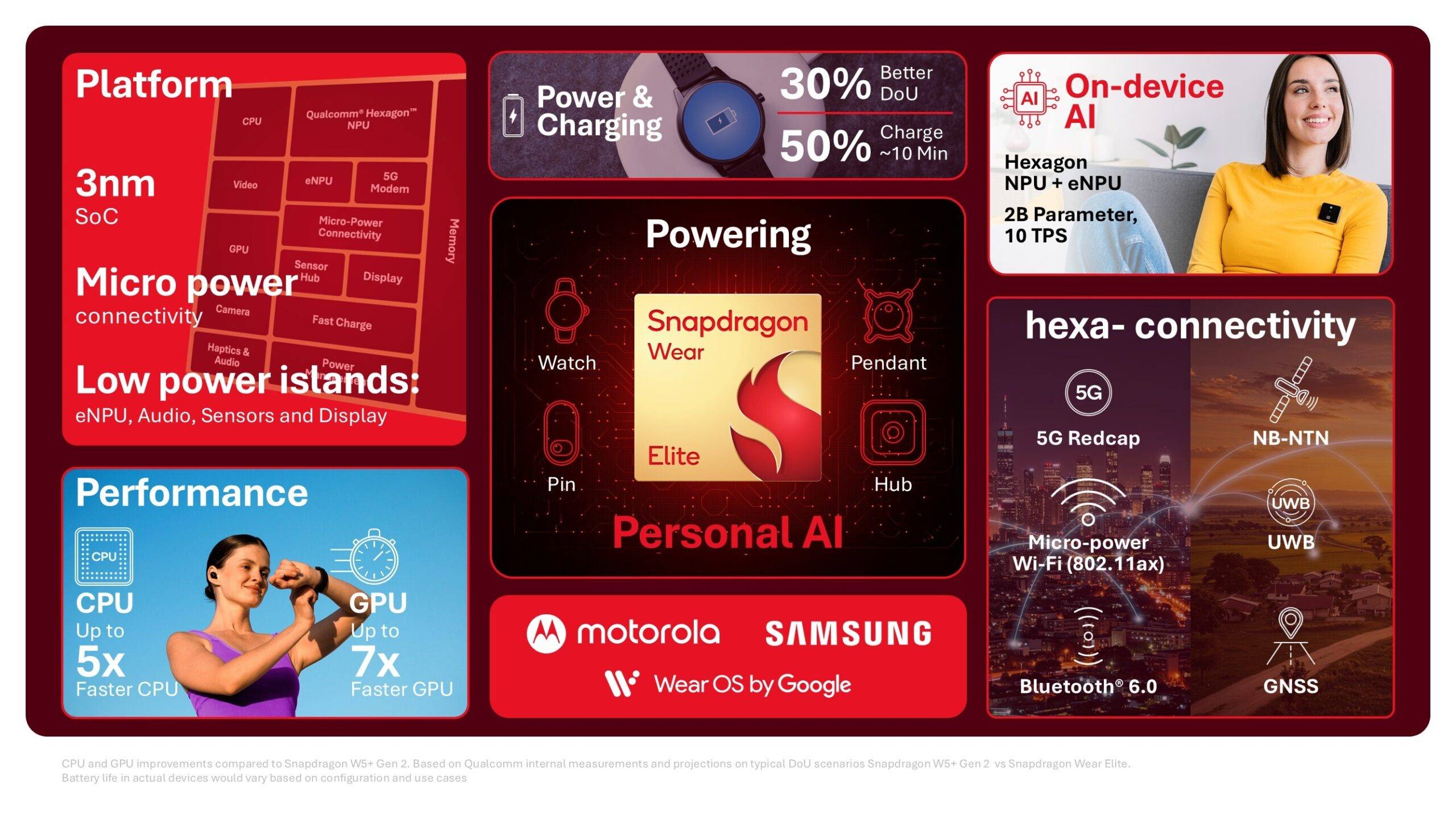
According to Qualcomm, the platform supports real-time, agentic AI use cases such as context-aware recommendations, natural voice interactions, continuous life logging, and AI agents that can take actions and orchestrate tasks on a user’s behalf. The company pairs the NPU with advanced sensor fusion, low-power computing, and high-efficiency connectivity to maintain responsiveness without sacrificing battery life.
Qualcomm claims significant performance improvements over the previous generation, with up to 5x improvement in single-core CPU performance, 7x faster GPU performance, and 30 percent longer day-of-use battery life. The Snapdragon Wear Elite is also claimed to deliver multi-day battery support and faster charging to 50 percent in about 10 minutes. Longer smartwatch battery life is becoming increasingly important. As AI features expand and processing demands grow, bigger batteries and better efficiency will be essential to keep these devices running longer on a single charge.
Snapdragon Wear Elite also comes with a multi-mode connectivity architecture including 5G RedCap, Micro-Power Wi-Fi, Bluetooth 6.0, Ultra-Wideband (UWB), GNSS, and NB-NTN satellite connectivity. The inclusion of NB-NTN satellite messaging, developed in collaboration with partners including Skylo, is notable as it enables two-way messaging when internet connectivity or a cellular network is unavailable. UWB support also enhances precise device finding and secure proximity-based interactions, such as unlocking cars or accessing smart homes.
Major ecosystem partners, including Google, Motorola, and Samsung, are supporting the platform. Qualcomm has confirmed the first commercial devices powered by Snapdragon Wear Elite are expected in the coming months.
The launch comes as OEMs increasingly emphasise AI capabilities. Apple has been expanding on-device intelligence across its hardware lineup, while Samsung and Google have pushed deeper AI integration within Wear OS devices. With better AI integration, powerful NPU, and stronger battery life, Qualcomm appears to be positioning Snapdragon Wear Elite as a premium-tier solution aimed at flagship smartwatches.
With new smartwatches expected to launch this year with Snapdragon Wear Elite, it may be wise to hold off on buying right now. Especially for users who prioritise long battery life with high performance, advanced AI features, satellite messaging, and next-gen connectivity. However, real-world performance, thermal efficiency, and software optimisation will ultimately determine whether the platform’s upgrades translate into meaningful everyday improvements.
So, it’s still best to wait for full device announcements and reviews before upgrading, particularly if current devices already meet their needs.