With the Vivo S2 FE now out, packing a humongous 10,000mAh battery, it’s Vivo’s biggest-capacity smartphone in India, which goes against another heavyweight under Rs 40,000, the POCO X8 Power. While both handsets share the same battery capacity and display specs, the similarities end there, since you get distinct software, design, and camera setups. If you’re torn about which smartphone to choose, this quick comparison will help you decide based on your preferences.
Table of Contents
Vivo S2 FE vs POCO X8 Power: specs at a glance
| Specification | Vivo S2 FE | POCO X8 Power |
| Display | 6.83-inch 1.5K AMOLED, 120Hz refresh rate, 2,000 nits HBM | 6.83-inch 1.5K AMOLED, 120Hz refresh rate, HDR10+, 2,000 nits HBM |
| Processor | MediaTek Dimensity 7300e | Qualcomm Snapdragon 6 Gen 5 |
| Cameras | 50MP primary, 32MP selfie | 50MP primary + 8MP ultrawide, 32MP selfie |
| Battery | 10,000mAh, 44W fast charging | 10,000mAh, 100W fast charging |
| Software | OriginOS 6 with Android 16, 3+5 years | HyperOS 3 with Android 16, 4+6 years |
Vivo S2 FE vs POCO X8 Power: price in India
The Vivo S2 FE starts at Rs 38,999 in India with 6GB RAM and 128GB storage, while the POCO X8 Power starts at a lower price of Rs 35,999 with 8GB RAM and 128GB storage on its base variant. On price alone, the POCO X8 Power has a major edge over the Vivo S2 FE.
| Storage | Vivo S2 FE | POCO X8 Power |
| 6GB + 128GB | Rs 38,999 | N/A |
| 8GB + 128GB | Rs 42,999 | Rs 35,999 |
| 8GB + 256GB | N/A | Rs 38,999 |
Vivo S2 FE vs POCO X8 Power: display, design
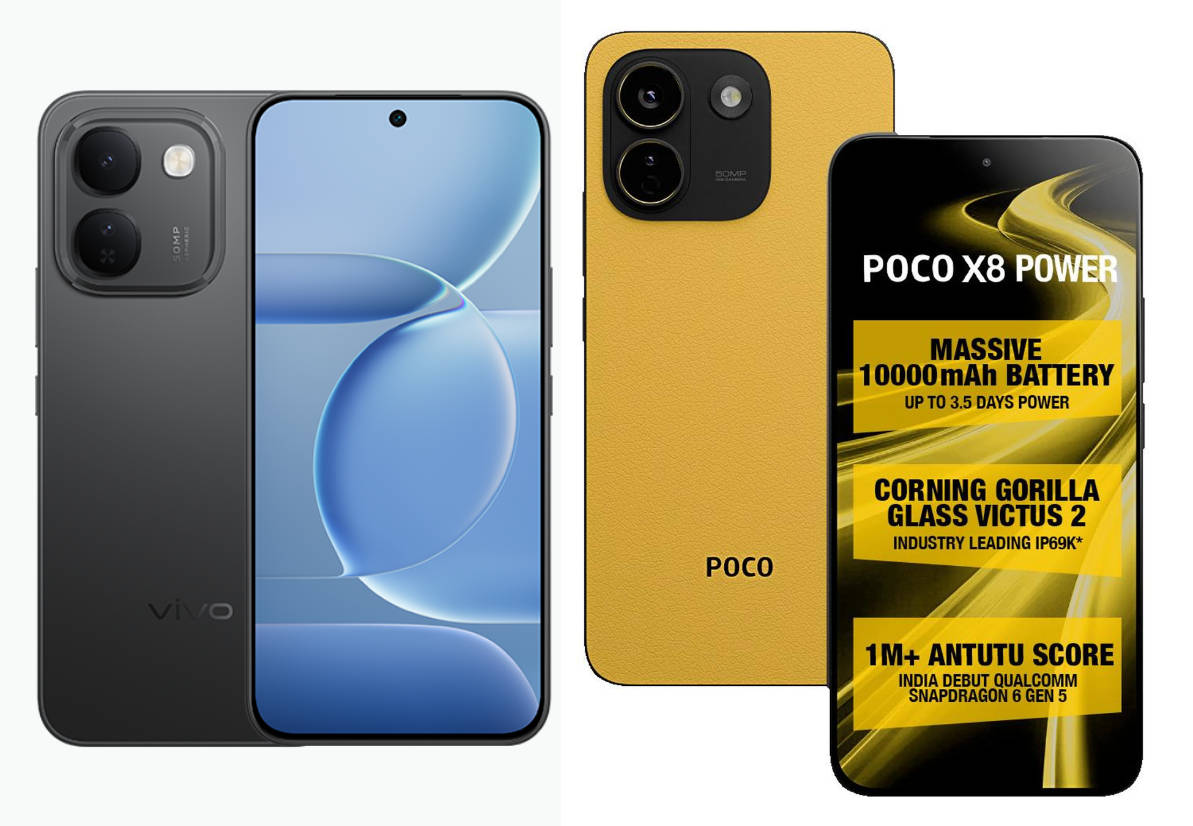
Both phones feature nearly identical 6.83-inch 1.5K AMOLED panels with 120Hz refresh rates for smooth scrolling and media consumption. The POCO X8 Power edges ahead with higher peak brightness of up to 3,500 nits, Dolby Vision support, HDR10+, and Corning Gorilla Glass Victus 2 protection.
The Vivo S2 FE offers solid brightness around 2,000 nits HBM and a clean, modern look. In design, both devices are on the heavier side due to their large batteries, with the Vivo S2 FE weighing 224g, while the POCO X8 Power is slightly heavier at 229g. Both carry strong IP68/IP69 dust and water resistance ratings. The POCO X8 Power adds extra drop resistance claims, while the Vivo S2 FE focuses on a simpler, elegant build available in colours like Stellar Green, Zen White, and Titan Black. The POCO comes in Black and Yellow options.
Vivo S2 FE vs POCO X8 Power: chipset
The POCO X8 Power runs on the Snapdragon 6 Gen 5 (4nm), a chipset focused on reliable overall performance and efficiency in the mid-range segment. The Vivo S2 FE uses the MediaTek Dimensity 7300e (6nm) processor, a variant of the Dimensity 7300 that handles everyday tasks, multitasking, and light-to-moderate gaming well, per our experience. In real-world use, both should feel responsive for daily apps, social media, and casual gaming. The Snapdragon 6 Gen 5 may pull slightly ahead in more demanding scenarios and sustained performance, while the Dimensity 7300e remains efficient enough for most users.
Vivo S2 FE vs POCO X8 Power: battery
Battery is where both smartphones completely shine when compared to the competition. With a massive 10,000mAh battery on both phones, they promise excellent all-day (or multi-day) endurance for heavy users. The clear difference is charging speed, where the POCO X8 Power supports much faster 100W charging, while the Vivo S2 FE is limited to 44W. Both handsets also offer reverse charging for juicing up other devices, like earphones. After all, the battery capacities match those of actual power banks. Both should easily last a full day of intensive use, with the POCO’s faster charging giving it a practical advantage when you need a quick top-up.
With smartphone brands cutting back on higher storage and advanced camera hardware in 2026 on their midrange and upper-midrange smartphones due to rising memory prices, battery is one area where these companies can still go the distance and improve endurance.
Vivo S2 FE vs POCO X8 Power: cameras
Both phones centre around a 50MP primary rear camera and a 32MP front camera. The POCO X8 Power adds a more useful 8MP ultrawide lens and optical image stabilisation (OIS) on the main sensor, which should help in low light and video. The Vivo S2 FE pairs its 50MP main sensor with a basic bokeh lens. On paper, the POCO offers a more versatile camera setup. Real-world results will depend on software tuning, but the POCO’s extra ultrawide and OIS should give it an edge for everyday photography and content creation.
Vivo S2 FE vs POCO X8 Power: software
The Vivo S2 FE and POCO X8 Power run Android 16 out of the box. The Vivo S2 FE comes with OriginOS 6, while the POCO X8 Power uses HyperOS 3; Vivo has promised three OS upgrades and five years of security patches, while POCO is set to receive four OS upgrades and six years of security updates. In terms of software longevity, the X8 Power has an advantage, gaining an extra Android upgrade and two more years of security patches.
In terms of look and feel, both OriginOS and HyperOS offer multiple customisation options, productivity features such as Origin Island on Vivo and Hyper Island on HyperOS, and AI features scattered throughout the UI. Based on our experience with both, if you want flexibility in accent theming, two control centre options, and more multitasking capabilities, the S2 FE’s OriginOS 6 suits you, while HyperOS 3 on the X8 Power excels at delivering smooth animations and transitions.
Summing up
The POCO X8 Power holds the upper hand with a lower starting price of Rs 35,999 while offering more RAM over the Vivo S2 FE’s standard 6GB RAM and 128GB model at Rs 38,999. Even though both smartphones carry mammoth 10,000mAh cells, the POCO X8 Power’s 100W fast charging should take noticeably less time to top up, especially when you are about to leave.
With an 8MP ultrawide lens, the X8 Power offers a more flexible camera setup, while HDR on the display delivers brighter tones when watching supported content on YouTube or Netflix. That said, the Vivo S2 FE remains a strong contender if you prefer OriginOS and its design. On the other hand, if you want a better overall package with faster charging, more camera flexibility, and slightly better performance, the POCO X8 Power is the safer recommendation.