Vivo X500 series launched in China with Dimensity 9600 series chips, bigger batteries and camera upgrades


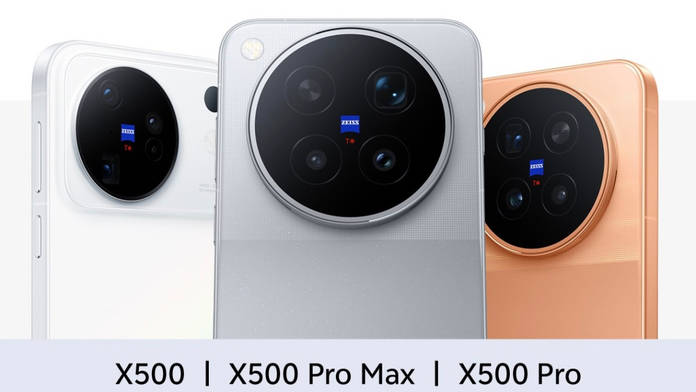
Vivo has officially launched its X500 series in China, introducing the X500, X500 Pro and X500 Pro Max. The new lineup comes with a focus on mobile photography, as has been the case with Vivo’s flagship lineup, with the top-end X500 Pro Max getting a 200MP periscope camera.
The Vivo X500 Pro and X500 Pro Max are the first phones announced with MediaTek’s Dimensity 9600 Pro chipset. The standard X500 uses the Dimensity 9600M, which is essentially a rebadged version of the previous-generation Dimensity 9500.
Show Full Article
The series also introduces a novel camera accessory – a 3.92-inch AMOLED wireless companion screen that can be attached to the phone and used as a live monitor. It is designed to make rear-camera selfies and vlogging easier, while also helping users frame subjects when using Vivo’s long-range Zeiss telephoto accessories.
Table of Contents
Specifications, design and features
After seeing a camera “plateau” popularised by the iPhone 17 Pro series, we’re seeing its emergence in the Android world. The Vivo X500 gets a wide rectangular camera plateau across the upper portion of the rear panel, enclosing a left-aligned circular camera arrangement. The X500 Pro and Pro Max retain a large centred circular camera module, but the rear panel now gently slopes towards the camera bump. Besides making the sizeable camera hardware look more integrated, the slope also provides a natural finger rest.
Vivo has changed sizing across the range. The X300 had a 6.31-inch display and weighed 190 gms, while the X300 Pro featured a larger 6.78-inch screen. The X500 Pro returns to the compact flagship format with a 6.36-inch display and weighs 197 gms, while the X500 Pro Max goes larger with a 6.85-inch panel and 229 gms weight. The X500 sits in the middle with a a 6.59-inch and weight of 211 gms.
The standard X500 uses a 1.5K AMOLED panel with a resolution of 1,260 x 2,750 pixels and a 144Hz refresh rate. The X500 Pro and X500 Pro Max step up to LTPO AMOLED panels with 1,216 x 2,660-pixel and 1,440 x 3,168-pixel resolutions, respectively, with both supporting a 144Hz refresh rate. The two Pro models use BOE Q11 displays and are rated at up to 4,500 nits peak brightness, while the standard X500 is rated at up to 4,000 nits. The Pro models also support 1-144Hz variable refresh rates, making their displays more adaptable to different usage scenarios.
Battery capacity is another major change. The X500 packs a 7,500mAh battery, the X500 Pro gets a 6,510mAh cell, and the Pro Max has an 8,000mAh silicon-carbon battery. All three support 90W wired and 40W wireless charging. For context, the X300 and X300 Pro had 6,040mAh and 6,500mAh batteries respectively. That’s quite the jump for Vivo which was on the lower end of battery capacities last year when the Si-C wave took over the industry taking capacities to unseen ranges.
The phones also have IP68 and IP69 protection and run OriginOS 7 based on Android 17.
Cameras are the biggest upgrade
The Vivo X500 Pro Max gets the most ambitious camera hardware in the series. Its 50MP Sony LYTIA L910 main camera uses a 1/1.28-inch sensor, f/1.57 aperture and 3-degree OIS, with the company claiming up to 17EV of dynamic range. It’s paired with a 200MP Samsung ISOCELL HP0 periscope telephoto with a 1/1.4-inch sensor, 3.5x optical zoom and CIPA 7.0 professional-grade stabilisation.


The X500 Pro uses the same 50MP LYTIA L910 main camera, although its stabilisation is rated at 1.5 degrees. Its 64MP Sony LYTIA 610 periscope offers 3.5x optical zoom and OIS. Both Pro models also get a 50MP Samsung JN5 ultrawide camera and support the optional 400mm Zeiss G2 Ultra telephoto extender. The standard X500 has a 50MP Sony LYTIA 828 main camera with a 1/1.28-inch sensor, alongside a 64MP telephoto and 50MP JN1 ultrawide camera.
The previous X300 generation Pro used a 200MP main camera, whereas Vivo has moved the 200MP sensor to the X500 Pro Max’s telephoto system. The new flagship puts more emphasis on long-range photography while retaining a large main sensor and stronger stabilisation.
The Pro models also put more emphasis on video. Both support 4K recording at 240fps, while the X500 Pro Max can record in 8K at 30fps. They also support 10-bit 4:2:2 video and the ACES colour management framework.
Vivo has also announced a 3.92-inch AMOLED wireless companion screen, marketed as the Vivo Snap Screen or Magnetic Smart Camera Screen. It attaches to the back of the phone and acts as a live monitor, allowing users to frame themselves while shooting with the rear cameras. It can also remotely control core camera functions from up to 10 metres away and is designed to work with Vivo’s Zeiss telephoto extenders.
Price and availability
The Vivo X500 starts at CNY 5,499, (around Rs 79,000) for the 12GB + 256GB variant. It comes in white, grey and black. The X500 Pro starts at CNY 6,499 (around Rs 93,000), and is available in white, grey, black and orange. The X500 Pro Max starts at CNY 6,999 (around Rs 1 lakh), and also comes in white, grey, black and orange.
Open sales in China begin September 24th. Vivo hasn’t officially detailed global launch plans yet. However, current information points to the X500 and X500 Pro Max launching in India around late October or early November, with the Pro remaining China-exclusive. As per tips, the X500 is expected to be priced at around Rs 95,000 in India, while the X500 Pro Max could cost around Rs 1.3 lakh to Rs 1.4 lakh. At those expected prices, the X500 Pro Max will compete with nothing but the Ultra and Pro Max from Samsung and Apple, with its advantage being the combination of a large 200MP telephoto sensor, advanced video recording, a much larger battery and optional Zeiss telephoto accessories. Camera enthusiasts with the budget should definitely wait for the phones.