AMD Ryzen 7 9850X3D Review: The Sweet Spot?


AMD’s X3D processors have quietly become the dream CPUs for gamers. The formula is simple: take already powerful Ryzen chips, stack a massive slab of cache on top, and watch games fly.
The Ryzen 7 7800X3D set the tone. Then, the Ryzen 7 9800X3D refined the formula with Zen 5. Now, the Ryzen 7 9850X3D arrives as a refresh designed to squeeze even more performance out of the same concept.
On paper, it looks like a small upgrade. Like, honestly, way too small. Then again, it promises the gaming strengths of the 9800X3D while inching closer to the flagship Ryzen 9 9950X3D, without the price or power demands of a 16-core chip. But does it deliver? Is this the new sweet spot for enthusiasts? Let’s find out.
Table of Contents
AMD Ryzen 7 9850X3D: What’s New
The Ryzen 7 9850X3D is essentially a refined, better-binned version of the 9800X3D. It uses the same Zen 5 architecture and second-generation 3D V-Cache, but AMD has pushed clock speeds higher to extract a bit more performance. The boost clock jumps to 5.6GHz, a 400MHz increase over the 9800X3D, while retaining the same 8-core/16-thread configuration and 120W TDP.


Here’s how the 9850X3D stacks against the AMD Ryzen 7 9800X3D and the Ryzen 9 9950X3D:
| CPU | Ryzen 7 9800X3D | Ryzen 7 9850X3D | Ryzen 9 9950X3D |
| Architecture | Zen 5 | Zen 5 | Zen 5 |
| Cores / Threads | 8 / 16 | 8 / 16 | 16 / 32 |
| Boost Clock | 5.2GHz | 5.6GHz | 5.7GHz |
| L3 Cache | 96MB | 96MB | 128MB |
| TDP | 120W | 120W | 170W |
| Target User | Gamers | Gamers + Enthusiasts | Gamers + Creators |
In simple terms, the Ryzen 7 9800X3D is built purely to dominate gaming, offering exceptional frame rates and efficiency for players who don't need extra cores for heavy workloads. The Ryzen 7 9850X3D builds on that same formula but refines it with higher clock speeds and slightly better responsiveness, making it a faster and more polished version of an already excellent gaming CPU.
Meanwhile, the Ryzen 9 9950X3D sits at the top as a powerhouse designed for users who want elite gaming performance alongside serious productivity muscle for tasks like rendering, streaming, and content creation. This places the Ryzen 7 9850X3D neatly in the middle, acting as the ideal balance between pure gaming performance and everyday versatility.
Test Bench Explained
To ensure we tested the Ryzen 7 9850X3D to its full potential, we built a test rig that screams performance. Every component was picked with a purpose.

CPU Cooler: MSI MAG Coreliquid i360 Black
A high-performance 360mm AIO like the MAG Coreliquid i360 is perfect for keeping a powerful CPU like the Ryzen 7 9850X3D cool under sustained loads. Its large radiator and efficient pump design ensure stable temperatures during heavy gaming and benchmark runs, while the clean all-black aesthetic fits well with a performance-focused build.
Motherboard: ASUS ROG Crosshair X870E HERO
The ROG Crosshair X870E HERO is a premium AM5 motherboard designed to handle high-end Ryzen processors with ease.

With robust power delivery, PCIe 5.0 support, and excellent BIOS tuning capabilities, it ensures the 9850X3D can perform at its absolute best while offering plenty of headroom for enthusiasts.
RAM: 32GB G.Skill Trident Z5 Neo DDR5-6000MT/s
This 32GB DDR5-6000 kit from G.Skill hits the sweet spot for Ryzen systems, delivering optimal memory speeds and low latency for Zen 5 CPUs. The Trident Z5 Neo lineup is also tuned specifically for AMD platforms with support for AMD Expo, ensuring stable performance in both gaming and productivity workloads.
SSD: Samsung SSD 9100 PRO 1TB PCIe 5.0
The Samsung 9100 PRO is a cutting-edge PCIe 5.0 SSD that delivers extremely high sequential speeds, ensuring storage never becomes a bottleneck during testing.
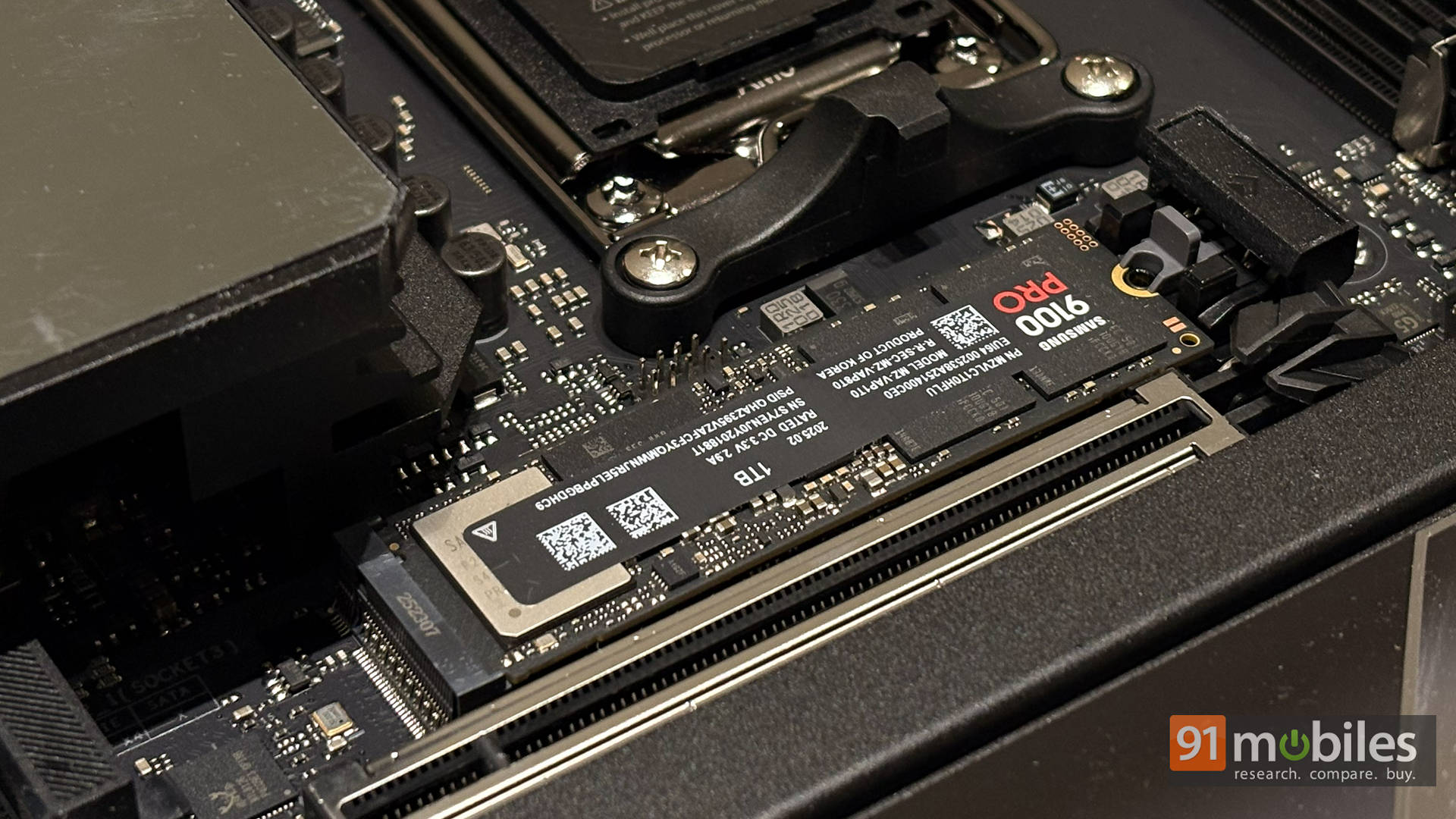
With blazing-fast read and write performance and Samsung's reputation for reliability, it's ideal for quick game load times, rapid file transfers, and handling large benchmark datasets with ease.
GPU: MSI GeForce RTX 5070 Ti Ventus 3X OC
Pairing the CPU with the RTX 5070 Ti ensures the GPU never becomes a bottleneck during gaming tests. The Ventus 3X OC variant features a triple-fan cooling design and factory overclock, delivering strong performance and reliable thermals even in demanding modern titles.
PSU: MSI MAG A1000GL Black
A powerful build demands a reliable power supply, and the MAG A1000GL provides a generous 1000W capacity with strong efficiency. Its fully modular design helps keep cable management clean while ensuring stable power delivery for both the CPU and GPU under load.
Cabinet: MSI MAG PANO 100R PZ Black
The MAG PANO 100R PZ offers excellent airflow and a spacious interior, making it ideal for housing high-end components and large cooling solutions. Its panoramic glass design not only showcases the hardware beautifully but also ensures proper ventilation for sustained performance.
AMD Ryzen 7 9850X3D: Performance Analysis
Okay, now that we have the spec sheet and test bench out of the way, let's start talking actual performance, shall we?
Synthetic Benchmarks
Let's start with the numbers that show raw CPU muscle. These tests remove GPU limitations and highlight improvements in clock speed, architecture, and core scaling. Across synthetic workloads, the 9850X3D behaves exactly how the spec sheet suggests.
Starting with synthetic benchmarks, the Ryzen 7 9850X3D behaves largely the way its specifications suggest. Since the primary upgrade over the 9800X3D is a higher boost clock, the most noticeable gains appear in single-core workloads. Tests like Cinebench R24 Single-Core, Cinebench R23 Single-Core, and Geekbench Single-Core all show the 9850X3D edging ahead of the 9800X3D.
| 9800X3D | 9850X3D | 9950X3D | |
| Cinebench R24 MT | 1293 | 1281 | 2238 |
| Cinebench R24 ST | 130 | 138 | 136 |
| Cinebench R23 MT | 22890 | 21900 | 42398 |
| Cinebench R23 ST | 2087 | 2209 | 2275 |
| Geekbench ST | 3391 | 3492 | 3391 |
| Geekbench MT | 18774 | 17977 | 20106 |
The differences aren't dramatic, but they are consistent enough to show that the extra frequency does translate into slightly better single-thread responsiveness. In practical terms, this means tasks that rely on fast individual cores, things like general system responsiveness, light productivity apps, or parts of modern game engines, can see a small uplift.
However, once we shift to multi-core workloads, the story changes slightly. Despite the higher clocks, the 9850X3D doesn't consistently maintain its lead over the 9800X3D. In both Cinebench R24 Multi-Core and Cinebench R23 Multi-Core, the older chip posts slightly higher scores, and the same trend holds in Geekbench Multi-Core as well. Since both processors share the same 8-core/16-thread configuration, the difference likely comes down to power behaviour, scheduling, and the way X3D chips balance frequency under full load. The takeaway here is that while the 9850X3D improves single-core performance, it doesn't necessarily translate into stronger multi-core throughput.
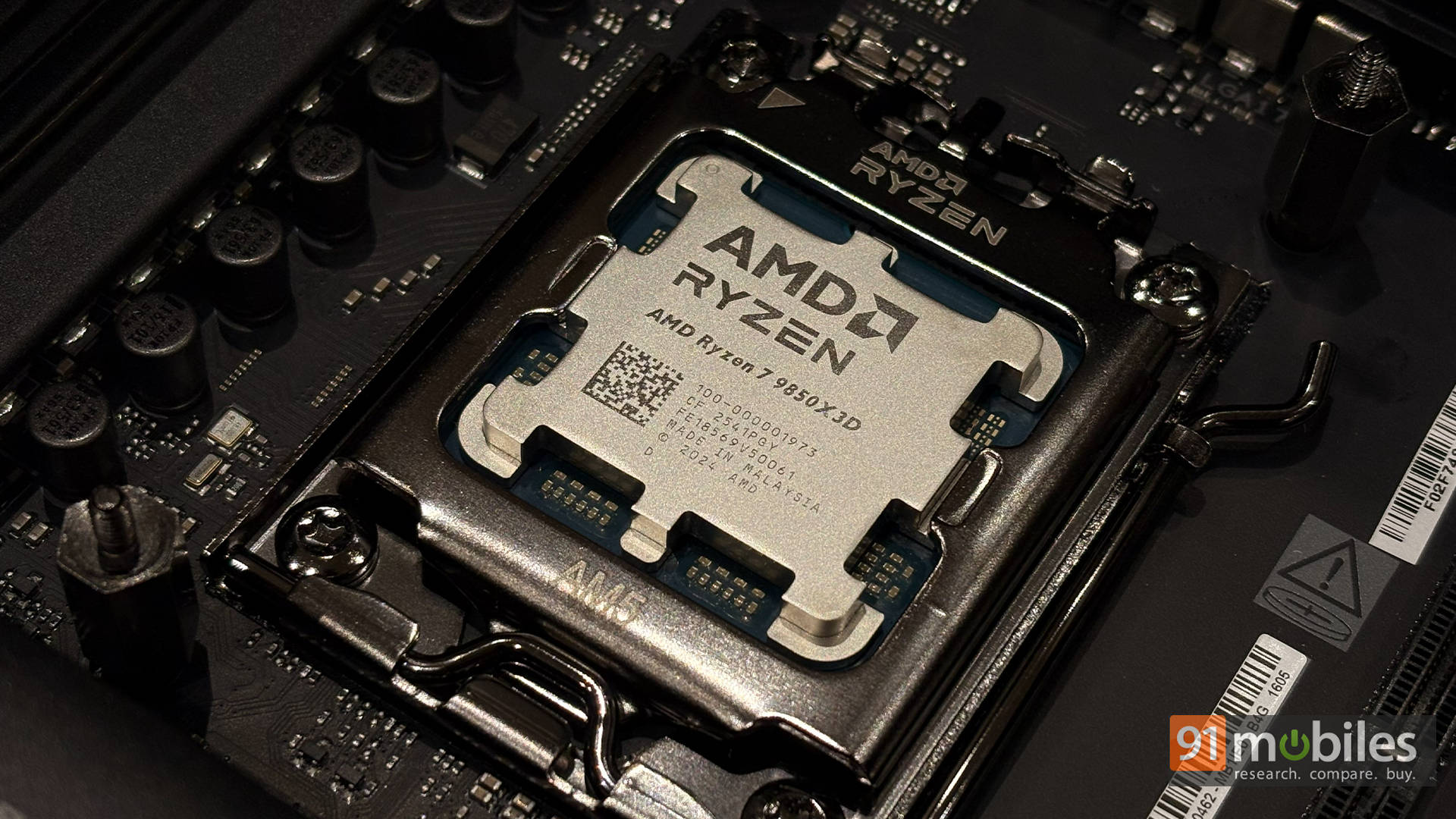
When compared to the Ryzen 9 9950X3D, the gap becomes much more obvious. With twice the core count, the flagship chip pulls far ahead in multi-threaded workloads like rendering and heavy compute tasks, as seen clearly in the Cinebench multi-core scores. Even in single-core tests, where the difference is smaller, the 9950X3D still manages to stay competitive thanks to its aggressive boost behaviour.
What it means
One small note worth mentioning is that while both the 9800X3D and 9950X3D were tested using 32GB Kingston DDR5-8000MT/s memory, the Ryzen 7 9850X3D was paired with 32GB of G.Skill Trident Z5 Neo DDR5-6000MT/s RAM. In theory, this shouldn't significantly impact CPU-bound benchmark results, but it's worth pointing out for the sake of transparency.
Overall, the synthetic benchmark results place the Ryzen 7 9850X3D exactly where you'd expect it in AMD's stack. It offers a slight single-core advantage over the 9800X3D thanks to its higher clock speeds, but doesn't consistently outperform it in multi-core workloads, while the 16-core Ryzen 9 9950X3D still sits comfortably ahead in heavily threaded scenarios.
Gaming Benchmarks
Now to the part everyone actually cares about: gaming. This is where X3D chips flex, and they know it. Games absolutely love cache, and AMD's stacked 3D V-Cache helps reduce memory latency while improving frame consistency, which basically means smoother gameplay and higher FPS without breaking a sweat.
| Game Title | Avg FPS (1440p Native) | Avg FPS (4K Native) |
| Cyberpunk 2077 | 130 | 63 |
| Alan Wake 2 | 100 | 67 |
| Black Myth Wukong | 107 | 76 |
| Forza Horizon 5 | 198 | 155 |
| Red Dead Redemption 2 | 112 | 79 |
| God of War Ragnarok | 158 | 96 |
| Indiana Jones and the Great Circle | 141 | 86 |
In simple terms, modern games constantly juggle game logic, physics, AI, and world data, and the faster the CPU can access that information, the better the performance. With its massive cache, the Ryzen 7 9850X3D keeps critical game data close to the cores, so the processor spends less time waiting and more time pushing frames.
| Game Title | Avg FPS (1080p High) |
| Counter-Strike 2 | 1395 |
| Valorant | 1232 |
Competitive shooters like Counter-Strike 2 and Valorant are where things get borderline ridiculous, comfortably pushing well beyond the 1000 FPS mark at 1080p with high settings. Whether the workload involves twitchy esports titles or massive open-world adventures, the 9850X3D is built to deliver consistently top-tier gaming performance without drama.
Creative Needs
Content creation, however, is where the story becomes familiar. The Ryzen 7 9800X3D was an outstanding gaming CPU, but never the go-to recommendation for serious creators. Running PugetBench for DaVinci Resolve shows a small improvement this time around, though the presence of a significantly stronger GPU means the comparison isn't perfectly apples to apples.
Even so, the conclusion doesn't really change: this remains a gaming-first processor. It can handle creative workloads perfectly fine, but there are plenty of older and higher-core CPUs that can match or outperform it in heavy production tasks. In short, it's still the best gaming specialist, just not the workstation hero.
Verdict: Worth the Extra Frames?
The AMD Ryzen 7 9850X3D currently sits at around Rs. 52,000, firmly in high-end gaming territory. Meanwhile, the Ryzen 7 9800X3D floats between Rs. 45,000 and Rs. 48,000, which naturally raises the big question: Is that extra spend actually worth it? Surprisingly, yes… but with an asterisk.
During our briefing, AMD openly acknowledged that a slightly tuned 9800X3D can get very close to 9850X3D performance with some BIOS tweaking. But here's the thing: most people don't want to play BIOS simulator before launching a game. The Ryzen 7 9850X3D refines AMD's already excellent gaming formula with slightly higher clock speeds and marginally better single-core performance. In games, it remains one of the fastest CPUs available, delivering excellent frame rates and smooth gameplay thanks to the large 3D V-Cache.
However, the gains over the 9800X3D are modest, and multi-core performance remains limited compared to higher-core Ryzen 9 chips. For gamers building a new system, it's an easy recommendation, but existing 9800X3D owners won't find enough reason to upgrade. Importantly, AMD isn't forcing an upgrade, and the 9800X3D isn't going anywhere, which means buyers still have a real choice.
Editor's Rating: 8.8 / 10
Pros:
- Outstanding gaming performance
- Higher clocks improve single-core speed
- Efficient power consumption
- Future-proof with AM5 & DDR5 support
Cons:
- Small gains over 9800X3D
- Weak multi-core productivity performance