ASUS ROG Zephyrus G16 (2026) Review: Performance per kilogram, perfected


Review Summary
Expert Rating
ASUS has spent years trying to bridge that gap with its Zephyrus lineup, and the new ROG Zephyrus G16 (2026) is perhaps its most refined attempt yet. What’s interesting is where this laptop sits within ASUS’ own ecosystem. The company already has the ROG Strix series for hardcore gamers chasing maximum performance and the ProArt lineup for creators who prioritise colour accuracy and professional workflows. The Zephyrus G16 sits right in the middle, aiming to offer the best of both worlds without leaning too heavily in either direction.
Powered by Intel’s latest Core Ultra 9 386H Panther Lake processor and NVIDIA GeForce RTX 5070 Ti Laptop GPU, the ASUS ROG Zephyrus G16 (2026) packs serious gaming and content creation capabilities into a chassis that weighs under 2kg. On paper, it ticks all the right boxes, but with a price tag of around Rs 4.5 lakhs, the real question is whether its blend of performance, portability, and premium features is worth the asking price.
Table of Contents
Design and Build Quality
ASUS hasn’t dramatically changed the Zephyrus formula for 2026, and honestly, that’s perfectly fine. The Zephyrus G16 remains one of the best-looking gaming laptops available today.

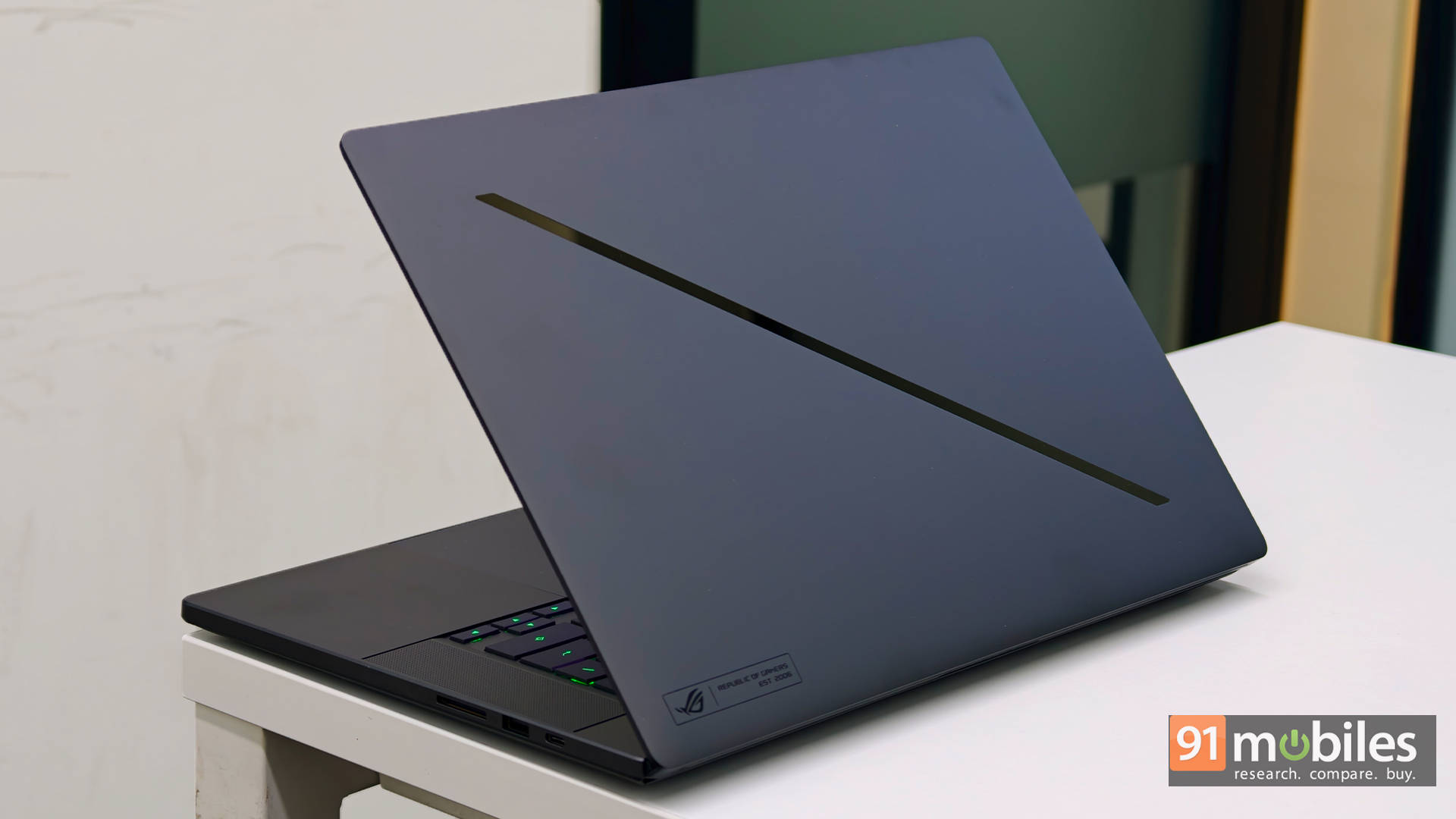
Unlike many gaming-focused machines that rely on aggressive styling and excessive RGB lighting, the G16 takes a far more mature approach. It looks equally comfortable in a gaming setup, an editing studio, or a corporate boardroom. That said, the signature Slash Lighting element returns on the lid, adding a touch of personality without making the laptop look overly flashy.

What continues to impress me most is just how portable this machine feels. Despite featuring a 16-inch display and high-end internals, the laptop never feels large or cumbersome. At 1.95kg, it’s surprisingly easy to carry around, making it a practical option for creators and professionals who frequently travel.

More importantly, the chassis feels even sturdier than before. During my usage, there was no noticeable flex in the keyboard deck, no creaking when lifting the laptop from a corner, and no concerning movement in the display lid. The CNC-machined aluminium construction feels exceptionally solid, and ASUS’ military-grade durability certification should provide additional confidence for users who frequently work on the move.

Port selection remains excellent, too. ASUS has managed to include everything most users could ask for, including USB-A ports, USB-C connectivity, HDMI, a headphone jack, and most importantly, a full-sized SD card reader. For photographers and videographers, that’s a genuinely useful addition that eliminates the need for an external dongle.
Display and Audio
If there is one area where the Zephyrus G16 immediately justifies its premium positioning, it’s the display.

The laptop features a 16-inch 2.5K OLED ROG Nebula HDR display with a 240Hz refresh rate, G-Sync support, and excellent factory colour calibration. Quite simply, this is one of the best laptop displays available right now. Whether I was gaming, editing photos, grading videos, or simply binge-watching content, the panel consistently impressed. Colours look vibrant without appearing oversaturated, contrast is exceptional thanks to OLED technology, and blacks are as deep as they come.

For content creators, colour accuracy is excellent, making the panel suitable for professional workflows. At the same time, the 240Hz refresh rate and near-instant pixel response times make it equally appealing for competitive gaming. This is one of those rare displays that genuinely excels at both creation and entertainment.

The display is stunning, but the six-speaker setup deserves equal applause. Audio is loud, detailed, and surprisingly punchy, with enough bass to make movies, music, and games genuinely enjoyable without reaching for headphones. In fact, it’s one of the few Windows laptops that can comfortably go toe-to-toe with a MacBook Pro, making the Zephyrus G16 an absolute multimedia powerhouse.
Keyboard and Touchpad
The Zephyrus G16 continues to offer a comfortable typing experience. The keyboard feels responsive and well-spaced, making it suitable for everything from long writing sessions to gaming marathons. Key travel remains satisfying, while the large glass touchpad is smooth, accurate, and among the best you’ll find on a Windows machine.

That said, there are a couple of decisions that feel slightly odd. The first is the continued use of single-zone RGB lighting. While this won’t bother everyone, some buyers spending this much money may have expected per-key RGB lighting or at least a more advanced implementation. My bigger complaint, though, is the arrow key layout.

This is a 16-inch chassis that doesn’t even include a numpad, yet ASUS still opted for half-height up and down arrow keys. There’s more than enough space available to accommodate full-sized arrow keys, making this feel like a design choice driven by aesthetics rather than practicality. Will it bother everyone? Probably not. But if your workflow relies heavily on navigation keys, it’s something worth keeping in mind.
Performance
Under the hood, the Zephyrus G16 packs Intel’s new Core Ultra 9 386H processor alongside NVIDIA’s GeForce RTX 5070 Ti Laptop GPU with 12GB of GDDR7 memory. Rounding things off is 32GB of LPDDR5X-8533 RAM and a spacious 2TB PCIe Gen4 SSD, which is about as flagship as laptop specs get in 2026. Unsurprisingly, performance is excellent across the board.
The real star of the show, however, is Intel’s new Panther Lake architecture. To put its improvements into perspective, I’ve compared the laptop against last year’s Zephyrus G16 as well as the Lenovo Legion Pro 5i Gen 10. The results speak for themselves. Whether it’s synthetic CPU benchmarks, everyday productivity workloads, or creator-focused tasks, the new G16 consistently pulls ahead of its predecessor while putting up a respectable fight against the much bulkier Legion.
| Model | ASUS ROG Zephyrus G16 (2025) | ASUS ROG Zephyrus G16 (2026) | Lenovo Legion Pro 5i Gen 10 |
| CPU | Intel Core Ultra 9 285H | Intel Core Ultra 9 386H | Intel Core Ultra 9 275HX |
| GPU | 16GB NVIDIA GeForce RTX 5080 | NVIDIA GeForce RTX 5070 Ti | 12GB NVIDIA GeForce RTX 5070 Ti |
| Battery Capacity (WHrs) | 90 | 90 | 80 |
| Cinebench R24 MT | 992 | 1208 | 2060 |
| Cinebench R24 ST | 119 | 125 | 137 |
| Cinebench R23 MT | 18202 | 21219 | 34179 |
| Cinebench R23 ST | 2058 | 2104 | 2231 |
| PCMark 10 | 7931 | 10111 | 9224 |
| PCMark 10 Extended | 11082 | 13359 | 12634 |
| Geek Bench 6 ST | 2739 | 2905 | 3100 |
| Geek Bench 6 MT | 16227 | 16968 | 20431 |
The GPU story is equally interesting. On paper, moving from last year's RTX 5080 to an RTX 5070 Ti might sound like a step backwards, but that's only half the story. The previous-generation model ran its GPU at a relatively conservative 120W, whereas the new Zephyrus pushes the RTX 5070 Ti up to 140W, putting it in the same league as the Legion Pro 5i. As a result, the laptop delivers strong graphics performance across demanding 3DMark workloads and modern games alike, while the 12GB GDDR7 framebuffer also provides a welcome boost for newer AAA titles.
| Model | ASUS ROG Zephyrus G16 (2025) | ASUS ROG Zephyrus G16 (2026) | Lenovo Legion Pro 5i Gen 10 |
| Geek Bench OpenCL | 162231 | 166832 | 175014 |
| Geek Bench Vulcan | 133080 | 147617 | 172136 |
| 3DMark Time Spy Extreme | 15249 | 7810 | 9323 |
| 3DMark Time Spy | 7771 | 16372 | 18369 |
| 3DMark Fire Strike Extreme | 20094 | 19605 | 21731 |
| 3DMark Fire Strike | 32090 | 32565 | 31598 |
| 3DMark Night Raid | 63704 | 66745 | 85309 |
Of course, a thicker gaming laptop like the Legion still has an advantage when it comes to brute-force performance. But that's also missing the point. The Zephyrus G16 isn't trying to win benchmark charts at any cost; it's trying to deliver as much performance as possible without turning into a 2.5kg desktop replacement. And when you consider that ASUS has managed to squeeze this level of performance into a sub-2kg chassis, the achievement becomes a lot more impressive. In many ways, that's the Zephyrus G16 in a nutshell: a laptop that prioritises performance per kilogram rather than performance at all costs.
Thermals and Battery Life
Packing a Core Ultra 9 processor and an RTX 5070 Ti into a chassis this slim is a bit like fitting a V8 engine into a hatchback: something's bound to get loud. Under heavy loads, temperatures can cross the 85°C mark, and the fans certainly make their presence known. However, ASUS deserves credit for keeping the heat away from the areas that matter. While the internals are working overtime, the keyboard deck and palm rests remain surprisingly comfortable, with most of the warmth confined to the area above the keyboard.
More importantly, real-world usage is less dramatic than synthetic benchmarks suggest. During gaming, the laptop remains composed and delivers consistent performance without excessive throttling. Similarly, content creation workloads such as timeline editing, colour grading, and asset management are handled effortlessly. The fans mostly become noticeable during exports and rendering workloads, where sustained performance matters most.
Battery life is another area where Panther Lake makes a strong case for itself. The biggest upgrade this year isn't immediately visible on a spec sheet. It's the fact that the Zephyrus G16 feels far more comfortable being used as an everyday laptop rather than just a gaming machine that occasionally leaves the desk. For creators and professionals who spend as much time working as they do gaming, that's a meaningful improvement.
Verdict
The ASUS ROG Zephyrus G16 (2026) is the kind of laptop that makes a fantastic first impression and somehow keeps getting better the longer you use it. From the gorgeous OLED display and powerful speakers to the premium build quality and impressive portability, it's one of the rare machines that feels equally at home rendering videos, crushing deadlines, or running the latest AAA games.
The catch, however, is the price. At around Rs 4.5 lakh, the G16 finds itself competing not just with rival gaming laptops, but also with its own predecessor. Last year's Zephyrus G16 with an RTX 5080 can be found for Rs. 3.5 lakhs, which translates to savings of almost a lakh. On the other hand, even cheaper options like the Lenovo Legion Pro 5i offer more raw horsepower if portability isn't a priority.

That said, ASUS has done enough to make the new G16 feel like a genuine upgrade. Panther Lake brings meaningful efficiency gains, performance remains excellent, and the overall experience is about as polished as gaming laptops get. It's not the fastest laptop in its class, nor the best value-for-money option, but if the goal is to own a premium machine that can seamlessly switch between creator laptop and gaming powerhouse, the Zephyrus G16 makes a compelling case for itself.
The asking price remains steep, though ASUS does soften the blow with offers such as instant discounts, no-cost EMI options for up to 18 months starting at Rs. 11,111 per month, and extended warranty plans. While these won't make the laptop any cheaper, they do make stepping into ASUS' flagship ecosystem a little easier on the wallet.
Editor's Rating: 8.5 / 10
Pros:
- Premium design that's both portable and practical
- Best-in-class multimedia experience
- Excellent balance between gaming and content creation
- Strong all-round performance with improved efficiency
Cons:
- Very expensive compared to alternatives
- Fan noise can get aggressive under heavy loads
- Limited upgradeability