Best Laptops in India Across Price Ranges – Tested (June 2026)


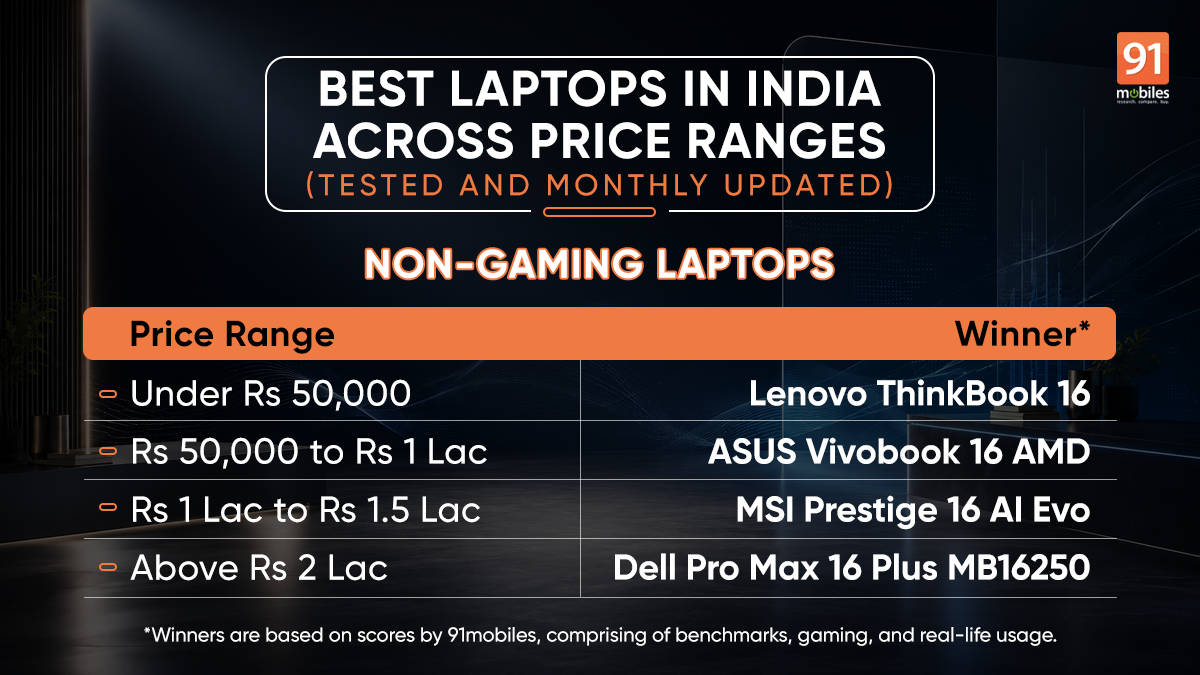
Picking a laptop in 2026 should be simple. It is not. Every price band now has credible options from at least four or five brands, and the difference between a great buy and a regrettable one often comes down to details that spec sheets do not mention. This guide cuts through the noise with hands-on tested recommendations across four non-gaming price tiers, so you can stop second-guessing and start using.
Table of Contents
Our Testing Process
Every laptop in this guide was tested with a consistent benchmark suite and real-world usage patterns. We run Cinebench R23 and R24 for CPU performance across both multi-threaded and single-threaded workloads, PCMark 10 and PCMark 10 Extended for productivity and creative performance, and Geekbench 6 for cross-platform comparisons. Battery runtimes are recorded using PCMark’s Video Loop test at 80% brightness on Balanced mode.
Beyond the numbers, each machine goes through extended daily use to assess build quality, thermals, keyboard feel, display accuracy, and port layout. A laptop that looks good on paper but throttles under load or runs uncomfortably hot does not make the cut.
Each price tier has one Ultimate Champion with the full breakdown, and two Quick-Fire Alternatives for different priorities or budgets.
Best Non-Gaming Laptops Across Price Ranges
Under Rs 50,000: Lenovo ThinkBook 16 Gen 7 (21MWA0AJIN) – Rs 46,990
The sub-50K non-gaming segment is littered with 15-watt processors stuffed into plasticky chassis that feel designed to hit a price point, not to be used. The Lenovo ThinkBook 16 Gen 7 is different. It runs the AMD Ryzen 5 7535HS at a 45W TDP, which is significantly higher than most competitors at this price, and it produces benchmark results that genuinely reflect that. Cinebench R23 multi-thread came in at 9,393 with a single-thread score of 1,463. Cinebench R24 multi-thread was 519. PCMark 10 scored 5,779. Geekbench 6 returned 2,002 single-core and 8,072 multi-core.
Those numbers matter because this is a laptop you will actually feel the difference on. Multitasking with twenty browser tabs, running spreadsheets with heavy formulas alongside Teams calls, handling local media work, the ThinkBook 16 does not hesitate the way cheaper machines do. The HS-series chip has genuine headroom where U-series alternatives do not.
The 16-inch IPS display in a 16:10 aspect ratio is a meaningful productivity upgrade over standard 16:9 panels. You get more vertical screen real estate for documents, code, and content, and the chassis carries the display without flex. Build quality here punches above the price as the ThinkBook series has always leaned professional, and Gen 7 continues that. The dual RAM and dual SSD slots deserve a specific mention: at under Rs 50,000, the ability to upgrade your machine as your needs grow is a rare and practical advantage.
Battery life from the 45Wh cell came to 9 hours in our test. Respectable, though not class-leading. The display brightness is average, and colour accuracy is not going to impress anyone doing colour-critical work, but for document editing, productivity, and general use, it is fine. The chassis is heavier than 14-inch alternatives, which is the trade-off for the larger screen.
For anyone who wants the strongest performing laptop available under Rs 50,000 and is willing to carry a little extra weight, the ThinkBook 16 Gen 7 is the clear answer.
Pros:
- Strongest CPU performance in the sub-50K non-gaming segment
- Spacious 16-inch 16:10 display with genuine productivity benefit
- Dual RAM and dual SSD slots for upgradability
- Professional build quality that justifies the ThinkBook name
Cons:
- Average display brightness and colour accuracy
- Heavier than 14-inch alternatives
- 45Wh battery is adequate but not a standout
Performance Rating: 8.4/10
Quick-Fire Alternatives
- Acer Aspire 14 AI (NX.JP3SI.001) — Rs 43,999 (7.3 / 10)
- Acer Aspire 3 A324-53 (UN.34RSI.004) — Rs 40,990 (7.5 / 10)
Non-Gaming Rs 50,000 to Rs 1 Lakh: ASUS Vivobook 16 AMD (M1607KA-MB109WS) – Rs 75,990
The Rs 50,000 to Rs 1 lakh non-gaming bracket in 2026 has genuine depth, and picking the right machine requires being clear about what you actually need from it. For most users, whether they are students, professionals, content consumers, or anyone running a mix of productivity and creative applications, raw CPU throughput delivered consistently is the most important single metric. On that basis, the ASUS Vivobook 16 AMD is the top pick in this segment.
The AMD Ryzen AI 7 350 at 28W TDP delivered Cinebench R23 multi-thread of 14,035 and single-thread of 1,937. Cinebench R24 multi-thread reached 773 and single-thread 111. PCMark 10 scored 6,820. Geekbench 6 single-core was 2,814, and multi-core came in at 10,968. Those are strong numbers across the board, and the Ryzen AI 7 350 is built on AMD’s newest mobile architecture with NPU cores for AI-accelerated workloads. The Radeon 860M integrated GPU is a meaningfully capable chip for light creative work, significantly ahead of what Intel’s integrated options can manage at this price.
As for the rest of the machine, the 16-inch IPS panel at 60Hz gives you a large canvas for productivity. 16GB of DDR5 RAM and 512GB of Gen 4 NVMe storage are appropriately specced. The chassis is well-built without being precious about it. Clearly, this is a laptop designed to be used and put through the wringer. Battery life from the 42Wh cell came to 7 hours 51 minutes. That is the honest limitation: the battery is smaller than you would ideally want for a 16-inch machine, and if portable untethered use is a priority, you should have a look at the alternatives section. For users who work near a charger and want the most raw performance at this price, the trade-off is easy to accept.
At Rs 75,990, no other reviewed laptop in this band comes close to this level of multi-threaded CPU performance.
Pros:
- Highest CPU performance in the Rs 50K to Rs 1L non-gaming segment
- AMD Ryzen AI 7 350 with strong integrated Radeon 860M graphics
- 16-inch display with good productivity real estate
- Competitively priced at Rs 75,990
Cons:
- 42Wh battery limits all-day portable use
- 60Hz IPS display is functional but unremarkable
- No OLED option at this price
Performance Rating: 9.3/10
Quick-Fire Alternatives
- ASUS Vivobook 16 Intel (X1607CA-MB139WS) — Rs 70,990 (8.0 / 10)
- Acer Swift 14 AI (SF14-51, NX.J2HSI.002) — Rs 89,990 (7.8 / 10)
Non-Gaming Rs 1 Lakh to Rs 1.5 Lakh: MSI Prestige 16 AI Evo B2HMG – Rs 1,50,000
There is a shift that happens around the Rs 1 lakh mark. Below it, you are mostly choosing between CPU platforms and accepting display compromises. Above it, the best machines stop making you choose. The MSI Prestige 16 AI Evo B2HMG is exactly that kind of laptop. It is a laptop where performance, build, display, and battery have all been treated as requirements rather than variables.
The Intel Core Ultra 9 285H at 45W TDP is the strongest Intel non-gaming mobile processor in active production, and the numbers reflect it. Cinebench R23 multi-thread came in at 17,882 and single-thread at 2,131, the highest single-thread score across all laptops in this guide outside the over-1.5L segment. Cinebench R24 multi-thread was 1,015 and single-thread 126. PCMark 10 scored 8,183, and PCMark 10 Extended 8,303. Geekbench 6 single-core returned 2,931 and multi-core 17,538. These are workstation-adjacent scores in a portable chassis.
The battery is where this machine makes its clearest statement. The 99.9Wh cell is the largest allowed in passenger aircraft carry-on under IATA regulations, and our measured runtime was 14 hours 13 minutes. For a 16-inch laptop with a Core Ultra 9 processor and an OLED display, that endurance is genuinely unusual. The Prestige 16 is designed for hybrid professionals who move between office work, travel, and extended sessions without wanting to think about battery anxiety.
The 16-inch OLED panel is a proper display, rich and accurate in a way that IPS panels at this price cannot match. The 32GB LPDDR5x and 1TB Gen 4 NVMe are matched to the class. Intel Arc 140T integrated graphics handle light creative work without complaint. The port layout, including dual Thunderbolt 4 and an SD card reader, covers professional connectivity. The 60Hz refresh rate is the one area where the panel feels conservative for a laptop at Rs 1,50,000, and the rear-positioned ports require adjustment for desk setups. Neither is a dealbreaker.
If you are spending in this range and need a large display, powerful CPU, and exceptional battery life in one package, the MSI Prestige 16 AI Evo earns its place at the top of this segment decisively.
Pros:
- Core Ultra 9 285H delivers the highest single-thread scores in this segment
- 99.9Wh battery with 14+ hour runtime is exceptional for a 16-inch machine
- OLED display with strong accuracy and rich colour
- Comprehensive connectivity with dual Thunderbolt 4 and SD card reader
Cons:
- 60Hz panel refresh rate feels conservative at this price
- Rear-facing ports require some adjustment for desk users
- Keyboard feedback is adequate but not the best in class
Performance Rating: 9.2/10
Quick-Fire Alternatives
- ASUS Vivobook S 14 (M5406WA-PP962WS) — Rs 1,04,990 (7.5 / 10)
- HP OmniBook X 14 (B91BSPA) — Rs 1,43,499 (7.5 / 10)
Non-Gaming Over Rs 1.5 Lakh: Dell Pro Max 16 Plus (MB16250) – Rs 9,00,000
Most laptops at this price are very good. The Dell Pro Max 16 Plus is something different. It is a professional workstation that happens to be portable, and it makes no attempt to disguise that. In one sentence, it’s the Intel Core Ultra 9 285HX at 55W, NVIDIA RTX Pro 5000 Blackwell, 128GB CAMM2 RAM, and Gen 5 NVMe storage in a 16-inch chassis. That is a platform specification you would expect to find in a tower. It is priced comparably to a tower as well, with the budget that can be allotted to a small hatchback in India.
The benchmark results match the hardware. Cinebench R23 multi-thread reached 36,274, by far the highest CPU score in this guide, with single-thread at 2,199. Cinebench R24 multi-thread was 1,982, again the highest here. PCMark 10 scored 8,430 and PCMark 10 Extended came in at 11,599. Geekbench 6 single-core was 3,008 and multi-core 20,962. The RTX Pro 5000 is not a gaming GPU. It is a professional graphics card with certified drivers for workstation applications. The kind of setup used by engineers, architects, and visual effects professionals running simulation, rendering, and compute workloads, where reliability and accuracy under sustained load matter more than peak frame rates.
The 4K Tandem OLED display is among the best panels available in any laptop currently on the market. The modular architecture allows for RAM, storage, and port expansion in ways that consumer laptops do not permit. The 96Wh battery is reasonable given the hardware it supports. It runs hot under full load, and it is not light, and at Rs 9 lakh it occupies a completely different purchasing category from everything else in this guide.
The Dell Pro Max 16 Plus is not a laptop you buy to cover your bases. It is a laptop you buy when your work genuinely demands it, and when it does, nothing else in this guide can substitute.
Pros:
- Highest CPU performance in this guide by a significant margin
- RTX Pro 5000 Blackwell for professional GPU workloads
- 128GB CAMM2 RAM and modular expansion architecture
- 4K Tandem OLED display is exceptional
- Enterprise build quality and durability
Cons:
- Runs very hot under sustained load
- Significant weight for a portable workstation
- Rs 9,00,000 price point is a specific professional investment
Performance Rating: 9.4/10
Quick-Fire Alternatives
- Samsung Galaxy Book 6 Ultra — Rs 3,00,000 (8.5 / 10)
- ASUS ExpertBook Ultra — Rs 3,49,990 (8.0 / 10)