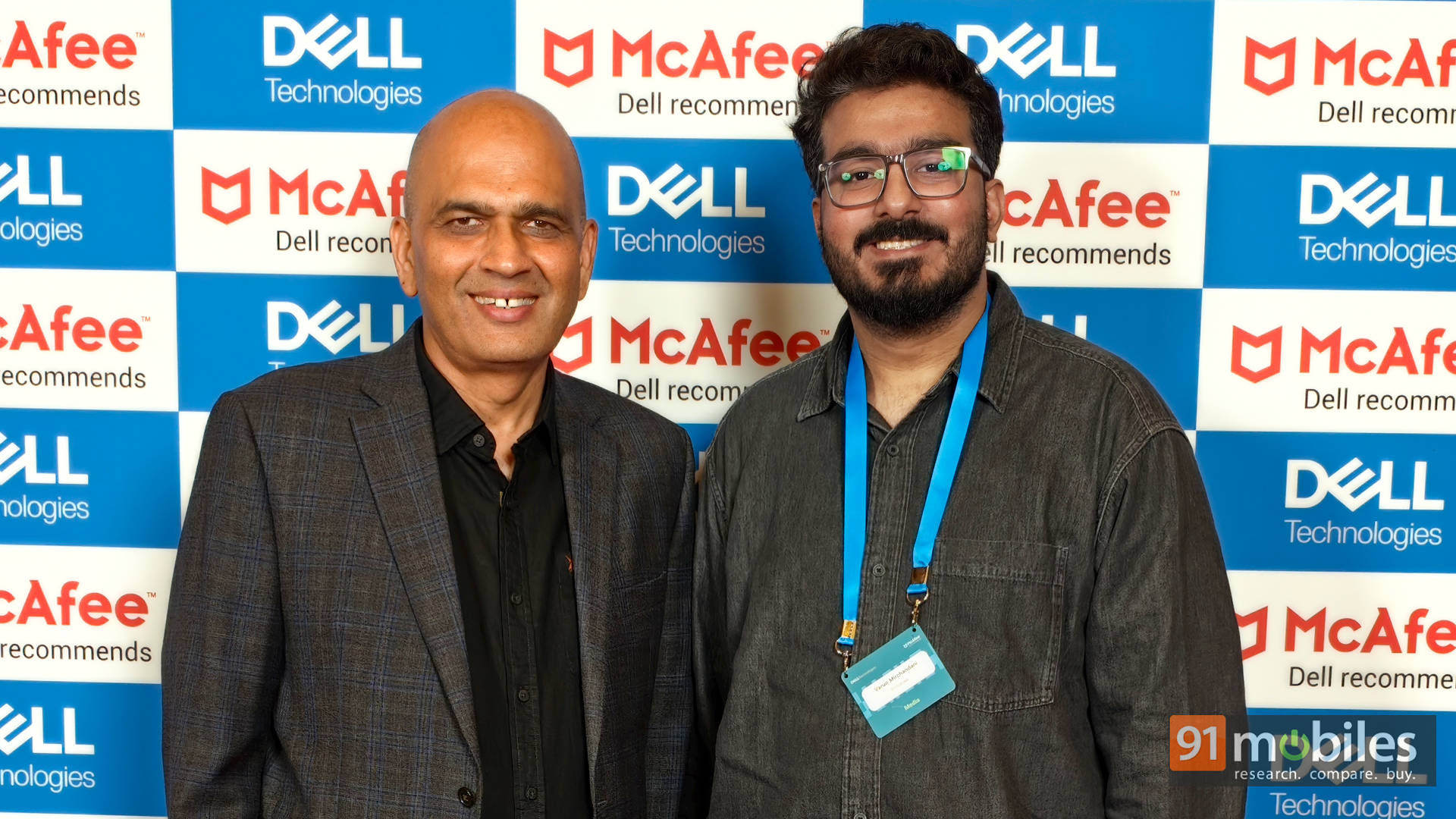
At Dell’s latest launch event in Delhi, I sat down with Raj Kumar Rishi, Vice President and General Manager for Dell Technologies’ consumer business across Asia Pacific and Japan. What followed was less of a formal product briefing and more of a wide-ranging conversation about how people now use their laptops, where Dell sees the biggest opportunities in India, and why the traditional lines between work, gaming, and content creation are becoming increasingly blurred.
We spoke about Alienware’s push towards a wider gaming audience, Dell’s growing reach beyond major metros, and the role physical stores still play in a market where most research begins online. More importantly, Raj explained why the laptop is no longer just another device on the desk. For a new generation of creators, freelancers, founders, and gamers, it is increasingly becoming the office, the studio, the gaming setup, and sometimes the entire business.
The PC is becoming the new corner office
Raj pointed towards a significant change taking place within his own family and social circle. He knows a YouTube filmmaker, someone who has started an AI company in the legal space, and another person who left her job to launch a fashion brand. Their professions are different, but none of them began by renting a conventional office.
In our time, if you wanted to start a business, you first had to have an office or a space you would work from. They all work from home. The PC is their office, so to say.
That observation explains much of Dell’s current consumer strategy. A filmmaker editing advertising projects and hoping to produce a short film will not need the same machine as someone primarily working with documents and browser-based applications. Similarly, a gamer who also edits videos or creates online content may require considerably more graphical performance than a typical office user.
That is where our role comes in as a technology company: to provide the right devices that can serve these various use cases.
In practical terms, Dell is no longer treating creators, gamers and professionals as entirely separate categories. One person may edit videos during the day, handle business tasks in the evening and play games at night, all on the same laptop. The company’s expanding portfolio is intended to serve these overlapping requirements rather than force every buyer into a narrowly defined category.
Alienware is expanding beyond hardcore enthusiasts
For years, Dell divided its gaming portfolio between the relatively accessible G-series and the distinctly premium Alienware family. Alienware represented the aspirational end of PC gaming. Its laptops were powerful, visually distinctive, and priced for enthusiasts willing to pay for the complete experience.
That approach is now changing. Dell is bringing its entire consumer gaming portfolio under Alienware and introducing products such as the Alienware 15 to reach a much wider group of gamers.
All gaming is Alienware, and we are trying to bring the Alienware experience to a very broad set of gamers, starting from hobbyist gamers to more serious gamers and then super-serious gamers.
According to Raj, the Alienware 15 still delivers the brand’s familiar cooling, performance, design, and overall gaming experience. What changes is not the identity of the product, but the kind of buyer Dell hopes to reach. That makes the laptop an important entry point into Alienware. It is aimed not only at enthusiasts upgrading an existing gaming setup, but also at first-time buyers looking for a proper gaming machine without jumping straight to the top of the range.
Can Alienware become accessible without diluting the brand?
That broader positioning naturally raises a difficult question. When a premium brand moves into more accessible price segments, does it risk losing the qualities that made people aspire to own it?
During our interaction, I raised concerns about the Alienware 15’s construction compared with Dell’s more expensive gaming laptops. Although the machine retains the familiar Alienware styling, reaching a lower price point inevitably requires different decisions around materials, specifications, and overall design. However, Raj rejected the suggestion that Dell is compromising on quality. Instead, he described the Alienware 15 as one level within a broader product ladder.
I wouldn’t say that we are compromising on quality. We created a portfolio depending on the usage. There are enough features, build quality, and experience in each of them.
The idea is that different Alienware laptops will serve different levels of performance and usage. A hobbyist gamer may begin with the more accessible model, while buyers requiring greater performance, more advanced cooling or additional premium features can move further up the range.
As the usage goes up the stream, there are additional products available.
That distinction is important. Dell is not positioning the Alienware 15 as a replacement for its highest-end gaming machines. It is meant to serve as an entry point into the wider Alienware ecosystem.
Whether users feel it delivers enough of that familiar Alienware experience will ultimately depend on the product itself. However, Dell’s intention is clear: make the brand accessible to more gamers without turning every Alienware laptop into the same machine at a different price.
Dell is trying to fill every gap in its Indian lineup
The company’s renewed focus is not limited to gaming. Dell’s latest Indian consumer portfolio includes the XPS 13, Alienware 15 and the Dell 14S and 16S. Together, these machines allow the brand to compete across a wider range of price points and usage scenarios.
With these launches, we are making our portfolio much more comprehensive and addressing areas where we had some gaps.
The XPS 13 sits within Dell’s premium ultraportable range, while the 14S and 16S address more mainstream productivity requirements. Alienware, meanwhile, covers gaming and workloads that benefit from dedicated graphics. Raj’s broader recommendation, however, is based on how the laptop will be used rather than simply its price or branding.
If you are a light user, we have the Dell series of everyday laptops. If you are a productivity user, you have the XPS or the 14S and 16S. If you are a creator-cum-gamer, or someone deeply involved in technology, probably the Alienware 15 is the right product.
In simple terms, Dell is building a consumer ladder. Everyday Dell laptops sit at one end, the S-series and XPS address increasingly demanding productivity needs, and Alienware caters to gaming and GPU-heavy work.
Smaller cities do not necessarily mean smaller budgets
An interesting topic we decided to touch upon was the distinction in “budget” based on the tier of the city. You see, premium laptops are often assumed to be products meant primarily for Delhi, Mumbai, Bengaluru, and a handful of other major metropolitan markets. Raj believes that assumption is becoming outdated.
The tiers of cities are not necessarily economically that different. There is a lot of economic goodness in tier-two cities as well. I wouldn’t just go by price points.
A gamer in Indore, a creator in Kochi, or a business owner in Jaipur may have the same performance requirements as someone living in a larger metro. The more meaningful challenge is ensuring that the desired product is actually available locally. Raj said Dell has more than 500 exclusive stores spread across approximately 350 Indian cities. The company also aims to make newly introduced products available nationally within the first few weeks rather than limiting early availability to a handful of major markets.
The XPS 13 that we are launching, we are trying to make sure that within the first few weeks, it is available across the country, not just in the top five or ten cities.
Dell also plans promotions around regional purchasing periods rather than relying entirely on national festive sales. Raj cited Onam and Ganesh Chaturthi as examples of regional occasions that can influence demand in different states.
The practical takeaway is that Dell does not want premium products such as XPS and Alienware to become metro-exclusive simply because of where a buyer lives.
Offline stores still matter, especially for premium laptops
Most laptop purchases now begin online. Buyers can compare specifications, watch reviews, examine benchmarks, and read user feedback without visiting a store. Brand websites such as Dellstore.com can also make model numbers and available configurations clearer than some large marketplaces, where similar-looking listings may contain different specifications. However, researching a laptop and purchasing one are not always the same thing.
For our kind of products, offline continues to play a very strong role. If somebody wants to buy an Alienware or an XPS device, I’m sure they would like to touch and feel the product.
That makes sense, particularly when a buyer is spending a substantial amount of money. A specification sheet cannot fully communicate how rigid the chassis feels, whether the keyboard is comfortable, how reflective the screen may be, or whether a large gaming laptop will become inconvenient during a daily commute.
Dell is therefore attempting to connect its website and exclusive stores rather than treat them as competing businesses. A buyer can find a product online, locate a nearby Dell store, experience the device physically, and then choose where to complete the purchase.
We are trying to make sure that we are there where the customer wants to buy. Both offline and online will continue to exist.
For buyers, that is arguably the ideal combination. Online platforms provide convenience and easier comparison, while physical stores offer a final confidence check before the purchase.
Dell wants trust to extend beyond the laptop itself
During the interaction, I also highlighted findings from surveys conducted within the 91mobiles community. Dell frequently emerged as a brand that existing owners were willing to buy again. Several respondents either already owned a Dell laptop or said they would consider another Dell when upgrading after five or six years. Raj attributed that loyalty to an experience extending beyond the laptop’s specification sheet.
We have the highest quality benchmarks as far as product quality, robustness and reliability are concerned. But it is also about bringing the latest technology and having a huge focus on after-sales support.
He specifically highlighted both telephone-based assistance and on-site service, along with Dell’s investment in training staff at its exclusive stores.
It is the experience that we provide across the touchpoints
Those touchpoints begin before the purchase and continue well after it. They include product availability, the quality of information inside a store, promotions, technical support and the process of repairing or replacing a device when something goes wrong.
We will not say we will do two out of five, or even four out of five. We try to score five out of five.
Naturally, service experiences can differ between users and locations. However, Raj’s larger point is valid: long-term trust is rarely created by one impressive laptop. It develops through the entire ownership experience and, eventually, whether the customer feels comfortable returning to the same brand for the next upgrade.
Final thoughts
Dell’s strategy reflects how the role of the PC is changing in India. The Alienware 15 may attract the most attention because it pushes an aspirational gaming brand towards a wider audience. However, the more important story is the portfolio being built around it. Dell wants an everyday laptop for lighter users, S-series machines for mainstream productivity, XPS devices for premium mobile computing and Alienware laptops spanning casual gamers through to demanding enthusiasts.
It also wants those products available beyond the largest metropolitan markets and through whichever channel the buyer prefers, whether that means ordering online or visiting a physical store first. The PC is no longer merely a work device or an entertainment machine. For a growing number of creators, founders, professionals and gamers, it is where work, business and play all come together.
The PC is no longer simply inside the office. Increasingly, the PC is the office.