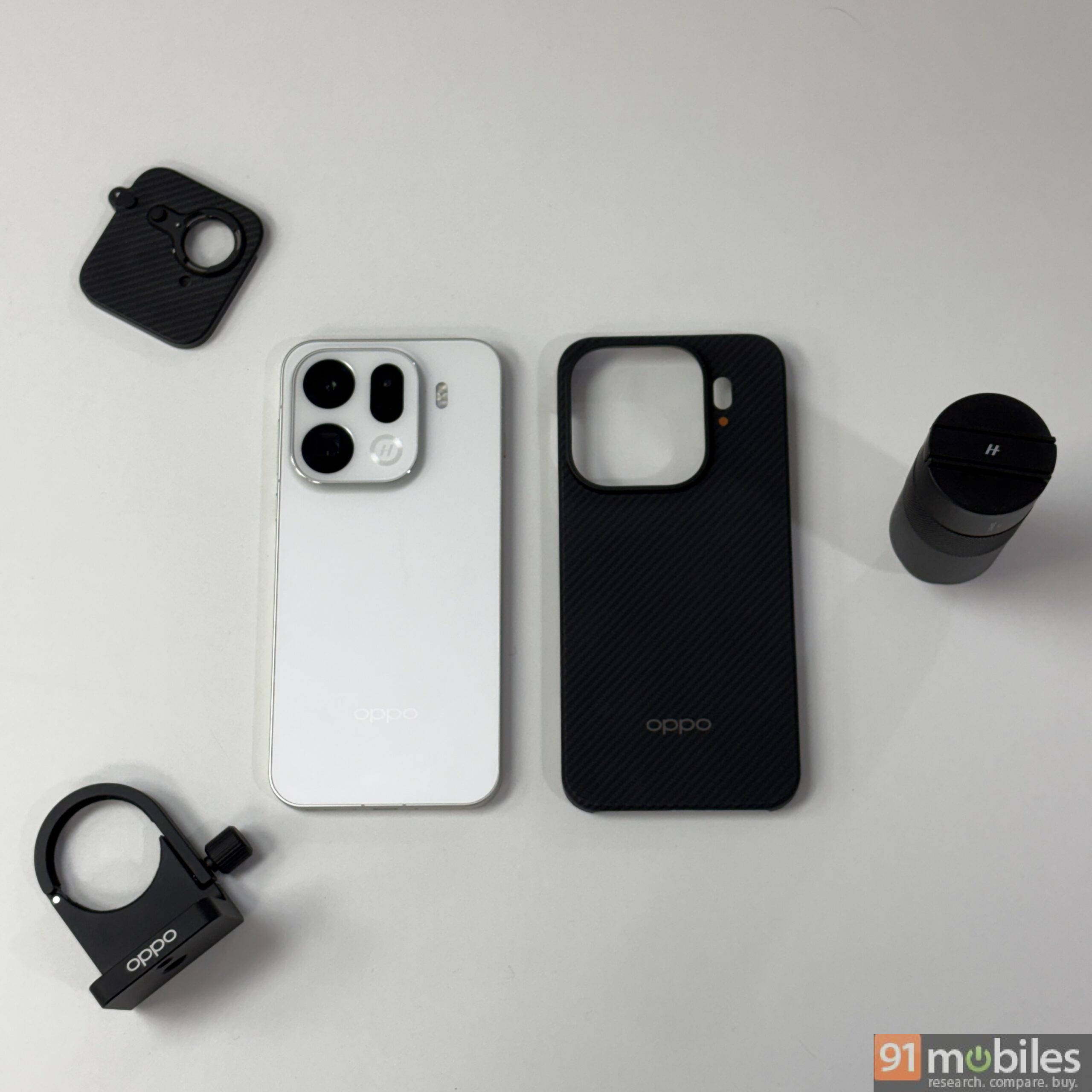
There’s so much to unpack about the OPPO Find X9 Pro‘s camera system that it almost demands a dedicated deep dive. The phone sports a powerful triple-lens setup, comprising a 50MP Sony LYT-828 primary sensor, a 50MP ultra-wide lens, and a 200MP periscope telephoto unit – co-engineered with camera manufacturer Hasselblad.
And if that weren’t impressive enough, OPPO has introduced a specialised Hasselblad camera kit that enhances the periscope’s optical zoom range from 3x to an extraordinary 9.6x. This kit not only expands focal length versatility for portrait work but also allows users to capture distant subjects with up to 200x zoom.
The Find X9 Pro’s front camera sees an upgrade, jumping from last year’s 32MP unit on the Find X8 Pro to a new 50MP sensor. Unlike typical setups that rely on pixel-binning to produce 12MP images, often resulting in softened details when zoomed in, these sensors can capture at their full native resolution, preserving sharpness and texture.
OPPO has also introduced a 21mm ‘True Colour Camera’ designed for more accurate and lifelike colour reproduction. Complementing the hardware is the Lumo Image Engine, OPPO’s advanced computational photography platform first introduced on the Find X8 series, which refines clarity, enhances dynamic range, and suppresses noise for more balanced and realistic results across lighting conditions. Additionally, the OPPO Find X9 Pro is the industry’s first to capture a 4K Motion Photo, which lets you extract an ‘ultra-clear’ frame within an image.
I’ve been testing the phone for over a week, capturing over a thousand photos to evaluate its real-world performance and see how all those camera promises hold up outside the spec sheet.
Table of Contents
Primary camera: Big on detail & dynamic range
Starting with the primary camera, it features a 50MP Sony LYT-828 sensor with OIS and an f/1.5 aperture lens. It is the latest sensor from Sony with a 1/1.28-inch sensor size, 1.22 micron Pixel size, and a new technology called Hybrid Frame HDR, which is capable of offering up to 100db of dynamic range. The results are evident in real-world shots, whether in daylight or low light, the camera maintains impressive detail and balance, preserving texture in shadows without blowing out highlights.
Daylight
Low light
As seen in the images above, the OPPO Find X9 Pro captures intricate architectural details remarkably well in both bright and low-light conditions. These nuances may not be fully visible here when zoomed in, owing to compression. Even so, the images appear visually appealing and natural, with colour reproduction that remains true to life – slightly brighter in low light and with softened shadows.
The sensor also excels at swiftly locking focus and capturing shots in rapid succession. However, image processing can take a moment, which is common across the sensors of the phone. This shouldn’t be a deal breaker for many, considering the final output is nothing short of impressive. The OPPO Find X9 Pro appears punchier, brighter, and pleasing to the eyes, even if this comes at the cost of slightly crushed shadows. While colour accuracy leans towards a more saturated palette, the tones remain relatively natural and lively, making the images instantly likeable.
oplus_3145728
oplus_3145728
oplus_137363456
oplus_3145728
oplus_3145728
oplus_3145728
oplus_3145728
oplus_3145728
oplus_3145728
oplus_3145728
oplus_3145728
oplus_3145728
oplus_3145728
oplus_3145728
oplus_3145728
oplus_3145728
oplus_3145728
oplus_3145728
oplus_3145728
oplus_3145728
oplus_3145728
oplus_3145728
OPPO allows users to customise the colour science to their preference, with varied filters and a Retouch option. No matter how you go about it, the Find X9 Pro delivers crisp details, especially in well-lit environments where the sensor captures images with full 50MP resolution. In low light, photos can appear slightly softer as the resolution drops and pixels merge to enhance detail and suppress noise. However, they don’t make the images any less appealing. You will still be awed by the results, with minimal light flare and good dynamic range.
Maintaining consistency with the ultra-wide sensor
Speaking of the ultrawide camera, it also uses a 50MP lens with the same Samsung SKJN5 sensor as its predecessor. The lens provides a field of view (FoV) of 120 degrees, an f/2.0 aperture, and an impressively short 3.5 cm minimum focusing distance. Like the main camera, the lens can also capture images at its maximum 50MP resolution in well-lit environments.
Primary
Ultrawide
While it may not be the most exciting sensor in the setup, the images look visually appealing. The dynamic range is equally commendable, maintaining balanced exposure and preserving shadow detail, though some minor edge distortion is noticeable around the frame. Moreover, there is a slight shift in colour compared to the primary camera. Notice how the blue looks a bit cyan in the images above. Irrespective of that, the sensor remains reliable to get you those beautiful landscape shots of nature or tall buildings, especially where you are crammed for space.
Telephoto lens: the major attraction, and it delivers
Now, coming to the main highlight, the Find X9 Pro’s 200MP periscope telephoto lens, capable of up to 3x optical zoom. It employs a Samsung sensor with a large 1/1.56-inch format, a bright f/2.1 aperture, and OIS to maintain sharpness and clarity. The resulting shots are crisp, detailed, and vibrant, with impressive dynamic range and minimal noise. By default, images are saved at 50MP, but switching to the Hasselblad Hi-Res mode unlocks the full 200MP resolution for those finer details. However, this mode produces significantly larger files, requires noticeably longer processing time, and can have a bit of softening in certain areas.
oplus_3145728
oplus_3145728
oplus_3145728
You are best with the regular ‘Photo’ mode for non-portrait shots, where the sensor supports up to 6x zoom in the viewfinder while maintaining nearly the same level of detail, dynamic range, and colour vibrancy as the optical zoom. The resolution is slightly reduced, which can soften the fine textures a bit. The phone’s 6x zoom can be seen in action in the images below, where the image on the right brings out more details even in low light than the one on the left, captured from the 3x telephoto camera. The colours also maintain a similar level of accuracy as the main sensor without any lens flare.
3x zoom
6x zoom
Moving on, the phone delivers lossless zoom up to 13.2x, though I did notice a slight smoothing effect creeping in.
Portrait perfection & a pocket DSLR
oplus_137363456
oplus_137363456
oplus_137363456
oplus_137429008
oplus_137429008
When it comes to portraits, the telephoto sensor offers 70mm and 85mm focal lengths, producing shots with excellent subject separation, crisp detail, and natural-looking skin tones. The bokeh effect appears pleasingly realistic, and there’s no noticeable distortion – even fine elements like individual hair strands remain clean and well-defined. Users have the option to use the primary lens to capture portraits with a 23mm focal length that produces similar results – good details, punchy colours, and excellent edge detection. However, for a more pronounced depth-of-field effect and stronger background compression, it’s best to shoot at the higher focal lengths.
That focal length can be extended up to 920mm using the Hasselblad Teleconverter kit. Sold separately, it attaches to the periscope lens using a special case and an attachment to extend the phone’s optical zooming capability to 9.6x. This could be there to compensate for the missing 6x periscope lens, which was there on Find X9 Pro’s predecessor, along with the 3x sensor.
The only hassle with the Hasselblad camera kit is its practicality. It’s a bit cumbersome to carry around, and once mounted, it adds noticeable top heaviness to the Find X9 Pro while obstructing access to the phone’s other sensors. If you can look past these trade-offs, there is plenty to like about the kit, which isn’t unique, but OPPO has done well to optimise it for the smartphone.
The lens works exclusively with ‘Hassleblad Teleconverter’ mode, which is tucked under the ‘More’ option within the camera app. Beyond offering 10x, 20x, and 40x zoom capabilities, the setup offers varied focal lengths, starting from 230mm, enhancing subject separation, adding natural depth to portraits, and delivering a pleasing background blur. While the resulting images tend to have a lower resolution (around 18MP in well-lit scenes) compared to standard shots, the setup captures impressive detail and lifelike colours. That said, shadow retention could still use some improvement.
oplus_137363456
oplus_137363456
oplus_137363456
oplus_137363456
oplus_137363456
oplus_3145728
oplus_3145728
oplus_3145728
oplus_3145728
oplus_137363456
oplus_3145728
oplus_3145728
oplus_3145728
oplus_3145728
oplus_3145728
oplus_3145728
oplus_3145728
oplus_3145728
oplus_3145728
Moreover, while the setup extends the phone’s zooming range up to 200x digitally, which is impressive, the processing can add an unnatural-looking texture to the images. It even becomes difficult to hold the shot still at the maximum zoom levels. I still admired the lens’s ability to take crisp shots of distant subjects with its optical zoom, which can come in handy during sightseeing, attending a concert, and more.
Users can also record videos using this lens, though it must be done within the same ‘Hasselblad Teleconverter’ mode by tapping the video icon in the bottom left corner. Using any other mode results in inverted visuals due to the lens’s internal configuration. The recorded footage looks pleasing, with smooth, stable motion, near-DSLR-like quality, accurate colours, minimal lens flare, and decent details across varied lighting conditions.
Add-ons
OPPO Find X9 Pro XPan mode in action
In addition to that, there are several built-in modes on the OPPO Find X9 Pro that won’t make you stop capturing photos. The one I really liked is the XPan mode, which isn’t new to the phone, but it now comes with new filters to capture images with six different colours. The mode, basically, crops the image to 65×24 for a panoramic-like effect – perfect for landscape shots or capturing a lean tall building.
Additionally, the phone offers a ‘Master’ mode, which lets you play with the granular settings of the camera by adjusting ISO, shutter speed, exposure, focus, and white balance – similar to a DSLR to capture an image according to your preference rather than the system’s. The mode gives you nice feedback, kudos to the Find X9 Pro’s haptic motor, as you adjust the mode, and it is really fun to play around with.
Photo mode
Master mode
In the slider above, the regular photo mode may look more appealing and detailed. Still, the Master mode captures the scenario more accurately, maintaining colours close to reality after manual ISO adjustment.
The OPPO Find X9 Pro also features ‘Smart Scenes’, namely Stage, Silhouette, and Fireworks, which automatically adjust exposure levels based on the shooting scenario. What’s particularly thoughtful is how these modes appear as recommendations depending on the lighting conditions. For instance, if the lens detects intense lasers or studio lights, it suggests Stage mode, which lowers the exposure to minimise light flare and deliver a more balanced, well-detailed shot.
The 4K Motion Photo, which is a first for a smartphone, works with Hasselblad Hi-Res mode on the Find X9 Pro. The feature captures a short video alongside each photo, allowing users to later select and extract an alternative high-resolution frame via Edit –> Motion Photo. I haven’t found it to have much of a real use case in my experience, but it’s good to see the brand making an effort to further enhance the photography experience. Additionally, these videos can be shared on social platforms such as Instagram.
Polished video, but audio needs fine-tuning
Talking about the video quality of the Find X9 Pro, it is crisp, stable, and mostly accurate in terms of colours, even at 4k resolution. Both primary and telephoto cameras deliver super smooth shots, thanks to the OIS, and are capable of capturing more frames, up to 120 fps, as opposed to 60 fps with ultrawide and selfie cameras. The audio quality may remain an area of improvement, with the Find X9 Pro failing to suppress the noise of the background to focus on the subject’s voice. There is an option to enhance audio; however, I still feel clarity could have been better.
Selfie camera: softer, smoother, but not sharper
Speaking of things that could be better, the selfie camera – despite being upgraded to a larger 50MP sensor from 32MP on its predecessor- lacks the details and sharpness that I have come to enjoy from the rear cameras. The images have a bit of smoothness and noise, which becomes discernible, especially in low light, and the skin tones also appear relatively flat. However, if you are someone who prefers their selfies less contrasty and smoother, the Find X9 Pro does a good job.
oplus_137363489
Users can record videos using both the front and rear cameras simultaneously. Unlike iPhones, which have only recently added this feature with just one layout, the Find X9 Pro offers far greater flexibility. You can choose between an oblong window that can be freely moved around the screen while recording, a split-screen view, or a bubble-shaped layout – giving you more control over framing and composition.
My other quirk with the camera system is its macro photography. Although it is not the most sought-after feature by enthusiasts, it can struggle with focus.
Verdict
The OPPO Find X9 Pro is clearly a smartphone that should appeal to creators and photography enthusiasts. The camera system has been enhanced from the ground up to deliver better results than its predecessor. The 200MP periscope lens, in particular, is noteworthy, not just for its reach, but for how confidently it maintains detail and colour consistency across zoom levels. Moreover, the optional Hasselblad Teleconverter kit reinforces OPPO’s ambition to go beyond smartphone photography norms, even if its practicality remains questionable for everyday use.
Both the primary and ultra-wide sensors deserve equal praise for keeping the overall camera experience consistently impressive. Their ability to shoot at the full 50MP resolution allows them to capture abundant detail, while the evolving Lumio Image Engine refines the output with balanced tones and natural colours. Even when some softness creeps in, the processing ensures the final images remain visually pleasing and well-composed.
However, it’s not that the OPPO Find X9 Pro is perfect. While the video output is impressive, the accompanying audio lacks the sharpness and clarity expected from a flagship of this calibre. The selfie camera, too, could use a boost in contrast and colour vibrancy to match the punchy, detailed results from the primary sensor. The macro performance, though decent, would also benefit from quicker and more consistent focusing. These are minor shortcomings, which could likely be ironed out through future software updates if OPPO ever decide to address them.
Nevertheless, the Find X9 Pro delivers a well-rounded camera system that perfectly aligns with OPPO’s broader strategy – to establish itself in the ultra-premium segment as the photography-first flagship that caters to serious shooters and visual storytellers. If your priority is a versatile, creatively empowering camera system backed by refined computational processing, this handset easily earns its flagship badge, and then some.
The OPPO Find X9 Pro is priced in India at Rs 1,09,999, while the Hasselblad Teleconverter kit will be sold separately for Rs 29,999. In our full review, we’ve also put its cameras up against the Pixel 10 Pro and last year’s Find X8 Pro. Have a look to see how far OPPO has pushed its imaging hardware this year – and whether the new setup is capable of taking on Google’s long-standing lead in computational photography.
Disclaimer: The writer attended OPPO’s global launch event for the Find X9 series in Barcelona, Spain. The opinions expressed in this article are entirely personal and remain independent of any brand influence.