Samsung Galaxy S26 Ultra, S26+ and S26 first impressions: all-in on AI


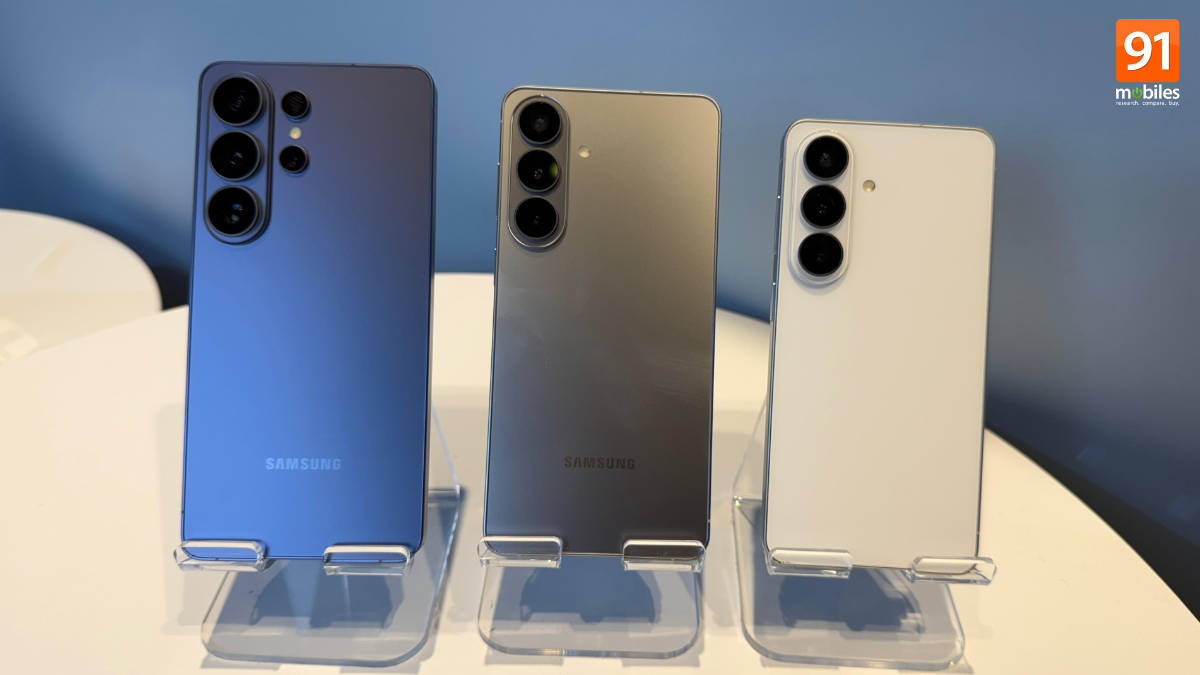
Samsung began doubling down on AI on its S series flagships a while ago, and we’ve seen progress with each iteration, especially in the last 2-3 years. The Galaxy S24 Ultra was positioned as one of the first AI phone, and then the S25 Ultra upped the ante further. And now, with the S26 series, things are at a stage where the AI phone label feels even more apt.
Table of Contents
Design: nothing drastic, but still an improvement
From a design perspective, Samsung hasn’t broken the mould per se, but there are noticeable improvements. The discrete camera lenses on the back are gone, and the lenses are now placed on an oval island, very similar to the Galaxy Z Fold7’s cameras. Also, the corners of the phones are more rounded than before. While the Galaxy S24 series used a blocky design, the S25 series changed it a bit with rounded edges. The S26 series takes this approach further, and I think it helps improve the in-hand feel of the new phones quite a bit. The S26 Ultra reaps the most benefits of this design since it’s the largest of the trio. Most other design elements seem familiar and are placed at their usual positions, with the S Pen silo at the bottom being the key differentiator for the Ultra model, apart from the size.

Specs and cameras: flagship-grade as expected, with faster charging and more
From a specs perspective, things are as loaded as expected, staying true to the premium flagship positioning. Powered by the Snapdragon 8 Elite Gen 5 for Galaxy (on the S26 Ultra), mated to 12 or 16 gigs of RAM and up to 1 terabyte of storage, it’s a fast device. Also on the Ultra is a redesigned vapour chamber for improved heat dissipation, and Super Fast Charging 3.0, promising 75 percent battery levels within 30 minutes. There are, however, no built-in magnets to enable wireless Qi 2.0 charging, as on the latest iPhones and Pixel 10 series smartphones. The device, therefore, has to rely on MagSafe-enabled cases, and Samsung is introducing quite a few new case options designed specifically for the S26 series.
On the face of it, the S26 Ultra’s cameras appear unchanged from its predecessor. However, wider apertures promise better low-light photos, and the addition of new features and upgrades (such as Enhanced Nightography, better Super Steady capabilities, etc) sound interesting too. It remains to be seen how these new goodies add to the photography experience, but the fact is that the S26 Ultra’s predecessor was already a chart-topper in terms of shooting prowess. So even a small improvement here is more than welcome.

AI and software: a lot of action here
On the AI and software side of things, Samsung has added tons of new goodies. One of the most noteworthy new features comes in the form of Privacy Display. Only available on the S26 Ultra, enabling it makes the display unreadable from an angle, ensuring no one can read your personal messages by peeking over your shoulder. Interestingly, this feature can be enabled automatically on a per-app level, so you could choose to turn it on when you launch the photo gallery, for instance.
Next, an upgraded Photo Assist feature lets users modify their images using their own words. You could, for instance, ask it to add the Taj Mahal in the background, or click a photo of a cap and ask it to add it to your selfie. There’s a new Now Nudge feature that pulls context, pulls info from various apps, and suggests actions accordingly, all without breaking your workflow. So if you receive a message about a meeting, it can check your calendar for conflicts and suggest changes. The S26 series also integrated multiple AI tools, including Gemini, Perplexity and Samsung’s own Bixby. The device can handle multi-step tasks at one go.

To conclude
Samsung’s Galaxy AI umbrella is growing by the day, and at CES 2026, the brand showcased how it’s taking AI beyond smartphones and integrating it into other segments, such as appliances. Advancements in AI are happening at breakneck speed, and with the new S26 series, the brand is showing how the core aspects of AI — task automation, productivity enhancement, image editing, photography, etc — are finally coming together meaningfully, like pieces of a puzzle. These new Samsung devices are much more than smartphones now — they’re AI-enabled systems or platforms designed to enhance, speed up, and smoothen everyday tasks, and in turn, improve lives. While this seems like a profound statement to make, that’s really the overall premise, and whether it translates into reality is something we’ll find out soon enough. In any case, the direction is clear — we’re entering the AI era at warp speed, and the Galaxy S26 series of phones looks like a suitable vehicle for this.
Disclosure: this writer attended the global Unpacked event in San Francisco on Samsung India’s invitation.