Sony BRAVIA Theatre Trio review: Big Sound, Big Price, No Compromises


Soundbars and home theatres have gone through an amazing transition over the past 5 years. From soundbars like the JBL Bar 1300MK2, which lets you detach the sides and use them as surround speakers, to modular soundbars that let you buy the sub and rear speakers separately, consumers are spoiled for choice when it comes to home entertainment. However, if there is one company that has pushed the envelope of innovation, it has to be Sony. From the Sony HT-A9, which lets you place speakers wherever you want in the room, to the BRAVIA Theatre Quad, which proved that room-filling sound was possible without altering the structure of your room or using precise speaker placement, Sony is one company that has thought out of the box.

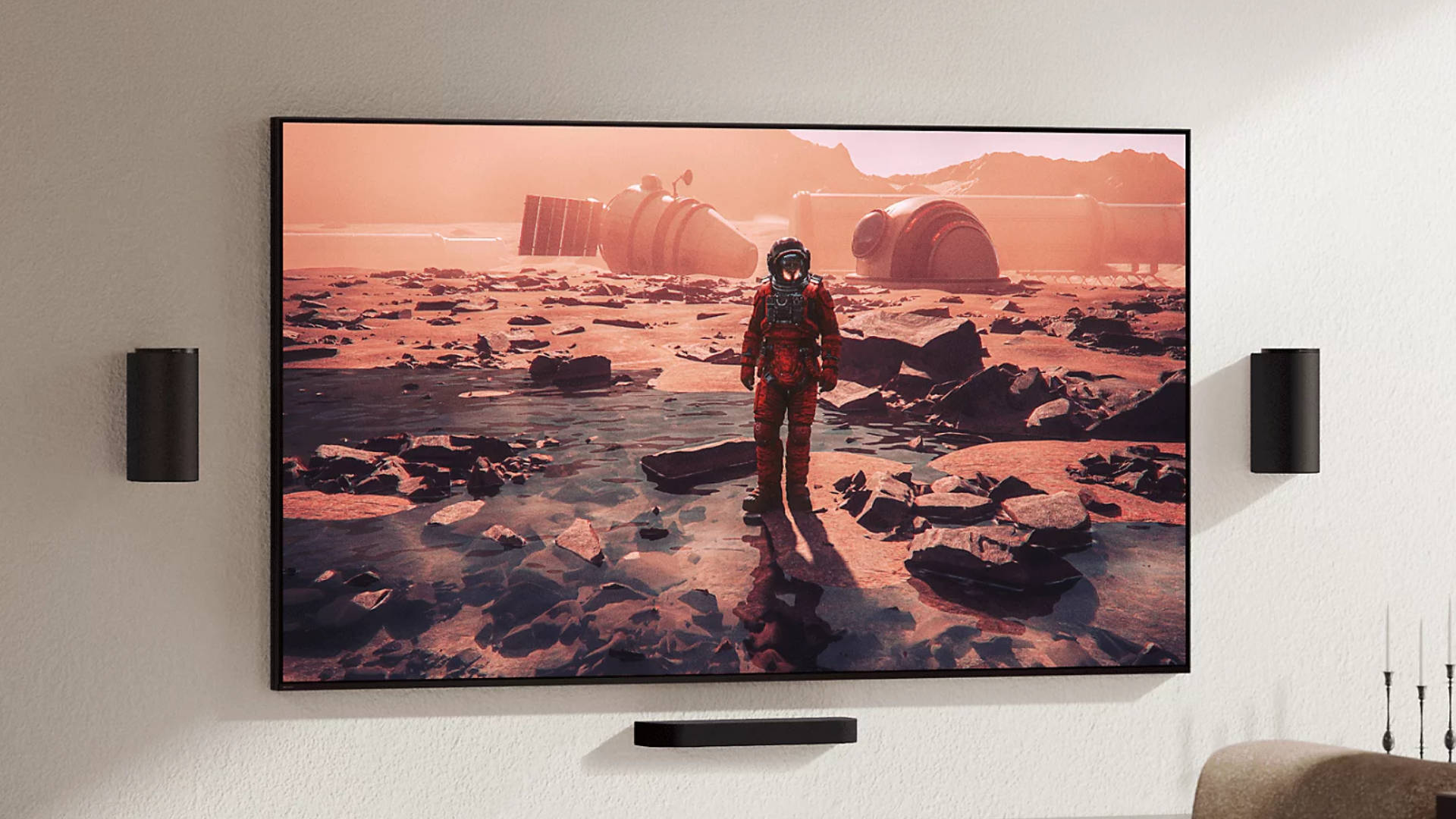
Today I have with me the BRAVIA Theatre Trio, a unique setup which comes with only a small bar in the box along with two monstrously sized left and right speakers. You can pair them with not one, but two subwoofers, with the catch being that they must be the same sub. The BRAVIA Theatre Trio is compatible with the BRAVIA Theatre Sub 8 and Sub 9, and for this review, I paired it with a single Sub 9. It is also compatible with the BRAVIA Theatre Rear 8 and 9, and for the duration of this review, I paired them with the 9. The combined MSRP of this setup is as follows:
- BRAVIA Theatre Trio: Rs 2,39,990
- BRAVIA Theatre Sub 9: Rs 94,990
- BRAVIA Theatre Rear 9: Rs 74,990
- Total Cost: Rs 4,09,970
So, is the BRAVIA Theatre Trio worth the asking price?
Table of Contents
Build and Design
Saying the device is built like a tank and commands attention would be an understatement. The Sony BRAVIA Theatre Trio comes with a relatively small centre channel bar but packs quite the punch with two woofers and a tweeter in the front, and one side-firing driver on either side. Each side speaker has a front-firing woofer and tweeter along with upfiring speakers for Dolby Atmos effects. The side speakers are so big, they make an Xbox Series X look compact, and rightfully so. The same can be said for the BRAVIA Theatre Rear 9, which comes with a front-firing and upfiring driver. The Sub 9 commands a substantial amount of space, and rightfully so.

All the speakers are black and look like something Batman would have in his entertainment setup. While they command a significant amount of space, they blend into a home entertainment setup quite easily. There is no display on the centre bar or any of the speakers. You just get small LED lights to indicate their status, and those blend into the background when the action kicks off on the screen.

Each of the surround speakers is substantially heavy too, adding to the weight and build. The grille covering each speaker feels premium, and the included power cables for each speaker and sub are quite long, ensuring you have the freedom to place them where you like.
The Sony BRAVIA Theatre Trio also comes with a mic in the box, which can be used for setup, along with wall mounts for each speaker.

On the back of the centre channel, Sony includes an HDMI eARC port along with a dedicated HDMI 2.1 input that supports 4K/120Hz, VRR (Variable Refresh Rate), ALLM, and SBTM passthrough, making it easy to connect a device like the PS5 or Xbox Series X or even the Apple TV 4K box and get the best possible output.
Overall, the entire setup is quintessential Sony premium build, aesthetically pleasing, and commanding a presence for itself, yet blending in when it needs to.
Remote control

The remote you get in the box is identical to the one we saw on the Sony Bravia Theatre System 6. Functional is the best way to describe the remote control. It has the standard set of controls, from changing the input to controlling the volume, a dedicated mute button, bass controls, and Night, Voice, and Sound Field modes.
Setup
Before we get into the setup, I want to clarify something about this system when compared to traditional soundbars: this is not a traditional soundbar. Rather, it looks to solve a problem I’ve had with soundbars in general. A standard soundbar has all the drivers in the front bar itself, left, centre, and right. Most soundbars today fit comfortably below a 50-inch to 75-inch TV, but the wide front soundstage relies heavily on the bar’s ability to virtually represent front surround sound. Bars like the Samsung Q990D/Q990F and even the Sonos Arc Ultra do this admirably well. However, the physical space the bar occupies can still be a deterrent to the “wide” audio provided from the front.

The Sony BRAVIA Theatre Trio aims to solve this by physically offering you front centre, left, and right channels separately. The wider apart you keep these three channels, the more in line with a traditional home theatre setup the wider and more impactful the front soundstage will be. This setup is also ideal for wall-mounting, making it perfect for a massive front soundstage. For example, when a plane is flying across the TV from left to right, the wider apart the front left and right channels are (with the centre channel perfectly centred below the TV), the better the flyby effect will sound. This is a simple example to show how impactful these speakers can be when paired with TVs 75 inches in size and larger.
While you can have a slightly mismatched position for the rear speakers, I personally feel their flexibility is a bit more rigid than the BRAVIA Theatre Quad. If you want maximum flexibility in speaker placement, I suggest you stick with the Theatre Quads.

Setting up the Sony BRAVIA Theatre Trio can take some time after you place the speakers in the ideal position and power them on. I highly recommend you download the companion BRAVIA app to set up the speakers. I set up the entire system: the centre, left and right, sub, and two surround speakers. Going through the app is a breeze, and each speaker is identified with a signature “da-dum” tune.
Once the speakers are set up, an update is downloaded, and then you will be asked to calibrate the room with the provided mic. The affair is pretty standard, turn the phone upside down, insert the mic into the USB-C port of the phone (sorry, iPhone users with a lightning port), and Bob’s your uncle. The app will ask you for the distance between you and the speakers as well as their specific positions, so do keep approximate distances handy. Because this setup relies on six individual physical units operating wirelessly (centre, left, right, rears, and sub), rock-solid connectivity is essential. Throughout my testing, the wireless connection across all modules remained rock-solid with zero audio dropouts or lip-sync latency issues.
Performance
I tested my standard suite of games, movies, and music on the system, and I have thoughts. Before we delve deep into the performance, there are two points I want to clarify:
- Content source matters: If your content source is poor, don’t expect the system to make it sound amazing. Low compression from some streaming services does affect the system negatively, and this isn’t a problem of the Theatre Trio. You can’t expect to put E20 fuel in a sports car and get peak performance.
- Room size: This speaker system is designed for a large room. While it was serviceable in my 10×12 room, it actually shone in my 15×30 living room a lot more. If you have a small space, know that you are better off with a traditional soundbar like the Sony BRAVIA Theatre Bar 9 or System 6.

Let’s start with the biggest surprise of the Sony BRAVIA Theatre Trio: the bass. The Sub 9 was connected and placed, and the last time I felt a punch this good from a sub was when I heard an SVS. That’s high praise for the Sony Sub 9, and rightfully so! The cherry on the cake is that you can pair two subwoofers with the Trio for twice the punch. The catch is that both subs need to be the same, so you can’t pair one Sub 9 and one Sub 8.

Whether I was listening to music by Teddy Swims (my daughter’s new favourite artist), some Linkin Park or Metallica to feel young again, or delving into some Daft Punk or good old Kishore Kumar, the music performance of the system is as phenomenal as any high-end Sony speaker. You are getting a more traditional stereo experience here, and that’s okay, as the experience on offer is room-filling and immersive with clean vocals, deep bass, and crystal clarity.
Moving over to movies, this is where I have some thoughts. Post-calibration, you can switch “Sound Field” on and off. When on, you get a wider soundstage. During the dogfight in Top Gun: Maverick, for example, you can feel the smooth transition from the front to the rear speakers when the planes swoosh by. Switch the Sound Field off, and the system performs more like a traditional 5.1 system, making the immersion feel a tad underwhelming. The same is true during the Battle of Helm’s Deep in Lord of the Rings: The Two Towers. With the Sound Field on, the battle sounds as though it is happening all around you. Switch it off, and it feels as though the front speakers are doing too much of the heavy lifting. Mind you, all this content was natively consumed in Dolby Atmos.

For TV shows, news, and regular content consumption, the experience is good with clean vocals, decent bass, and a fairly decent upmix of older 5.1 content. There is also a Night Mode to reduce loud explosions and keep dialogue audible. Additionally, if you pair the Trio with a compatible Sony BRAVIA TV, you unlock Acoustic Centre Sync. This feature integrates the TV’s built-in speakers directly with the centre channel, effectively pinning dialogue right to the screen actor’s lips.
When it comes to gaming, let me get the cons out of the way. I wish the rear speakers packed a tad more punch, especially in horror games. When I reviewed the Sony BRAVIA Theatre System 6, the rear speakers provided adequate presence in horror games like Silent Hill 2 and Cronos: The New Dawn to get me jumping out of my chair. Maybe my expectations were higher here, but the jump scares sounded a tad lower in volume than I liked.
However, in other games like DiRT 5 or Gran Turismo 7, when a car is overtaking you from behind, the rear channels do a very good job of positional audio. The Doom: The Dark Ages metal soundtrack is amazing on these speakers, with the shotgun really highlighting the bass capabilities of the Sub 9.
If you have the space to house these speakers, you will truly build a setup that could give a dedicated 5.1 + upfiring receiver setup a run for its money.
Verdict
If I had to nitpick, I would point out that the vocals on the Theatre Quad are slightly better due to its phantom centre processing, or that the app takes a heartbeat longer to connect than I’d like, but these are just nitpicks.

Here’s my real verdict: this system is not for everyone, and I don’t mean that in a bad way. For my 10×12 room, a system like the Sony BRAVIA Theatre System 6 or the Samsung Q990F is a fantastic solution for my movie and gaming needs. The Sony BRAVIA Theatre Trio would simply be overkill for this sort of space. It would also be overkill for a 55-inch TV, as you would place the two massive front-left and front-right speakers on either side of the TV, and the sound separation wouldn’t be any better than with a traditional soundbar.
However, if you have a dedicated listening room or a big living room with a minimum 65-inch (preferably 75-inch+) TV, ample depth, and you feel that your current “soundbar” isn’t doing justice to an immersive surround sound experience, then the Sony BRAVIA Theatre Trio is the solution for you. Its sheer physical size packs the engineering to do what single-bar soundbars can’t. Technically, it isn’t competing with a standard soundbar; it is the first step toward going beyond soundbars. It caters to those who want to build a dedicated home theatre but are still uncomfortable delving into traditional AV receivers, passive speakers, and the sheer cable management that a dedicated home theatre entails. If you are looking for a premium, plug-and-play solution that goes beyond the soundbar, this complete package is here to save the day.
Editor’s rating: 8.75 / 10
Pros
- Earth-shaking bass with the Sub 9
- Massive, wide front soundstage
- Premium, stealthy design
- Easy to set up
Cons
- Rear speakers lack aggressive punch in certain gaming scenarios
- Price point and use case make it a niche product