Most televisions get better in ways that are hard to pin down until you sit in front of one that genuinely is. The 2026 LG OLED evo G6 TV is not that kind of upgrade. The brightness is 3.9 times higher than earlier LG OLEDs, which means afternoon sunlight coming through the window behind you is no longer a reason to close the curtains. The contrast holds in a room lit to 500 lux, roughly the brightness of a well-lit living room, so the picture does not flatten out the moment someone turns a light on. Reflectance is under 0.5%, meaning ceiling lights and lamps behind the viewer stay where they belong rather than showing up as a smear across the screen. And for gamers, input lag sits at under 0.1ms, a number so low that the gap between pressing a button and seeing the result on screen has effectively ceased to exist. Available in five sizes at 55, 65, 77, 83, and 97 inches, the G6 TV is built around the Primary RGB Tandem 2.0 OLED panel with Hyper Radiant RGB Technology, and driven by the Alpha 11 AI Processor 4K Gen3 with Dual AI Engine.
Table of Contents
The panel: how Hyper Radiant RGB Technology changes the picture
The way most OLED panels produce colour has always carried a hidden compromise. White light passes through a colour filter, and the brighter you push the display, the more that filter struggles to keep colours accurate. It is why OLED televisions have historically had to choose between being bright and being faithful to the image. LG’s Hyper Radiant RGB Technology removes that compromise by replacing the filter with dedicated red, green, and blue OLED emitters that produce each colour directly. A sunset scene can now be rendered at the brightness it deserves without the oranges and reds losing their depth. Peak brightness reaches up to 3.9 times higher than earlier LG OLEDs, and the colours that come with it are the ones that were actually in the footage.
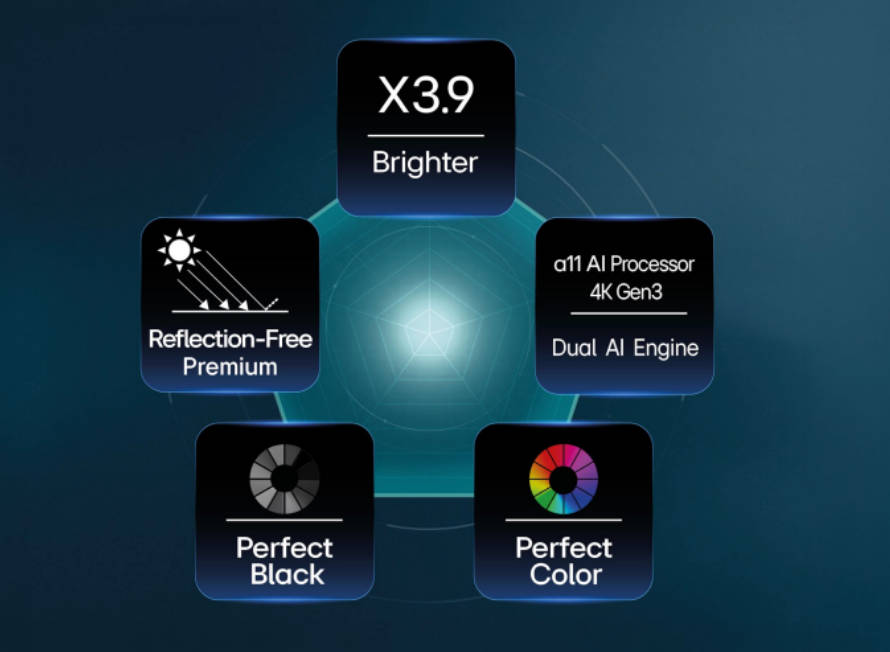
Black is the other half of contrast, and it is where OLED has always had LCD beat. Every pixel on the G6 switches off completely when it needs to show black, so a darkened corner of the frame is genuinely dark rather than a backlit approximation of it. That matters most in scenes with both bright and dark areas at the same time such as a lamp in a dim room. Those scenes reveal the difference between a panel that can hold true black and one that cannot. Perfect Black and Perfect Colour are verified at up to 500 lux, which means that contrast holds in a normally lit room.
Reflections are the practical concern that most panel specifications ignore. The Reflection-Free Premium treatment brings specular reflectance down to under 0.5%. In a room with a window or a ceiling light behind the viewing position, that figure is the difference between seeing the television and seeing yourself in it. This treatment is available across the 55, 65, 77, and 83-inch sizes.
The processor: what the Alpha 11 Gen3 does at every frame
A panel this capable needs a processor that can keep up with it, and the Alpha 11 AI Processor 4K Gen3 with Dual AI Engine is built for exactly that. It manages all 8.3 million individually lit pixels in real time, with 5.6 times faster neural processing, 50% faster CPU performance, and 70% stronger GPU output than its predecessor. The practical consequence of that headroom shows up most clearly when the content being watched was not shot in 4K.

The reality of most streaming libraries is that a significant portion of what people actually watch was never produced in 4K. Putting that content on a 4K panel without good upscaling produces a result that looks soft or artificially sharpened, sometimes both. LG’s AI Picture Pro analyses each frame individually and applies upscaling parameters matched to what is in the scene. A face is treated differently from a stone wall. The result is that content that was never 4K arrives on the G6’s panel looking closer to native 4K than it has any right to, without the halo edges and false texture.
The same problem exists with HDR. Most of what is on streaming platforms was graded for standard dynamic range, because it was produced before HDR became a production consideration. SDR grading compresses shadow detail into flat black and lets highlights blow out, because the displays it was made for could not show the full range anyway. AI HDR Remastering analyses each frame in real time and remaps the luminance toward HDR quality before it reaches the panel, pulling shadow detail back out of the blacks and keeping highlights from losing their colour. The G6’s brightness range is what makes that remapping meaningful because there is enough headroom in the panel to actually show what the processing recovers.
Dolby Vision, FILMMAKER MODE, and what cinema content needs
A film graded in Dolby Vision carries metadata for every scene that tells a capable display exactly how to render the light and colour. The G6 applies that metadata against a panel with the brightness and colour range to act on it accurately. Most of the time that difference is subtle, a slightly more convincing sunset, shadow detail that holds a little deeper into the dark end of the frame, highlights on a white shirt that stay white rather than glowing. Over the course of a film, it adds up to a more convincing image.
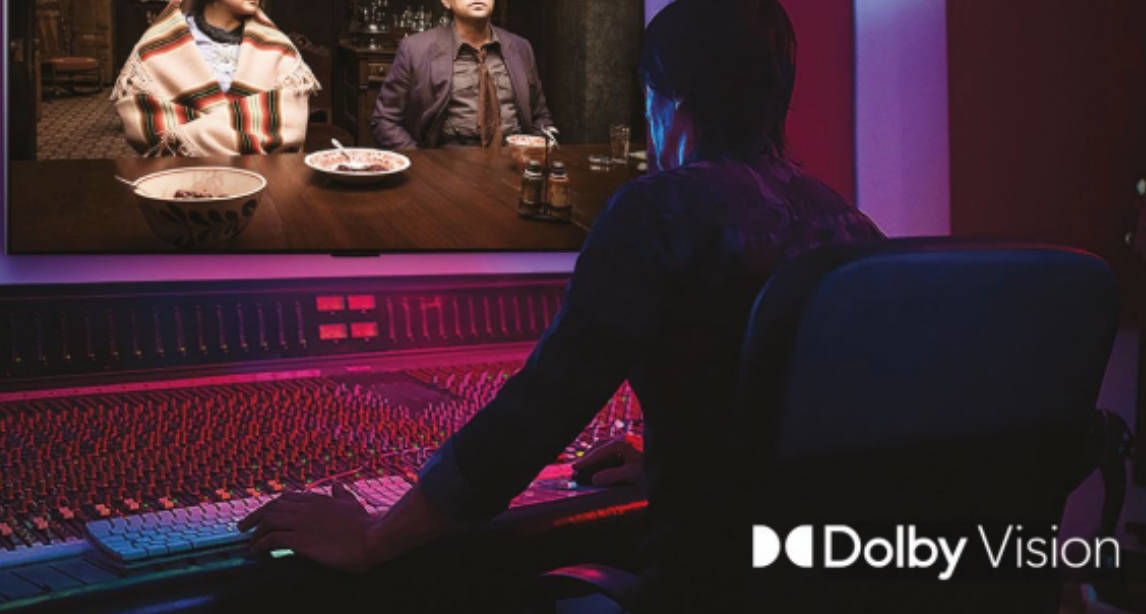
FILMMAKER MODE disables motion smoothing and post-processing so the film looks the way the director graded it. Motion smoothing is the setting that makes films look like they were shot on a video camera rather than in a cinema, and most viewers who notice it find it immediately distracting. FILMMAKER Ambient MODE extends that by using the ambient light sensor to adjust the picture for brighter rooms without the viewer having to touch the settings manually.
The audio runs through a 60W 4.2-channel speaker system that decodes Dolby Atmos. A full physical Atmos setup requires speakers placed above and around the room, typically fourteen or more. The G6 synthesises that spatial information from the audio data itself, creating height and surround from a single unit. Adaptive Acoustic Tuning then reads the acoustics of the room and adjusts the output accordingly. A hard-floored open kitchen and a carpeted bedroom are very different acoustic environments, and the system calibrates itself to each.
Sports and gaming
Cricket or football on a television that is not calibrated for it tends to produce motion blur on fast movement and colours that look slightly off compared to a stadium broadcast. Sports Mode adjusts motion processing for fast movement, shifts colour rendering toward outdoor broadcast conditions, and tunes the audio for crowd noise and live commentary. Cricket Mode goes further with calibration specific to subcontinental broadcast, which has its own lighting and colour temperature characteristics that differ from other sports coverage. Sports Alert sends a notification when a followed match goes live, Sports Tiles keep live scores on the home screen, and Sports Portal pulls feeds, highlights, and league tables into one place.

Gaming on the G6 runs at 4K and 165Hz across the 55, 65, 77, and 83-inch sizes. To put 165Hz in context, most televisions still run at 60Hz, meaning they refresh the image 60 times per second. At 165Hz the G6 refreshes nearly three times as often, which at high frame rates produces motion that is noticeably smoother, particularly in fast-paced games where the difference between 60 and 165 frames per second is visible to most players. Variable refresh rate synchronises the panel’s refresh cycle to whatever the console or PC is outputting, which eliminates the screen tearing that happens when the two fall out of sync. NVIDIA G-Sync and AMD FreeSync Premium cover both major platforms. Input lag at under 0.1ms means the response to a button press is as close to instantaneous as a display can get. Xbox Cloud Gaming and NVIDIA GeForce NOW run natively through the Gaming Portal, with GeForce NOW at 4K 120Hz HDR on NVIDIA’s Blackwell architecture, and Bluetooth Ultra Low Latency keeps wireless controller delay under 3ms.
The AI layer
The G6’s AI features work on top of the panel and processor rather than in place of them. AI Genre Selection detects what is being watched and adjusts the picture automatically: a football match gets stronger motion processing and more saturated colour. The viewer does not need to go into settings when the content changes; the television reads the switch and adjusts accordingly.
AI Picture Wizard handles the more personal layer. It presents pairs of sample images with subtle differences in colour and contrast and the viewer picks the one that looks better across several comparisons. The TV builds a picture profile from those choices and stores it per user, loading it automatically through AI Voice ID when that person starts watching. In a shared household, that means each person gets the picture they actually chose rather than whatever the previous person left the settings on.

For audio, AI Object Remastering Ultra separates the layers within an incoming audio mix, treating dialogue independently from background sound and effects. In a dense action scene or a crowded drama, dialogue and ambience arrive as a single compressed mix, which is why turning up the volume for conversation means bracing for the next loud effect. Separating those layers means speech is clearer without that trade-off. AI Sound Wizard builds a personal listening profile through a short setup and applies it automatically through AI Voice ID, so the right audio settings follow the right person.
Search on webOS 26 integrates Google Gemini and Microsoft Copilot, replacing the title-and-name limitations of standard smart TV search with something closer to a conversation. Ask for a film based on mood, ask what the score is in a match, ask a question about what is currently on screen. LG’s multi-AI architecture received a CES 2026 Innovation Awards Honoree recognition in Artificial Intelligence, and it shows in how differently the search experience works compared to a basic voice assistant bolted onto a content database.
Platform and security
LG Shield covers security across seven layers including software integrity, network encryption, user authentication, and security event monitoring. The webOS Re:New programme commits to platform updates for five years from purchase, which means the television the buyer takes home in 2026 is still receiving new features and security patches in 2031, well past the point where most smart TV platforms stop being maintained. webOS has held the avforums Best Smart TV System award for eight consecutive years. The 2026 LG OLED evo G6 is a television that earns its position through panel technology that changes what OLED brightness looks like and processing that has the headroom to apply that capability at every frame. Thirteen years of leading the OLED category, and the LG G6 still has somewhere new to go.
This is a promotional post done as part of a brand collaboration.