Samsung Galaxy S26 Ultra vs iPhone 18 Pro Max: Which Flagship Should You Buy?


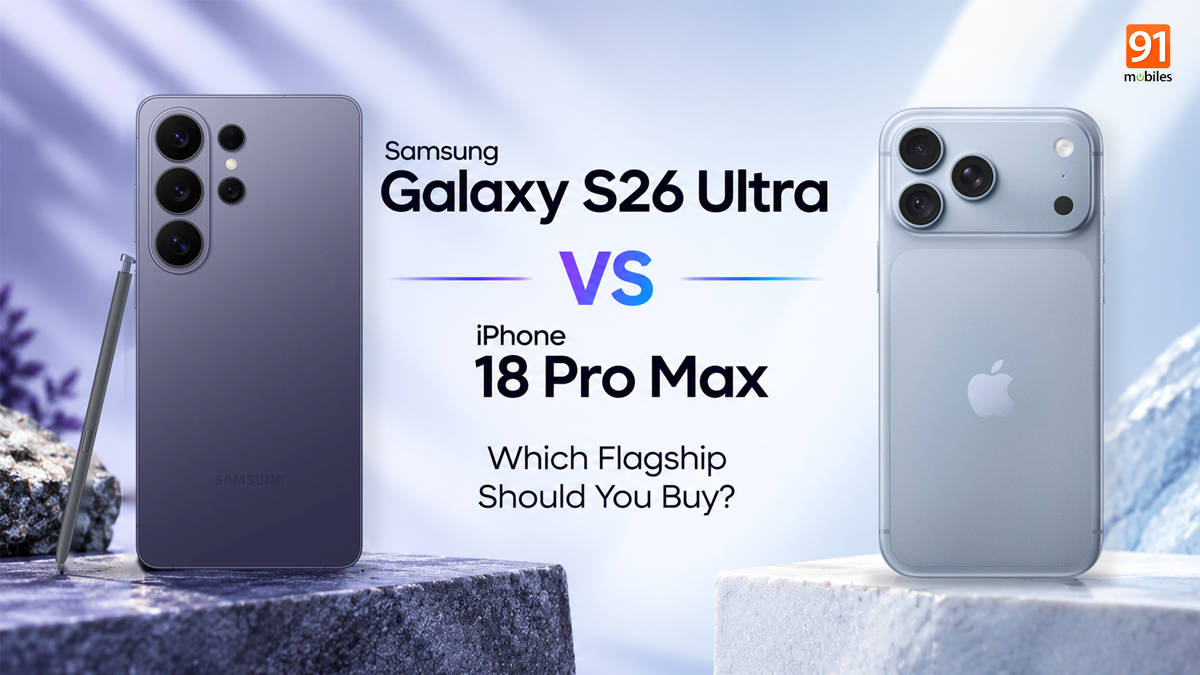
At the very top of the smartphone market, the choice usually comes down to two phones. This year, they are Samsung’s Galaxy S26 Ultra, with the world’s first built-in Privacy Display for mobile phones, and Apple’s iPhone 18 Pro Max, which comes with the new A20 Pro chip and a main camera with variable aperture. Both are fast, both are beautifully made, and both are built to last for years.
On paper, the two are closer than ever. Day to day, though, they suit different people, and the differences show up in ordinary moments: opening a banking app at a crowded counter, zooming in on a stage from the back row, or signing a document on the go. As you are about to spend a lot of your hard-earned money on your next daily driver, you would want to be absolutely sure what you’re getting into. Don’t worry, we’re here to help. Here, we will go over the key differentiators between the two phones and let you know which phone you should go for, depending on your needs.
Table of Contents
Galaxy S26 Ultra vs iPhone 18 Pro Max: Key Specifications
| Galaxy S26 Ultra | iPhone 18 Pro Max |
Display | 6.9-inch QHD+ AMOLED, 1Hz to 120Hz, 2,600 nits, Privacy Display | 6.9-inch OLED, ProMotion up to 120Hz, 3,000 nits outdoor |
Processor | Snapdragon 8 Elite Gen 5 for Galaxy | A20 Pro |
RAM and storage | 12GB with 256GB or 512GB, 16GB with 1TB | 256GB, 512GB, 1TB, or 2TB storage |
Rear cameras | 200MP main, 50MP ultra-wide, 50MP 5x, 10MP 3x | 48MP main with variable aperture, 48MP ultra-wide, 48MP 4x |
Zoom | 3x and 5x optical, up to 100x Space Zoom | 4x optical, 8x optical-quality, up to 40x digital |
Front camera | 12MP | 18MP Centre Stage |
Video | Up to 8K at 30fps, 4K at 120fps, APV codec | Up to 4K at 120fps, ProRes RAW, Apple Log 2 |
Battery | 5,000mAh, up to 31 hours of video playback | Up to 43 hours of video playback |
Charging | 60W wired, 25W wireless, Wireless PowerShare | Fast wired, plus 25W wireless via MagSafe or Qi2 |
Stylus | Built-in S Pen | Doesn’t support stylus |
Build | Aluminium frame, IP68, 7.9mm, 214g | Aluminium unibody, IP68, 8.75mm, 249g |
Software | Android 16 (One UI 8.5) at launch, seven OS upgrades, seven years of security updates | iOS 27 at launch |
Design: Slimmer, Lighter Body
The Galaxy S26 Ultra and the iPhone 18 Pro Max both have 6.9-inch screens, but the Galaxy is the slimmer and lighter phone, at 7.9mm and 214g against 8.75mm and 249g, even though it houses an S Pen. That is 35g less to carry for the same canvas, whether you are reading a long PDF, working on a spreadsheet, or running two apps side by side, and you feel the difference during long calls or when you hold the phone up to shoot a video.
Samsung pairs an aluminium frame with Corning Gorilla Armor 2 on the front, while the iPhone 18 Pro Max uses an aluminium unibody with Ceramic Shield 2. Both are rated IP68, so monsoon showers are no worry for either. With the same screen size, the Galaxy’s slimmer, lighter body makes it the more comfortable phone to hold and carry through a long day.
Display: Privacy Display Gives the Galaxy S26 Ultra a Clear Edge
Imagine opening your banking app at a busy billing counter, or reading a work email on a packed metro with someone glancing at your screen. That is the moment the S26 Ultra’s Privacy Display was made for. It limits how much of the screen people can see from the side, without the need for a separate screen protector. You can switch it on from the Quick Panel or with a double press of the side button, and choose whether it covers the whole screen, selected apps, notification pop-ups, or PIN and password entry. The iPhone 18 Pro Max does not offer anything similar.
Beyond privacy, the 6.9-inch QHD+ Dynamic AMOLED 2X panel is a sharper canvas for streaming, reading, and editing photos, adapting from 1Hz to 120Hz and peaking at 2,600 nits. Apple has claimed a higher outdoor peak of 3,000 nits for the iPhone 18 Pro Max, but both phones have anti-reflective displays, and in our use, the S26 Ultra’s screen, helped by Vision Booster, is easy to read when you check directions even in the afternoon sun.
Flagship Camera Comparison: The Galaxy S26 Ultra Zooms Further
From the back row of a concert, the stands at a cricket match, or a jeep on a wildlife safari, the thing you want to photograph is rarely close. This is where the S26 Ultra pulls ahead. It has two telephoto cameras, a 10MP 3x and a 50MP 5x. With the main camera, they deliver optical-quality zoom at 2x and 10x, and Space Zoom reaches up to 100x. The iPhone 18 Pro Max has a single 48MP 4x telephoto, with 8x optical-quality zoom and up to 40x digital zoom. If you often shoot from a distance, the Galaxy simply gives you more reach.
The main camera tells a similar story. The S26 Ultra’s 200MP sensor sits behind a wider f/1.4 aperture, which Samsung says brings 47 per cent better brightness than on the S25 Ultra, so night markets, Diwali lights, and candlelit dinners come out brighter. All that resolution also leaves room to crop into a group photo later while keeping plenty of detail. Apple’s big camera upgrade this year is a variable aperture on the iPhone 18 Pro Max’s 48MP main camera, a welcome tool that will matter most to people who like manual control.
Video and selfies are where Apple pushes back. The iPhone 18 Pro Max has an 18MP Centre Stage front camera and pro tools such as ProRes RAW, Apple Log 2, and genlock, which matter most if you film professionally, especially with several cameras. For everyone else, the Galaxy S26 Ultra holds its own, recording 8K video at 30fps and 4K at 120fps, and it is the first Galaxy phone to support the professional-grade APV codec. Super Steady with Horizontal Lock keeps footage level even if you rotate the phone a full 360 degrees, which is handy when filming from a moving auto-rickshaw. Samsung has also extended its improved AI image processing to the 12MP selfie camera for more natural skin tones. The iPhone 18 Pro shares the same camera system as the iPhone 18 Pro Max, so this comparison holds for both models.
Nightography Video: Galaxy S26 Ultra vs iPhone 18 Pro Max
Night-time is the real test for video, whether it is a baraat after dark or a concert crowd, and this is where the Galaxy S26 Ultra pulls ahead. Its Nightography Video pairs a wider f/1.4 main aperture with improved noise reduction for clean, detailed low-light footage, while the 50MP 5x telephoto gets a brighter f/2.9 aperture for zoomed-in night shots. The iPhone 18 Pro Max’s variable aperture opens to f/1.48 at its widest, a touch narrower than the Galaxy’s f/1.4, and it has a single 4x telephoto.
| Galaxy S26 Ultra | iPhone 18 Pro Max |
Main camera aperture | f/1.4 (200MP) | f/1.48 to f/4.0 variable (48MP) |
Low-light video | Nightography Video | Improved low-light video, with automatic aperture and frame rate adjustment |
Telephoto | 50MP 5x at f/2.9, plus 10MP 3x | 48MP 4x |
Maximum video | 8K at 30fps, 4K at 120fps | 4K at 120fps |
Stabilisation | Super Steady with Horizontal Lock | Ultra-stabilised video |
Pro video tools | APV codec, log video recording | ProRes RAW, Apple Log 2, genlock, Pro controls |
For night video, the Galaxy S26 Ultra is the clear pick: a wider main aperture, a brighter telephoto, and 8K recording, all working automatically so you get great low-light clips without fiddling with settings. The iPhone 18 Pro Max suits those who want manual control and pro formats such as ProRes RAW and Apple Log 2.
Performance: Flagship Speed That Stays Cool
The S26 Ultra runs on the Snapdragon 8 Elite Gen 5 for Galaxy, a 3nm chip that Samsung says delivers up to 19 per cent better CPU performance, 24 per cent better graphics, and 39 per cent faster AI performance than the S25 Ultra’s. Apple’s A20 Pro is built on a newer 2nm process, and Apple says its CPU is faster than the competition.
At this level, though, sustained speed matters more than peak numbers. Both use vapour chambers to manage heat, and the S26 Ultra gets Samsung’s largest yet, with 21 per cent better thermal performance than the S25 Ultra. That helps in long gaming sessions or a 4K video export. Its 12GB of RAM, or 16GB on the 1TB model, also leaves plenty of headroom for split-screen multitasking.
Galaxy AI vs Apple Intelligence
Galaxy AI on the S26 Ultra is built around small, everyday wins. When a friend asks for last weekend’s trip photos in a chat, Now Nudge picks up on the context and can suggest them right there. Spot an outfit you like in a reel, and Circle to Search with Google can find several items from it at once. Photo Assist lets you edit a picture by simply describing the change in your own words, in any of 41 languages. You also get a choice of AI agents, including Gemini and Perplexity, and Tailored Controls let you decide whether your requests are processed on the device or in the cloud. Samsung says its basic Galaxy AI features are free.
Apple has made progress too. Siri AI is a new, more conversational version of Siri, and features such as Visual Intelligence, Clean Up, and Writing Tools are all on board. However, Siri AI is still in beta and starts in English only, so for now, Galaxy AI offers the broader and more mature set of tools.
How Do Battery Life and Charging Compare Between the Two Phones?
On paper, the iPhone 18 Pro Max has the lead in battery life, while the Galaxy S26 Ultra adds the flexibility of reverse wireless charging. A wedding that runs past midnight, a day of meetings across the city, or a weekend trip on Google Maps is what really tests a battery. The S26 Ultra’s 5,000mAh battery is rated for up to 31 hours of video playback, and in our use, it comfortably lasts over a day. The iPhone 18 Pro Max is rated for up to 43 hours of video playback, but both phones will see you through a full day of use.
When you need a quick top-up, both phones charge quickly with a suitable adapter. Samsung’s 60W wired charging takes the S26 Ultra to 75 per cent in around 30 minutes with a 60W adapter, roughly the time it takes to get ready in the morning, while Apple has claimed up to 50 per cent in around 15 minutes for the iPhone 18 Pro Max with a 60W-capable adapter. Both phones also support 25W wireless charging. Notably, Wireless PowerShare on the Galaxy S26 Ultra lets you charge your earbuds from the back of the phone on a long flight, while iPhone 18 Pro Max does not feature reverse wireless charging.
Beyond the Spec Sheet: S Pen, DeX, and Quick Share
The S Pen is still the S26 Ultra’s most underrated feature. It lives inside the phone, so it is always there when you need to sign a PDF, mark up a screenshot for a colleague, or note down a number in the middle of a call. The iPhone 18 Pro Max has no built-in stylus. Samsung DeX goes a step further, turning the phone into a desktop-style workspace when you connect it to a monitor, which is handy in a hotel room or when your laptop is in for repair.


And if your friends and family use iPhones, sharing is no longer a hurdle. Quick Share on the Galaxy S26 series now works with AirDrop, so you can send and receive photos, videos, and files with iPhones, iPads, and Macs. That removes one of the most common worries about switching from an iPhone.
Which Ecosystem Should Influence Your Choice Between These Phones?
The devices you already own should weigh heavily on this decision. If your laptop is a MacBook, you wear an Apple Watch, and you use AirPods, the iPhone 18 Pro Max will slot into that setup most naturally, especially as an Apple Watch only works with an iPhone.
Samsung’s ecosystem, though, has grown into a strong alternative, and it is far more open. The Galaxy S26 Ultra is designed to work with Galaxy Watch, Galaxy Buds, Galaxy Tab, and Galaxy Book devices, and Samsung’s Knox Matrix extends security across connected Galaxy devices.
Beyond Samsung, Android works with a wide range of smartwatches, earbuds, and Windows PCs, and with Quick Share now working with AirDrop, sharing with friends on iPhones, iPads, and Macs is no longer a barrier. Unless you are deeply invested in Apple’s devices, the Galaxy S26 Ultra gives you more freedom to mix and match.
Software Updates: Samsung Puts a Number on It
If you keep phones for years or hand them down to family, long-term support matters. The S26 Ultra launched with Android 16 and One UI 8.5, and Samsung has already begun rolling out One UI 9 to the S26 series. It also promises seven generations of OS upgrades and seven years of security updates.
Apple ships the iPhone 18 Pro Max with iOS 27, but it does not publish a fixed number of years of support. Samsung’s written promise makes planning ahead much easier.
Galaxy S26 Ultra vs iPhone 18 Pro Max: Pricing and Feature Variations
Price is where the difference between the two is hardest to ignore. The Galaxy S26 Ultra launched in India at ₹1,54,999 for the 12GB and 256GB model, while the iPhone 18 Pro Max starts at ₹1,79,900 for 256GB, nearly ₹40,000 more. That makes the S26 Ultra the more affordable of the two, even though it offers a higher-resolution screen of the same size a built-in S Pen, and two telephoto cameras. These are launch prices, and current prices may vary. During the festive offers, however, the S26 Ultra’s effective price drops to ₹79,999, after applying ₹15,000 instant cashback and the exchange value of your old flagship device. Samsung also offers 40 months of No Cost EMI on the S26 Ultra.
How the features change across variants matters too. The S26 Ultra comes with 12GB of RAM and 256GB or 512GB of storage, or 16GB of RAM with 1TB, so the top model adds more memory as well as space, which helps heavy multitaskers. Every variant gets the same cameras, S Pen, and Privacy Display, so you do not need the most expensive model to get the full experience. Apple sells the iPhone 18 Pro Max in 256GB, 512GB, 1TB, and 2TB versions, and it weighs 249g against the S26 Ultra’s 214g.
Advantages of the Galaxy S26 Ultra Over the iPhone 18 Pro Max
Samsung’s advantages over the iPhone 18 Pro Max start with the screen. Both phones have 6.9-inch displays, but the S26 Ultra’s QHD+ panel has a higher resolution than the Pro Max’s 2868 x 1320, and only the Galaxy has Privacy Display. It is also slimmer and much lighter, at 7.9mm and 214g against 8.75mm and 249g, which makes a real difference during long calls or when you hold the phone up to shoot a video.
The Galaxy S26 Ultra offers two telephoto cameras and 100x Space Zoom against Apple’s single 4x telephoto and 40x digital zoom, along with a 200MP main camera, 8K video, a built-in S Pen, Wireless PowerShare, and a seven-year update promise, all at a lower launch price. The Pro Max’s clearest win is battery life, with Apple rating it for up to 43 hours of video playback, so if that matters more than anything else, it is worth a look.
Galaxy S26 Ultra vs iPhone 18 Pro Max: Which Should You Buy?
Both are outstanding phones, and neither is a bad choice. The iPhone 18 Pro Max makes the most sense if your life already runs on a Mac, an Apple Watch, and AirPods; if you shoot professional video with multiple cameras; or if battery life matters most to you.
For most people, though, the Galaxy S26 Ultra is the more complete flagship. It gives you a higher-resolution screen that can hide itself from prying eyes, much more zoom, a built-in S Pen, a broader set of AI tools, and a seven-year update promise, all in a body that is slimmer and lighter than Apple’s. In our view, it is the phone that does more for you every day.
With the festive offers, the Galaxy S26 Ultra is also the easier one to afford right now: an effective price of ₹79,999 after ₹15,000 instant cashback and the exchange value of your old flagship device, along with 40 months of No Cost EMI.
FAQs
Which has the better camera, the Galaxy S26 Ultra or the iPhone 18 Pro Max?
For most people, the Galaxy S26 Ultra, thanks to its 200MP main camera, two telephoto lenses, and Space Zoom up to 100x. The iPhone 18 Pro Max is stronger for professional video and selfies.
What is Privacy Display on the Galaxy S26 Ultra?
It is a built-in feature that limits how much of the screen others can see from the side. You can apply it to the whole screen or only to selected apps, notifications, or PIN entry.
Can the Galaxy S26 Ultra share files with an iPhone?
Yes. Quick Share on the Galaxy S26 series now works with AirDrop for photos, videos, and files.
How many years of updates will the Galaxy S26 Ultra get?
Samsung promises seven generations of OS upgrades and seven years of security updates for the Galaxy S26 Ultra.
Which is better, the iPhone 18 Pro Max or the Galaxy S26 Ultra?
For most people, the Galaxy S26 Ultra. It matches the Pro Max’s 6.9-inch screen size with a higher-resolution QHD+ panel and Privacy Display, and adds an S Pen and longer zoom in a lighter body that costs less at launch. The iPhone 18 Pro Max is the better pick if battery life, pro video tools, or Apple’s ecosystem matter most to you.
Which phone offers better overall performance?
Both phones use top-tier flagship chips. Apple says the A20 Pro’s CPU is faster than the competition, while the Galaxy S26 Ultra pairs the Snapdragon 8 Elite Gen 5 for Galaxy with up to 16GB of RAM and Samsung’s largest vapour chamber yet. Taking the screen, cameras, multitasking, and S Pen into account, the Galaxy S26 Ultra offers the more complete overall package.
Which phone is better for night video, the Galaxy S26 Ultra or the iPhone 18 Pro Max?
For most people, the Galaxy S26 Ultra, thanks to its f/1.4 main camera, Nightography Video with inbuilt color grading, a brighter 5x telephoto, and 8K recording. However, if you want to manual aperture and shutter control, and formats such as ProRes RAW and Apple Log 2 to grade night footage color grade the footage externally, then you can consider iPhone 18 Pro Max.
What is the effective price of the Galaxy S26 Ultra during the festive offers?
The effective price is ₹79,999, calculated after applying ₹15,000 instant cashback and the exchange value of an old flagship device.
Does the Galaxy S26 Ultra come with No Cost EMI?
Yes. Samsung offers 40 months of No Cost EMI on the Galaxy S26 Ultra.