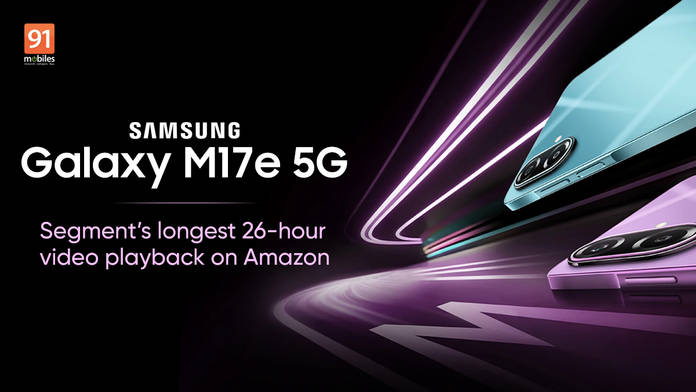
Battery claims in the budget smartphone segment are often wrapped in broad language. “All-day use” and “weekend-ready” sound reassuring, but they rarely explain what a phone can actually sustain under a single workload. On Amazon’s under ₹14,000 shelf, the Samsung Galaxy M17e 5G takes a more direct approach. It puts a concrete number forward – 26 hours of continuous offline video playback on a single charge, verified through a controlled in-house test conducted by the 91mobiles TestLab. That difference matters. In a segment where small capacity gaps and loosely defined testing can shift perception, a measurable result carries weight, showing the true potential of the Galaxy M17e 5G.
At a hardware level, the phone combines a 6000mAh battery, a 6.7-inch HD+ LCD display, the MediaTek Dimensity 6300 platform, 4GB or 6GB RAM, 128GB storage with microSD expansion up to 2TB, and Android 16 with One UI 8.0. This combination is tuned for power efficiency during prolonged video playback, and that tuning holds up under disciplined evaluation.
How the 26-hour result was measured
To evaluate single-charge video endurance, the 91mobiles TestLab conducted an offline video loop test designed to reflect realistic binge viewing rather than synthetic stress. The Galaxy M17e 5G was first charged to 100%. A 720p video file was then played continuously through the phone’s default gallery app. Playback continued without interruption until the device shut down automatically as the battery drained completely.
The test environment was tightly controlled to remove variables that often distort battery impressions. Room temperature was maintained at 21 degrees Celsius. Screen brightness was locked at 30% to reflect comfortable indoor viewing. Audio volume was fixed at 50%. All network communications were disengaged. The phone remained in Aeroplane mode throughout, with mobile data, Wi-Fi, Bluetooth, GPS, and SIM activity fully disabled. Under these defined conditions, the fully charged Samsung Galaxy M17e 5G sustained 26 hours of continuous video playback before powering off. The test concluded only when the device shut itself down, ensuring the entire usable battery capacity was exercised rather than estimated.
Why offline playback and 720p matter
Two thoughtful design-led choices strengthen the credibility of this result. The first is offline playback. By storing the video locally instead of streaming it, the test highlights how efficiently the Galaxy M17e 5G handles video without the added variability of cellular or Wi-Fi radios. This keeps power consumption focused on the display, chipset, storage, and audio pipeline, and closely reflects how people actually watch downloaded shows and movies during travel, daily commutes, or in areas with inconsistent network coverage. These are precisely the scenarios where uninterrupted playback delivers the most value.
The second choice is resolution. Running the loop at 720p allows the Galaxy M17e 5G to play long-form content while keeping decoding workload and memory bandwidth demands low, striking a practical balance between visual comfort and efficiency on a smartphone display. Rather than being an artificial setup, this mirrors real viewing habits in the budget segment, where users prioritise sustained playback and reliability over unnecessary processing overhead.
Display configuration and efficiency
The Galaxy M17e 5G features a 6.7-inch HD+ LCD display with a 720 x 1600 resolution, 260 PPI pixel density, and support for a 120Hz refresh rate. During the endurance test, brightness was set at 30% and auto-brightness was turned off to maintain a consistent, comfortable viewing level across the entire playback cycle. This ensured the display operated in a stable, predictable manner over extended hours.
While the panel is capable of 120Hz for everyday smooth interactions, long-form video playback naturally operates within standard frame rates. Aligning the display refresh behaviour with typical video output allowed the Galaxy M17e 5G to deliver smooth motion without unnecessary power overhead. The HD+ resolution further strengthens this approach by reducing the number of pixels that need to be refreshed each frame. Over a 26-hour playback window, this efficiency adds up significantly. The end result is a large screen that remains comfortable for long viewing sessions while supporting sustained battery performance rather than constraining it.
Battery, chipset, and storage synergy
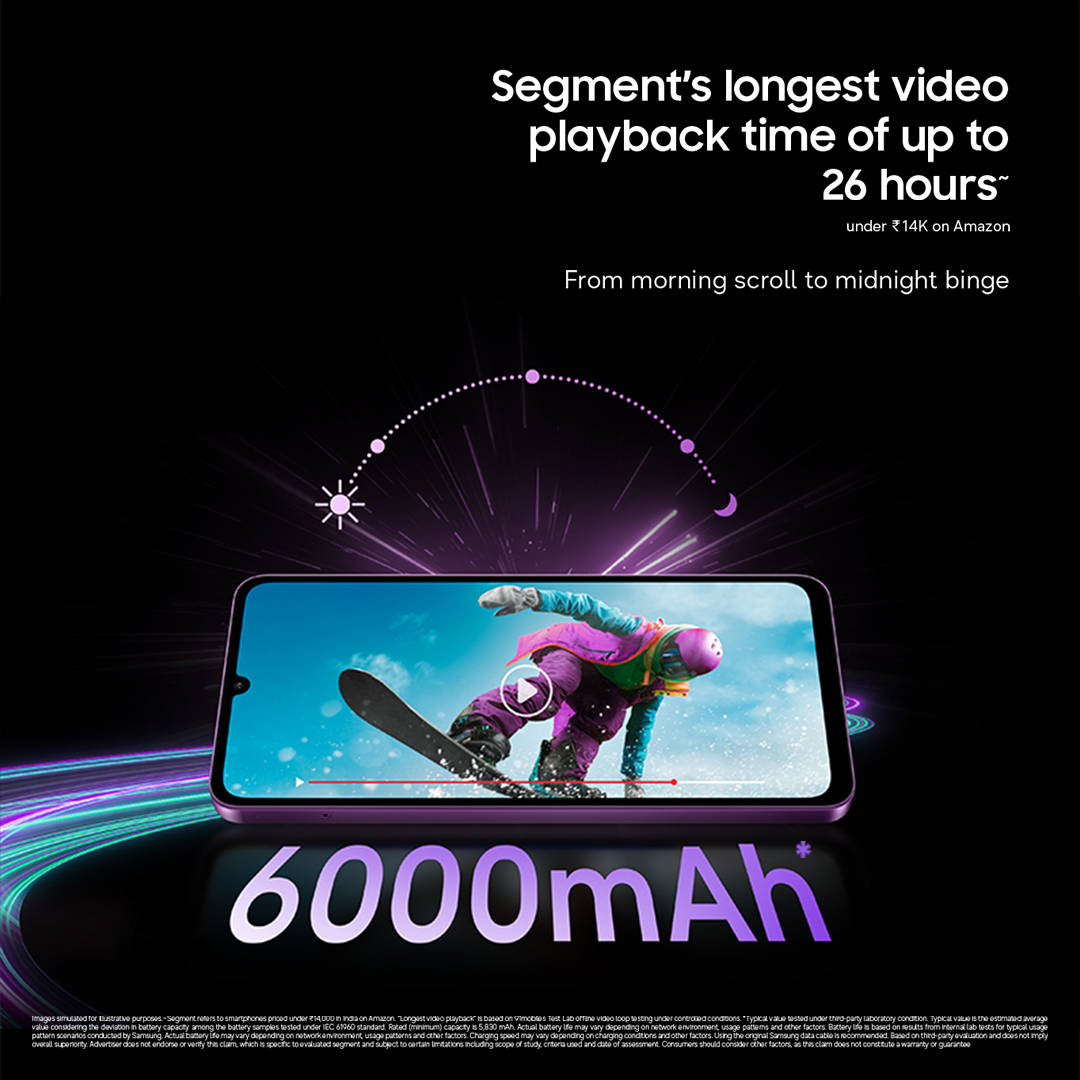
At the centre of the claim is the 6000mAh battery, paired with 25W fast charging for practical recovery once depleted. Capacity alone does not guarantee endurance as efficiency determines whether that capacity translates into real hours. The MediaTek Dimensity 6300 is designed with dedicated video decoding blocks that handle common formats without leaning heavily on general-purpose CPU cores. During the 720p playback loop conducted by the 91mobiles TestLab, decoding behaviour remained stable and predictable and kept power draw low and heat output controlled throughout the test. Over extended sessions, this consistency mattered more than short bursts of peak performance. Storage also contributes to this endurance profile. With 128GB of internal capacity and microSD expansion support up to 2TB via a hybrid SIM slot, users can maintain large offline libraries. During testing, efficient local file access avoided the overhead introduced by streaming and closely mirrored real-world viewing habits, aligning practical usage with the conditions under which the 26-hour playback result was established.
Eliminating hidden drains
In everyday use, battery performance is often shaped by background activity such as notifications, sync processes, and constantly scanning radios. To understand the Galaxy M17e 5G’s true endurance potential, the 91mobiles TestLab structured the evaluation to highlight the hardware at its most efficient. During testing, the device was kept in Aeroplane mode, allowing playback performance to be measured without interference from background network activity. Audio output was fixed at a realistic 50% volume, ensuring the results reflected normal listening habits rather than artificially muted conditions. The test environment was maintained at a steady 21 degrees Celsius, which helped avoid both cold-related inefficiencies and heat-induced throttling. Together, these controlled parameters produced a stable endurance profile that can be consistently reproduced, thereby reinforcing the credibility of the 26-hour playback result.
Why the claim holds on Amazon
Within the Amazon under ₹14,000 segment, the Galaxy M17e 5G earns its position as the smartphone with the longest offline video playback through clearly documented fundamentals. Its 6000mAh battery provides the scale needed for extended viewing and the HD+ display is configured for efficiency rather than excess. In addition, the MediaTek Dimensity 6300 handles video playback through hardware-accelerated decoding, keeping power draw stable over long sessions. And crucially, the 26-hour figure was established through a controlled, in-house endurance test conducted by the 91mobiles TestLab, with brightness, audio, network activity, and temperature carefully managed to ensure repeatability and transparency.
The 26-hour result highlights the Galaxy M17e 5G’s video playback capability at its most efficient, established through controlled testing by the 91mobiles TestLab. While everyday usage naturally layers in notifications, connectivity, and multitasking, this benchmark clearly defines the performance ceiling the hardware is engineered to reach. That clarity is valuable on an Amazon listing page, where buyers often have to choose between competing promises without a clear reference point.
What sets the Samsung Galaxy M17e 5G apart is that its endurance story is anchored in a verifiable outcome. The combination of a 6000mAh battery, an efficiency-focused display, and hardware-accelerated media handling translates into real, measurable playback time. For users who prioritise uninterrupted viewing on commutes or offline libraries, the Galaxy M17e 5G stands as a phone that delivers confidence through proof and not projection.