
Movie |
Uncle Nephew Relationship | Based On Novel Or Book
Disclaimer: All content and media belong to original content streaming platforms/owners like Netflix, Disney+ Hotstar, Amazon Prime Videos, JioCinema, SonyLIV etc. 91mobiles entertainment does not claim any rights to the content and only aggregate the content along with the service providers links.

Top Ten Films | 1958
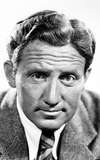
Best Actor For | 1958 | Spencer
Best Director | 1958 | John
Best Actor | 1958 | Spencer
Best Foreign Actor | 1959 | Spencer
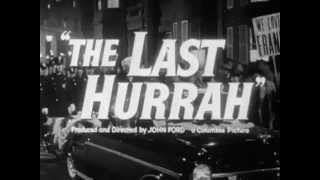
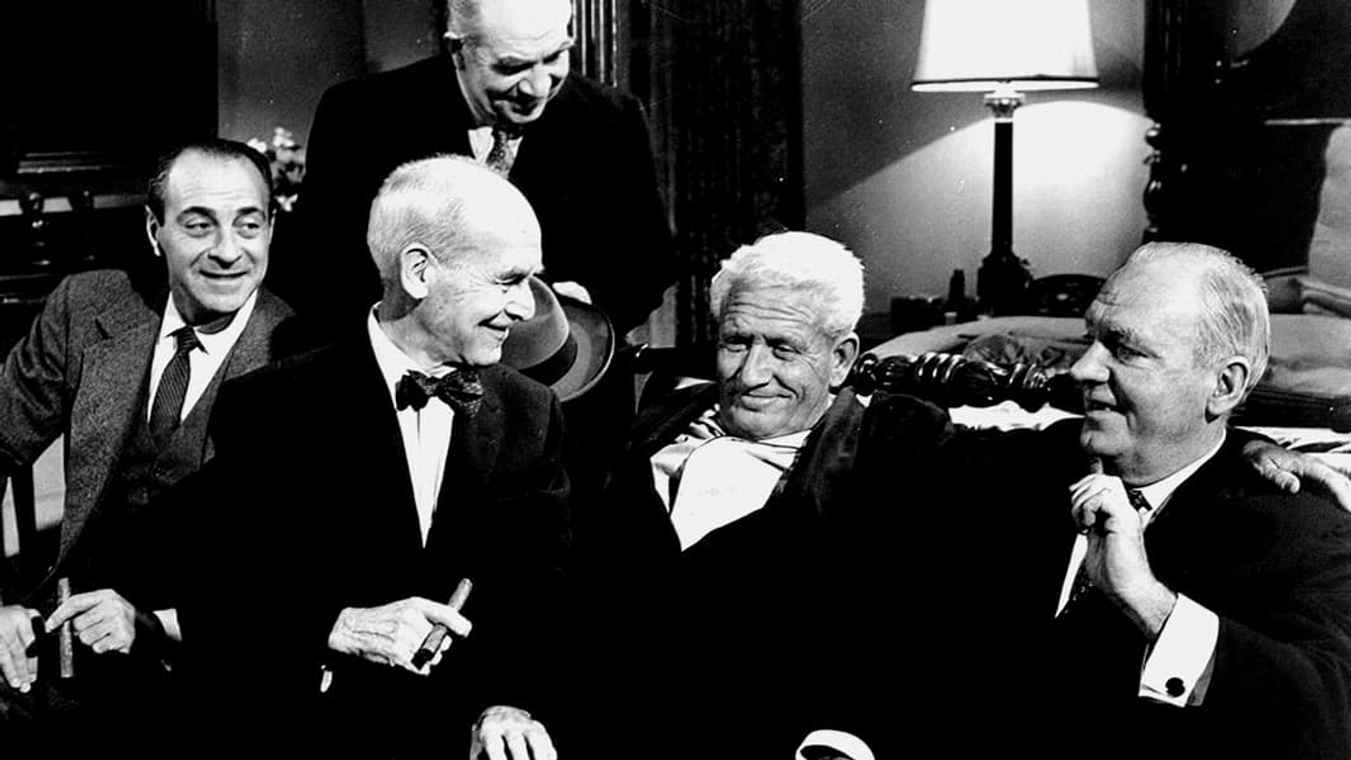
Orson Welles was John Ford's original choice to play Frank Skeffington, but Welles either lost or refused the part after Ward Bond, a Ford friend and an ultra-conservative Republican, publicly questioned Welles' loyalty to the U.S., as Welles was well known as a progressive Democrat. Ford was furious with Bond, since Welles and Ford were fans of each other's work.
Edwin O'Connor's 1956 novel The Last Hurrah, on which the movie is based, is a fictionalized version of former Boston mayor James Michael Curley, a celebrated rogue who raised municipal corruption to an art form. Curley tried to stop production, not because he was being negatively depicted, but because he believed the film would prevent Hollywood from making a biographical film of his life the way he wanted it done. Curley died at age 83 in 1958, the year the film was released. He had last served as mayor from 1946-50. Skeffington also says that he was several times mayor of " . . . this great city, and governor of the state", even though the name of the city and state are never revealed.
Early in the film one of Skeffington's advisors says of another candidate 'an Arab would have a better chance of becoming Mayor of Tel Aviv', and Skeffington says 'remember the recent Lord Mayor of Dublin'. This is a reference to the 1956 election of Robert Briscoe, the first Jewish Lord Mayor of Dublin. He was the son of Lithuanian-Jewish immigrants and after the second World War acted as a special advisor to Menachem Begin in the transformation of Irgun from a paramilitary group into a political movement and later into the Likud party.
A large exterior set of "Boston row houses" was constructed on the Columbia (now Warner Bros.) Ranch in Burbank for this film. Most of it burned down in 1974 but the Skeffington house survived.
Early in the film Skeffington says that his signature will never be as valuable as Button Gwinnet's, who apparently had publicly signed few documents in his life. Gwinnet, a delegate from Georgia, was the second signer of the Declaration of Independence, after John Hancock. Gwinnet's signature is quite rare and is considered the most valuable American signature by collectors, with sales recorded as high as $150,000, matched or exceeded only just behind signatures of Gaio Giulio Cesare (aka Julius Caesar) and William Shakespeare. However, it is not quite so rare as suggested by Skeffington, as there are at least 51 examples of Gwinnet's signature known to exist, and at one time during the 1920s five samples of his signature were owned by a dealer in rare books named Rosenbach.
"Roger Sugrue: [standing by Skeffington's bed] Well, at least he made his peace with God. There's one thing we all can be sure of - if he had it to do over again, there's no doubt in the world he would do it very, very differently. Mayor Frank Skeffington: [opening his eyes] Like hell I would."
"Mayor Frank Skeffington: One more regret at my age won't make much difference."