The numbers have confirmed what we knew all along. Buying an affordable smartphone in India has become more expensive this year. Phones priced below Rs 10,000 have faced the sharpest price increases, while shipments in the segment fell 65 percent year-on-year in the first half of 2026, as per a report by Counterpoint Research. Amidst these pressures, OnePlus has kept its average price hikes lower than the industry average, potentially helping it remain competitive as buyers become more conscious of what they spend.
Budget smartphones hit hardest
Smartphone prices in India increased by 16 percent on average in H1 2026, according to Counterpoint. The rise comes as manufacturers grapple with higher DRAM and NAND memory costs, driven partly by demand from AI data centres, alongside a weaker rupee that has made imported components more expensive. India’s average smartphone selling price reached a record USD 318 (around Rs 30,500) in Q2 2026, compared to USD 294 (around Rs 24,500 at that time) in 2024.
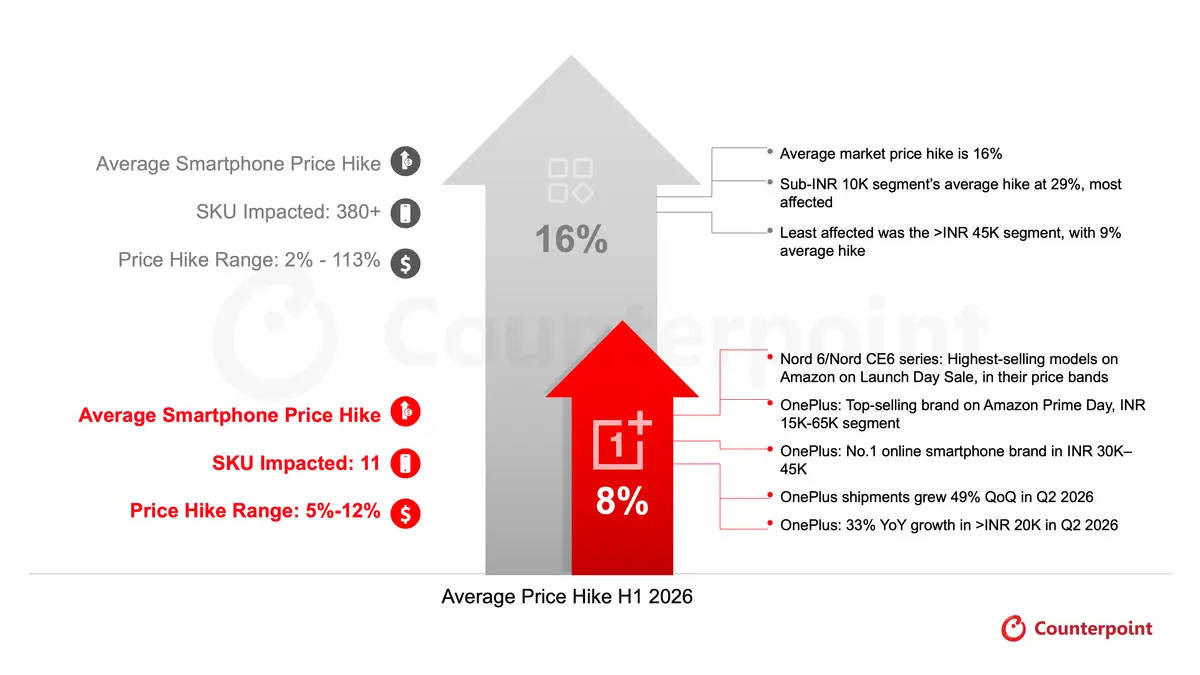
The impact has been uneven. The sub-Rs 10,000 segment recorded the steepest average price increases, while shipments fell 65 percent year-on-year. The Rs 10,000 – Rs 15,000 segment also saw shipments decline by 20 percent. Meanwhile, phones priced above Rs 20,000 continued to grow, supported by higher launch prices, trade-in offers and no-cost EMI schemes.
OnePlus raised smartphone prices by 8 percent on average in H1 2026, compared with the industry’s 16 percent, Counterpoint said. Its steepest individual price increase was 12 percent, while the highest increase recorded among other brands reached 113 percent. Counterpoint attributes the smaller hikes partly to OnePlus securing components earlier, when memory prices were lower, and maintaining a broad portfolio of nine smartphone models priced between roughly Rs 16,999 and Rs 93,999. This gives the company more room to distribute cost pressures across different price segments.
This coincided with stronger shipments. OnePlus shipments grew 49 percent quarter-on-quarter in Q2 2026, and the brand was the top-selling smartphone brand on Amazon Prime Day in the Rs 15,000 – Rs 65,000 segment, according to the company. Counterpoint also ranked it first on online channels in the Rs 30,000 – Rs 45,000 segment.
Counterpoint expects OnePlus shipments to grow 5 percent year-on-year in Q3 2026, while the overall smartphone market is projected to decline by double digits. However, this is a forecast, and sustained growth will depend on demand and how component costs evolve.
OnePlus’s relatively smaller price increases make its phones worth comparing with rivals, but that alone doesn’t make every model a better deal. Check current street prices, specifications and software support before buying. Those shopping below Rs 15,000 should pay particular attention to older models and ongoing discounts, which may offer a way to avoid paying the full price of newer launches.