When it comes to entry-level smartphones, most users know what to expect: lacking hardware, cluttered software, and more often than not, sluggish day-to-day performance. But that is not always the case, especially not with the Lava Storm Play. True to its name, the phone is aiming to take the budget segment by storm, focusing on what matters: raw, uncompromised performance. In this overview, we’ll look at how the MediaTek Dimensity 7060 helps position the Lava Storm Play as one of the fastest phones in its class.
Table of Contents
Exceptional power with the MediaTek Dimensity 7060
Here’s a quick breakdown of the hardware onboard:
- Processor: MediaTek Dimensity 7060
- CPU Cores: 2x Arm Cortex-A78 @ 2.6GHz + 6x Arm Cortex-A55 @ 2.0GHz
- GPU: IMG BXM-8-256
- RAM Type: 6GB LPDDR5
- Storage Type: 128GB UFS 3.1
The Lava Storm Play is the first smartphone in India to feature MediaTek’s new Dimensity 7060 SoC. This octa-core chipset is built on a modern 6nm architecture and clocks up to 2.6GHz. The core setup includes two high-performance Cortex-A78 cores at 2.6GHz, and six Cortex-A55 efficiency cores at 2.0GHz. What you get is a well-balanced chipset that knows when to deliver and when to dial back for battery efficiency.
One of the biggest pain points with affordable smartphones is the laggy experience. Apps tend to load slowly, there are stutters while switching, and the whole experience just feels choppy. A lot of that comes down to compromised hardware like slower RAM or storage types.
That is exactly where the Lava Storm Play really stands apart from its peers. Even the base variant gets 6GB of LPDDR5 RAM, which is an advantage over the 4GB LPDDR4X you often see under Rs 10,000. You also get UFS 3.1 storage, which offers over twice the speed of the more common UFS 2.2 found in most phones in this segment.
The hardware at use is surely impressive, but what’s the performance like? In the next segment, we’ll not only showcase some major benchmarks but also how it compares against similarly priced rivals.
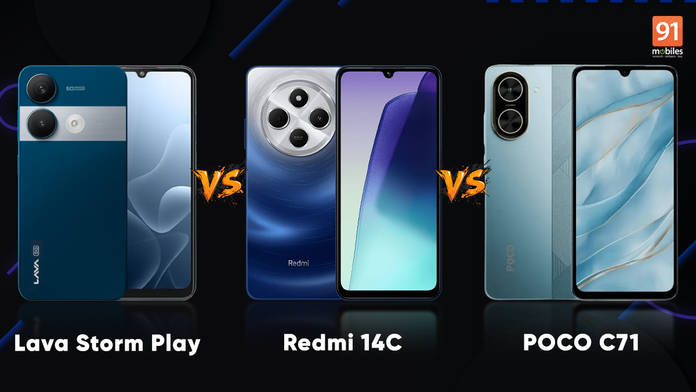
Lava Storm Play vs Redmi 14C vs POCO C71: Benchmarks
The Lava Storm Play competes with the likes of Redmi 14C and POCO C71 in the sub-Rs 10,000 segment. While the Redmi 14C runs on the Snapdragon 4 Gen 2, the POCO C71 is powered by the Unisoc T7250. Both are respectable entry-level chipsets, but a closer look at the benchmark numbers paints a clearer picture.
In AnTuTu, the Lava Storm Play scores higher than its rivals by a substantial margin. It delivers around 14% higher scores than the Redmi 14C and nearly 48% higher than the POCO C71.
AnTuTu scores | Lava Storm Play | Redmi 14C | POCO C71 |
Overall Score | 5,03,166 | 4,38,871 | 2,65,154 |
CPU score | 1,61,116 | 1,49,342 | 90,606 |
GPU score | 78,895 | 49,282 | 31,257 |
Memory score | 1,26,162 | 1,26,993 | 76,964 |
UX score | 1,36,993 | 1,13,254 | 66,327 |
When you dig deeper into the subcategories, the MediaTek Dimensity 7060 powering the Lava Storm Play is in the lead in every key metric. Its CPU and GPU scores, in particular, are higher, which translates to faster response times, smoother UI, and better performance in graphics-heavy workloads in real-world use. It is a meaningful difference, particularly when it comes to affordable smartphones, where basics matter a lot more.
Now let us look at how it performs in a CPU-specific benchmark, the Geekbench 6 test.
Geekbench score | Lava Storm Play | Redmi 14C | POCO C71 |
Single-core score | 1,056 | 919 | 440 |
Multi-core score | 2,464 | 2,206 | 1,481 |
The MediaTek Dimensity 7060 once again is in the lead, with a substantial advantage in multi-core performance. For context, single-core scores impact everyday tasks like app loading, scrolling, and web browsing, while multi-core performance kicks in during heavier workloads like gaming, multitasking, or editing photos and videos.
The Lava Storm Play delivers around 11% better performance than the Redmi 14C, and nearly 39% higher than the POCO C71 in multi-core. That is a significant jump, and it only reinforces the fact that when it comes to real performance in this price segment, the Lava Storm Play sits comfortably at the top.
The GFXBench Manhattan is a GPU-focused benchmark that helps evaluate how well a phone can handle graphics-heavy tasks like gaming and video rendering.
Lava Storm Play | Redmi 14C | POCO C71 | |
Overall Score | 5,520 | 2,802 | 2,018 |
We already saw how the AnTuTu GPU scores put the MediaTek Dimensity 7060 ahead of the pack, and the GFXBench Manhattan results only confirm that lead. The Lava Storm Play scores about 64% higher than the POCO C71 and a massive 49% higher than the Redmi 14C. That kind of gap shows up clearly in real-world usage scenarios, especially when playing graphics-intensive games or using apps that rely heavily on GPU.
Bottomline
If you are someone who usually skips the entry-level segment because of all the compromises, the Lava Storm Play might just change your mind. Powered by the MediaTek Dimensity 7060, it delivers the kind of performance you simply don’t expect at this price. Whether it’s CPU, GPU, memory speed, or storage, the Lava Storm Play consistently delivers better results than the competition in both benchmarks and real-world performance.
It is quite rare to see a budget phone that checks all the right boxes when it comes to speed, efficiency, and hardware quality. For users who want a fast, responsive phone under Rs 10,000, one that won’t struggle with everyday use or even gaming, this is as close to perfect as it gets.
This is a promotional post done as part of a brand collaboration.