Innovation without compromise: How MediaTek Dimensity chipsets continue to push the envelope in the flagship segment


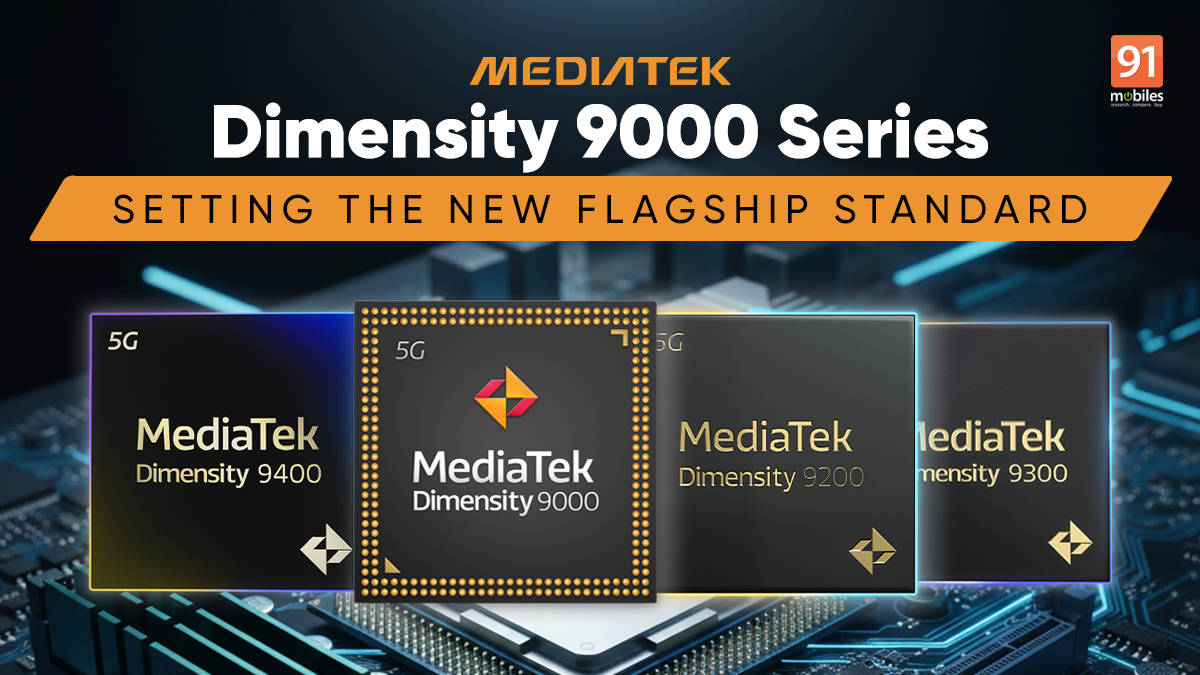
For years, premium smartphone processors have set the pace for innovation. After all, they not only impact the flagship device’s performance but also its display, camera capabilities, battery backup, and last but not the least, new-gen functionality such as AI.
But even giants like Google (with its Tensor chips) and Samsung (with its Exynos lineup) have faced hurdles in consistently matching the market’s leading performance and efficiency expectations year after year.
Enter MediaTek Dimensity and more importantly its Dimensity 9000 series. Instead of just trying to keep up, MediaTek charted its own course with a clear and effective philosophy: deliver cutting-edge innovation without compromise. At its core, this means adhering to the latest global connectivity standards while deploying powerful, state-of-the-art CPU and GPU architectures that are meticulously balanced for energy efficiency. This approach reflects MediaTek’s goal of making great technology accessible, ensuring that world-class performance isn’t a luxury reserved for only the most expensive flagships.
With a foundation built on this philosophy of balanced and uncompromising engineering, the Dimensity 9000 series quickly established itself as a formidable force in the flagship SoC market. As we await the launch of the newest flagship chipset in the Dimensity 9000 series, let’s first take a look at how MediaTek’s journey has unfolded:
Table of Contents
MediaTek Dimensity 9000 series
Launched in December 2021, the Dimensity 9000 marked MediaTek’s entry into the true flagship space. As the world’s first smartphone chipset built on TSMC’s cutting-edge 4nm process, it delivered a monumental leap in power efficiency and performance. The advanced 4nm node allowed for higher transistor density and reduced power consumption, meaning devices could offer flagship-level speed without compromising battery life. This processor perfectly embodied MediaTek’s philosophy of innovation without compromise.


This allowed phones like the Vivo X80 to leverage its powerful Arm Cortex-X2 core and advanced Imagiq 790 ISP, offering a top-tier camera experience and smooth high-end performance without sacrificing battery life.
Building on this successful foundation, MediaTek released the Dimensity 9000+, a strategic follow-up that provided targeted performance gains. By increasing the Cortex-X2 core’s clock speed to 3.2GHz and boosting the Mali-G710 MC10 GPU, they made it a perfect fit for the emerging foldable market, powering devices like the OPPO Find N2 Flip. The blend of higher peak performance and proven battery efficiency was crucial for delivering a fluid, responsive experience in a compact form factor where every milliamp of battery counts.
MediaTek Dimensity 9200 series
With the Dimensity 9200, MediaTek continued to build on its flagship strategy, this time by being the first to integrate several progressive technologies. It was the first smartphone chip to feature Arm’s Immortalis-G715 GPU, which brought hardware-based ray tracing to mobile devices. While the mobile gaming ecosystem was still in the early stages of adopting ray tracing, its inclusion was a strategic move to future-proof the platform. The Dimensity 9200 was also the first SoC to offer support for up to 8533MHz LPDDR5X RAM, which helps improve overall system responsiveness by allowing the CPU and GPU to access data more quickly.

The chip’s combination of a powerful Cortex-X3 core and an advanced ISP proved to be a potent formula for 2023 flagships. This was evident in devices like the Vivo X90 Pro, which utilised the platform’s imaging capabilities for its Zeiss-branded camera system, and the OPPO Find N3 Flip, where the chip’s efficiency was essential for managing the power demands of a foldable device.
The subsequent Dimensity 9200+ was a performance-focused refresh. MediaTek increased the clock speed of the prime Cortex-X3 core to 3.35GHz and boosted the GPU, resulting in a 10% increase in both CPU and graphics performance over its predecessor. This additional horsepower allowed the 9200+ to effectively power a wave of “flagship killer” devices. Phones like the Vivo V40 Pro and Vivo T3 Ultra leveraged this processor to offer advanced camera systems and flagship-grade performance at more accessible price points.
MediaTek Dimensity 9300 series
MediaTek’s Dimensity 9300 marked a significant shift in flagship SoC design by adopting an All-Big-Core CPU architecture. Unlike conventional chipset layouts, the 9300 combined four Arm Cortex-X4 high-performance cores with four Cortex-A720 performance cores, boosting peak multi-core performance by around 40% while reducing power draw by roughly 33% compared to the previous generation. This configuration not only pushed raw performance metrics but also improved sustained workloads and thermal management, which is doubtless a critical advantage for demanding applications.


On the AI front, the Dimensity 9300 featured the APU 790, a dedicated neural processing engine tailored for generative AI tasks. It enabled on-device inference for large language models and rapid on-device AI image generation. A practical example of these capabilities appeared in the Vivo X100 Pro, where the chip’s computational prowess and advanced Imagiq ISP powered a versatile Zeiss-backed camera system, which was widely regarded as one of the best camera systems for its time. It also delivered consistently fluid user interactions, even under intensive multitasking.
The Dimensity 9300+ built on this foundation by overclocking the prime Cortex-X4 core to 3.4 GHz and boosting the NPU’s throughput by an additional 10%. These enhancements set new benchmarks for smartphone performance, particularly in AI workloads. In devices like the Vivo X200 FE, Vivo’s first compact flagship in India, the 9300+ enabled advanced AI-driven camera features and powered a multitude of on-device AI features. Samsung also chose it to power the Galaxy Tab S10 Ultra, marking the first time the brand used a MediaTek processor in its flagship tablet series, a decision that validated MediaTek’s standing in the flagship market and its challenge to the status quo.
MediaTek Dimensity 9400 series
The Dimensity 9400 series represents the culmination of MediaTek’s flagship ambitions, refining the “All-Big-Core” strategy across a family of specialised chipsets. The lineup was led by the Dimensity 9400, which moved to the advanced 2nd-generation TSMC 3nm process. Featuring a prime Arm Cortex-X925 core and a new 12-core Immortalis-G925 GPU, it delivered a massive 41% boost in peak graphics performance and a 40% improvement in hardware ray tracing, all while being up to 44% more power-efficient than its predecessor.

The Dimensity 9400 also brought major upgrades to on-device AI. Its new NPU was built for Agentic AI, making digital assistants more proactive and context-aware. A key feature is its ability to perform on-device LoRA training, allowing the AI to be personalised with user data securely on the phone, improving privacy and responsiveness. It also introduced on-device generative video, meeting the growing demand for powerful and private creative AI tools.
This chipset debuted in top-tier flagships like the Vivo X200 series, which used the chip’s advanced ISP and NPU for its state-of-the-art camera, and the OPPO Find X8 series, which was an all-around flagship praised for its cameras, excellent battery life, and sustained gaming performance.
For the ultra-premium market, MediaTek released the Dimensity 9400+. It’s a higher-binned version of the 9400, pushing the prime Cortex-X925 core to 3.73GHz and enhancing NPU performance by 20% for more responsive on-device AI. This targeted upgrade made it a suitable choice for Samsung’s Galaxy Tab S11 Ultra, reinforcing MediaTek’s position as a supplier for the industry’s most demanding and luxurious flagship devices.
Rounding out the family, the Dimensity 9400e was introduced to bring these flagship innovations to a wider audience. Built on an efficient 3rd-generation TSMC 4nm process, it retains the core DNA of its siblings, including the “All-Big-Core” CPU design and a powerful Immortalis-G720 MC12 GPU. Its top-tier performance capabilities and value made it the perfect engine for devices like the Realme GT 7, which leveraged the chip’s power to deliver a premium gaming experience and advanced AI features at a more competitive price point.
Market Momentum: The Go-To Chipset for Top Brands
MediaTek’s Dimensity lineup has quickly become the go-to choice for a whole range of premium and flagship smartphones, signalling a real shift in the market. Top brands like Vivo and OPPO, who built their names on camera-focused flagships, now rely on Dimensity chips for their top-tier devices. This partnership has continued to grow, with the new Vivo X200 series and OPPO Find X8 Pro both adopting the powerful Dimensity 9400.
And it’s not just their established partners. Realme jumped aboard with the GT 7, using the Dimensity 9400e to pack flagship-level speed and gaming into a more affordable package. In a major vote of confidence, Samsung also chose the Dimensity 9400+ to power its most premium tablet yet, the Galaxy Tab S11 Ultra, equipping its flagship tablet with MediaTek’s class-leading performance and AI capabilities.
And the numbers back this up just as well. According to Counterpoint Research’s latest analysis, MediaTek’s Dimensity flagship SoC revenue doubled to $2 billion in 2024. The company’s flagship SoCs (D9300/9400) have been major growth drivers, significantly increasing both unit shipments and market penetration in the flagship segment. This growth has been driven by the strong adoption of high-end Dimensity chips by major brands, demonstrating MediaTek’s expanding presence in the flagship space.


While growing in the premium segment, MediaTek has maintained its leadership in the overall global smartphone SoC market. Based on Counterpoint Research data, the company kicked off Q3 2023 with a strong 38% share, commanded the market at 41% by Q1 2024, and after a seasonal dip, rebounded to 36% in Q1 2025, proving its product cycles are robust and demand for its chips remains unmatched. Further testament to its dominance is the fact that MediaTek has been the undisputed leader in the Indian smartphone market for 19 consecutive quarters, from Q3 2020 to Q1 2025.
MediaTek Dimensity 9400 vs Snapdragon 8 Elite: A quick overview
As aforementioned, MediaTek is all set to unveil the Dimensity 9400’s successor. But while we are waiting, let’s take a look at how the Dimensity 9400 performs against its primary competitor, the Qualcomm Snapdragon 8 Elite. Both are built on TSMC’s 3nm process, but they employ different architectural philosophies.
- Snapdragon 8 Elite: Uses a custom two-cluster design with two ultra-high-performance Oryon cores and six additional Oryon performance cores.
- Dimensity 9400: Features a three-cluster All-Big-Core design with one prime Cortex-X925, three high-performance Cortex-X4 cores, and four additional Cortex-A720 performance cores.
In the popular AnTuTu benchmark, both chipsets deliver virtually identical top-tier performance, confirming their status as market leaders. While individual CPU and GPU scores show minor variances, the overall results are on par, highlighting that in terms of performance, the two chipsets are evenly matched.


In Geekbench’s OpenCL test, which measures a GPU’s raw computational throughput, the Dimensity 9400’s Immortalis-G925 GPU shows a distinct advantage. This benchmark evaluates how well the GPU handles parallel processing, which is critical for demanding tasks like 4K video rendering, computational photography, and running complex AI models. The higher score indicates a greater capacity for these specific workloads, reflecting the chip’s architectural focus on high-throughput GPU and NPU performance.


If you look at the GPU score in the screenshot attached below, you’ll note that the Dimensity 9400 outperforms the Snapdragon 8 Elite by a significant margin.

This GPU advantage also shows up in real-world use. We did a test of our own using CapCut, where we edited and exported the same 4K video on both an OPPO Find X8 Pro (Dimensity 9400) and a OnePlus 13s (Snapdragon 8 Elite), each with similar specs. This is largely a use case that’s reliant on GPU, and thus should show us which chipset does better in actual use.
The results were consistent across three runs. On average, the OPPO Find X8 Pro finished the export in just 2 minutes and 5 seconds, while the OnePlus 13s took 3 minutes and 17 seconds. That’s a great lead of about 1 minute and 12 seconds for the MediaTek-powered phone.
This 40% speed advantage is a massive time-saver for anyone who frequently edits and exports video on their phone. It demonstrates how the Dimensity 9400’s balanced All-Big-Core design excels in sustained, GPU-intensive workloads, translating synthetic benchmark potential into tangible, real-world performance gains.
Conclusion
From its ambitious debut with the Dimensity 9000 to the refined power of the 9400, MediaTek’s flagship journey has been one of consistent evolution. While other industry giants have struggled to deliver in the fiercely competitive flagship space, MediaTek has steadily closed the gap, proving that innovation without compromise isn’t just a philosophy but is, in fact, a winning strategy.
The Dimensity 9400 stands as a testament to this effort. It not only excels in industry-standard benchmarks, but it also delivers where it counts. With its balanced “All-Big-Core” architecture, it provides the sustained, efficient performance that creators and power users demand. Our tests prove it, showing a clear advantage in real-world GPU tasks that make a tangible difference. MediaTek has earned its seat at the highest table, and it is actively helping set the new standard for what a flagship experience should be.
And that journey is only accelerating. MediaTek has announced the launch of its next flagship on September 22. As is the case with every Dimensity flagship, we can expect the next SoC from MediaTek to offer an incredible performance boost and deliver an unmatched gaming experience. Looking ahead, MediaTek has already completed the design and testing of its first chip using TSMC’s cutting-edge 2nm process. This milestone signals the next great leap in mobile computing, and with mass production expected in 2026, it firmly positions MediaTek at the forefront of semiconductor innovation.