Motorola Edge 70 Pro+ vs Nothing Phone (4a) Pro: which is the better choice under Rs 50,000?


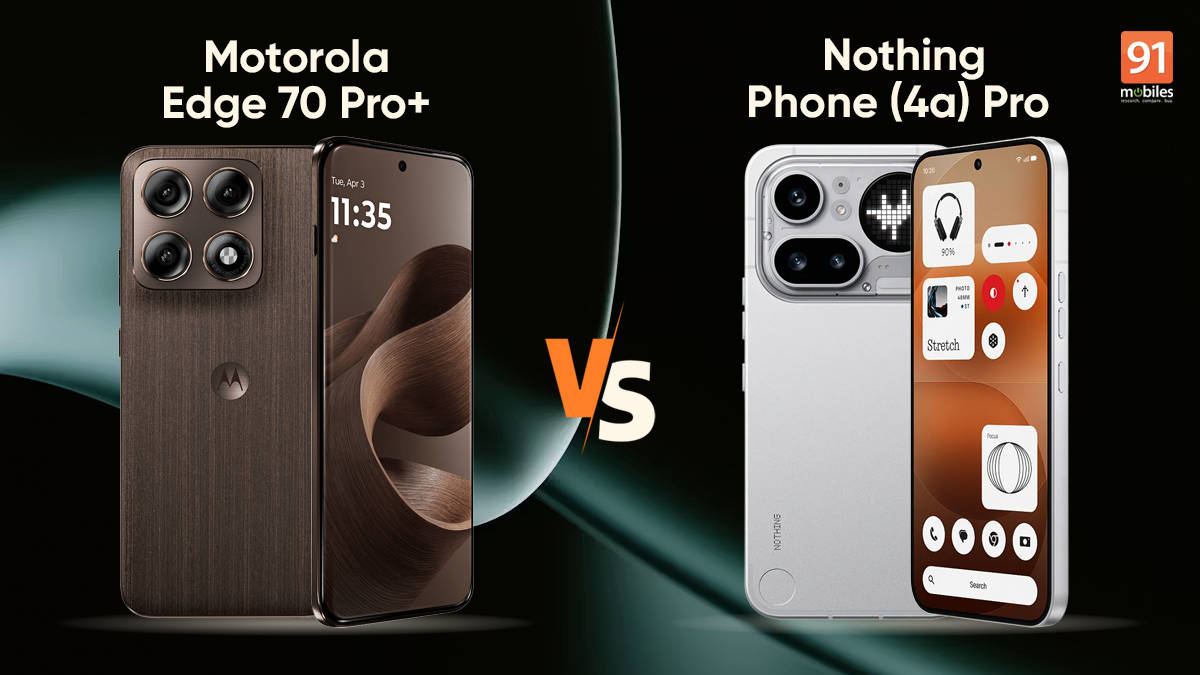
The Motorola Edge 70 Pro+ is the brand’s most premium Edge 70 series phone yet, bringing a slim design, a large 6,500mAh battery, a periscope camera, and a powerful Dimensity 8500 Extreme chipset. Priced at Rs 48,000, it competes against some very capable smartphones, including the Nothing Phone (4a) Pro (review). The latter takes a slightly different route with its cleaner design, Glyph Matrix-inspired identity, and a more camera-focused proposition.
Both phones sit in the premium mid-range space, but they appeal to different kinds of buyers. Here’s how the Motorola Edge 70 Pro+ and Nothing Phone 4a Pro compare and where each one seems to have the upper hand.
Table of Contents
Motorola Edge 70 Pro+ vs Nothing Phone 4a Pro: price in India
The Motorola Edge 70 Pro+ comes in a single 12GB RAM and 256GB storage variant priced at Rs 47,999. The Nothing Phone 4a Pro now starts higher, with the base 8GB + 128GB model crossing the Rs 50,000 mark after recent price hikes and the 12GB + 256GB variant going even further up.
| Variant | Motorola Edge 70 Pro+ price | Nothing Phone (4a) Pro price |
| 8GB+128GB | NA | Rs 49,999 |
| 8GB+256GB | NA | Rs 52,999 |
| 12GB+256GB | Rs 47,999 | Rs 55,999 |
So, despite its more premium positioning in Motorola’s own lineup, the Edge 70 Pro+ actually undercuts the Nothing Phone 4a Pro on price, which gives it a small advantage if you are value-sensitive.
Motorola Edge 70 Pro+ vs Nothing Phone 4a Pro: design, display
On paper, both phones look premium, but they approach design very differently. The Edge 70 Pro+ goes for Motorola’s quad‑curved, Satin‑Luxe look with a fabric‑style back, a slim 7.19mm frame, 190g weight, and IP68+IP69 rated MIL‑STD durability, which makes it the sleeker and more rugged option.


The Nothing Phone 4a Pro sticks to an all‑metal unibody with a flat front, an IP65 rating, and the signature Glyph Matrix on the rear, and it is quite a bit heavier at 210g and 7.9mm thick.


The displays on both phones are quite evenly matched on specs. The Edge 70 Pro+ offers a 6.8‑inch 1.5K quad‑curved AMOLED panel with a 144Hz refresh rate and up to 5200 nits peak brightness.
The Nothing Phone 4a Pro counters with a slightly larger 6.83‑inch flat 1.5K AMOLED at 144Hz and up to 5000 nits peak brightness. So Motorola gives you a brighter, curved screen and a tougher IP rating, while Nothing delivers a flatter, more traditional panel and that distinctive glyph design.
Motorola Edge 70 Pro+ vs Nothing Phone 4a Pro: cameras
Both phones are clearly camera-focused on paper, and both even get a proper periscope zoom lens. The Edge 70 Pro+ comes with a triple 50MP setup, including a 50MP main camera, a 50MP ultra-wide, and a 50MP periscope telephoto lens with 3.5x optical zoom and up to 50x hybrid zoom. Along with that, it offers a 50MP autofocus selfie camera and the ability to shoot 4K at 60fps from all 4 lenses.

The Nothing Phone (4a) Pro uses a 50MP main camera with OIS, an 8MP ultrawide, and a 50MP periscope telephoto lens with 3.5x optical zoom and over 100x hybrid zoom, plus a 32MP front camera. On specs alone, Motorola is stronger with its all 50MP rear setup, higher resolution selfie camera and videography, while Nothing puts more emphasis on extreme zoom. You can check out the (4a) Pro’s cameras down below:
Of course, the actual camera performance remains to be seen until we thoroughly test the new Motorola Edge 70 Pro+ in its dedicated review.
Motorola Edge 70 Pro+ vs Nothing Phone 4a Pro: chipset, battery
Under the hood, both phones use modern 4nm chips, but they come from different camps. The Edge 70 Pro+ runs on the MediaTek Dimensity 8500 Extreme with 12GB LPDDR5X RAM and 256GB UFS 4.1 storage, so it should feel very fast in everyday use.
The Nothing Phone 4a Pro uses the Snapdragon 7 Gen 4 with 8GB or 12GB LPDDR5X RAM and up to 256GB UFS 3.1 storage, which is still good but not quite as capable as its rival in terms of performance.
Battery and charging is where Motorola has the clear advantage on paper. The Edge 70 Pro+ packs a 6,500mAh silicon-carbon battery with 90W wired charging, 15W wireless charging, and reverse charging support.
The Nothing Phone 4a Pro comes with a smaller 5,400mAh battery and 50W wired charging, with no wireless charging option, so Motorola looks like the better pick if battery size and ease of charging matter more to you.
Motorola Edge 70 Pro+ vs Nothing Phone 4a Pro: software
Both phones run Android 16 out of the box and promise three major OS updates. Nothing has the edge here, though, since it offers six years of security patches compared with five on the Motorola. On the software side, both phones follow a stock Android style, but Nothing OS feels more polished and more distinct in terms of personality.
The Edge 70 Pro+ uses Hello UI, which stays close to stock Android and adds Motorola features like moto AI, Circle to Search, Gemini integration, and a few camera and note-taking tools.
The Nothing Phone 4a Pro runs Nothing OS 4.1 on top of Android 16, with three OS updates and up to six years of security patches. It also brings its own AI tools and Essential Space features, but it is the design language and customisation options that really make it stand out.
Motorola is the more straightforward and utility-focused phone, while Nothing feels more stylish and better supported over the long run.
Final thoughts
On specs alone, the Motorola Edge 70 Pro+ is a better “all‑rounder” package: a brighter curved display, a bigger 6,500mAh battery with wireless charging, faster UFS 4.1 storage, and a triple 50MP rear camera setup with a 50MP AF selfie camera.
The Nothing Phone (4a) Pro (review) is more focused on design flair and brand identity with its metal unibody, Glyph Matrix, and flat AMOLED, yet still offers a good periscope camera system and long software support. Although its performance and battery life are unlikely to match Motorola’s.
Given recent price hikes on the Nothing side, the Edge 70 Pro+ now actually undercuts some 4a Pro variants while offering more battery, faster charging, and higher-end memory, which makes Motorola the more balanced choice on paper if you are looking purely at value. The Nothing Phone 4a Pro, meanwhile, is better suited to buyers who prioritise a unique design, a flat display, characterful software, and a capable camera system.