While the Indian market received the Redmi Note 15 Pro series, Xiaomi unveiled the Redmi Turbo 5 lineup in China this week. The series has been circulating online for weeks and is now officially launched, bringing some genuinely eye-catching specifications. The Redmi Turbo 5 Max stands out with a massive 9,000mAh battery paired with MediaTek’s latest Dimensity 9500s chipset. The standard Redmi Turbo 5 may not match the Max on raw hardware, but it still delivers a comparable experience, offering the latest Dimensity 8500 Ultra SoC, AMOLED display, 50MP camera, and more.
Table of Contents
Redmi Turbo 5, Turbo 5 Max prices in China
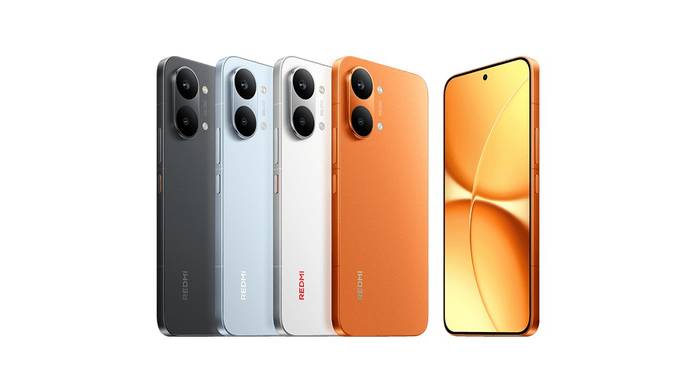
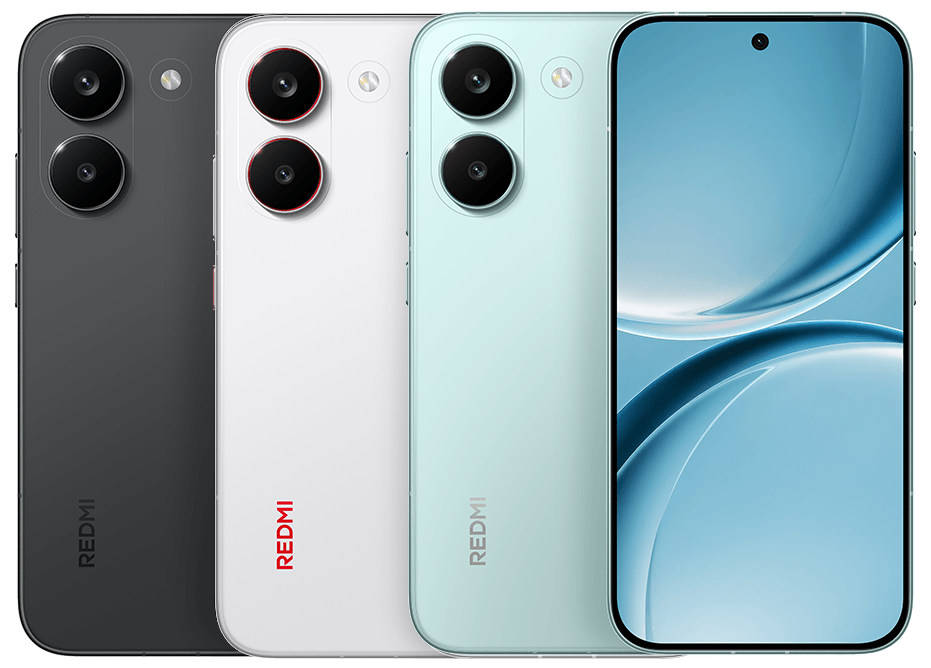
The Redmi Turbo 5 is priced at CNY 2,299 (~Rs 30,000) for the base variant with 12GB of RAM and 256GB of storage. The handset also comes with 12GB+512GB and 16GB+256GB configurations, which interestingly cost the same at CNY 2,599 (roughly Rs 34,000). The top-end 16GB of RAM and 512GB of storage configuration comes with a sticker price of CNY 2,899 (~Rs 38,000). The phone is available in three colours: white, black, and blue.

The Redmi Turbo 5 Max, on the other hand, comes with a sticker price of CNY 2,499 (~Rs 33,000) for the 12GB RAM and 256GB storage option. The 16GB+256GB and 12GB+512GB configurations cost CNY 2,799 (~Rs 37,000) and CNY 2,999 (~Rs 40,000), respectively. There is a 16GB + 512GB variant of the phone, priced at CNY 3,299 (~Rs 44,000). The phone also comes in white, black, and blue colour variants, similar to the Redmi Turbo 5, but there is an additional orange shade as well – seemingly, inspired by the iPhone 17 Pro Max.
Redmi Turbo 5 Max brings flagship-level hardware
Both the Redmi Turbo 5 and Turbo 5 Max feature a near-identical design, characterised by flat edges and a dual-camera setup housed in a pill-shaped module. This differs from the curved-edge design language used on the Redmi Note 15 series. However, the Redmi Turbo 5 series debuts with identical durability, featuring IP66, IP68, IP69, and IP69K ratings for dust and water resistance.
That said, the Redmi Turbo 5 Max has a slightly larger footprint than its sibling, measuring 162.99 x 77.93 x 8.15mm and weighing about 219g. This can be attributed to the 6.83-inch (1,280×2,772 pixels) AMOLED display, with a refresh rate of up to 120Hz, a touch sampling rate of up to 480Hz, peak brightness of up to 3,500 nits, 68.7 billion colours, Dolby Vision, and support for HDR10+ content. The display supports Wet Hand Touch 2.0 to keep it responsive and accurate with wet fingers.
At the core of the smartphone lies MediaTek Dimensity 9500s SoC, which was introduced earlier this year. It is the second-best chipset from MediaTek, positioned just below the Dimensity 9500, which we have seen on devices such as the Vivo X300 and OPPO Find X9 series in India. The 9500s is fabricated using the 3nm manufacturing process and delivers a peak speed of 3.73Ghz – just short of 4.21Ghz clock speed of the Dimensity 9500.
The Dimensity 9500s is MediaTek’s answer to Qualcomm’s Snapdragon 8 Gen 5. While the latter has already debuted in India, there is no sign of the MediaTek chipset coming to India anytime soon.
The Redmi Turbo 5 Max pairs the chipset with up to 16GB LPDDR5x Ultra RAM and 512GB UFS 4.1 storage.
The highlight of the Redmi Turbo 5 Max is its mammoth 9,000mAh battery, which should easily deliver two days of battery life on a single charge. It is backed by 100W wired fast charging, which should quickly charge the device, and 27W wired reverse charging.
In optics, the Turbo 5 Max sports dual cameras, comprising a 50MP Light Hunter 600 rear camera and an 8MP ultrawide lens. The front camera is a 20MP shooter for selfies and video calling.
Redmi Turbo 5 is relatively compact & slightly watered-down
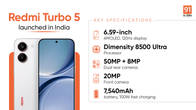
On the contrary, the Redmi Turbo 5 measures 157.53 x 75.19 x 8.18mm and weighs approximately 204g. The handset features a relatively small 6.59-inch (1,268×2,756 pixels) AMOLED display with the same refresh rate, colour gamut, touch sampling rate, and brightness as the Turbo Max. Under the hood, the handset is powered by a 4nm MediaTek Dimensity 8500 Ultra SoC, clocked at 3.74 GHz, paired with up to 16GB LPDDR5x Ultra RAM and 512GB UFS 4.1 storage.
The Redmi Turbo 5 features a similar camera setup but uses a different 50MP Sony IMX882 main sensor. The handset is powered by a 7,650mAh battery and supports 100W wired charging and 27W reverse wired charging.
Both smartphones run Android 16-based HyperOS3 out of the box and offer connectivity options including dual-SIM 5G, 4G LTE, USB-C, and Bluetooth 5.4.

That’s everything we currently know about the Redmi Turbo 5 series. Based on the specifications, the Turbo 5 Max will appeal to power users with its large battery and sub-flagship chipset, which should handle everything thrown at it without worrying about battery life. The vanilla Turbo 5 makes sense to everyday users in the mid-range segment. This is if you are in China.
As with its predecessor, the lineup is unlikely to launch in India under the Redmi brand. Instead, the Redmi Turbo 5 and Turbo 5 Max could arrive in the country as rebranded models in POCO’s F and X series. As a refresher, the Redmi Turbo 4 was rebranded as the POCO X7 Pro outside China. This is speculative at this time, and we advise you to take it with a grain of salt. Unless you are looking for an immediate smartphone as your daily driver, it is worth the wait.