Redmi Turbo 5 vs Vivo T5 Pro compared: which phone offers better value under Rs 40,000?


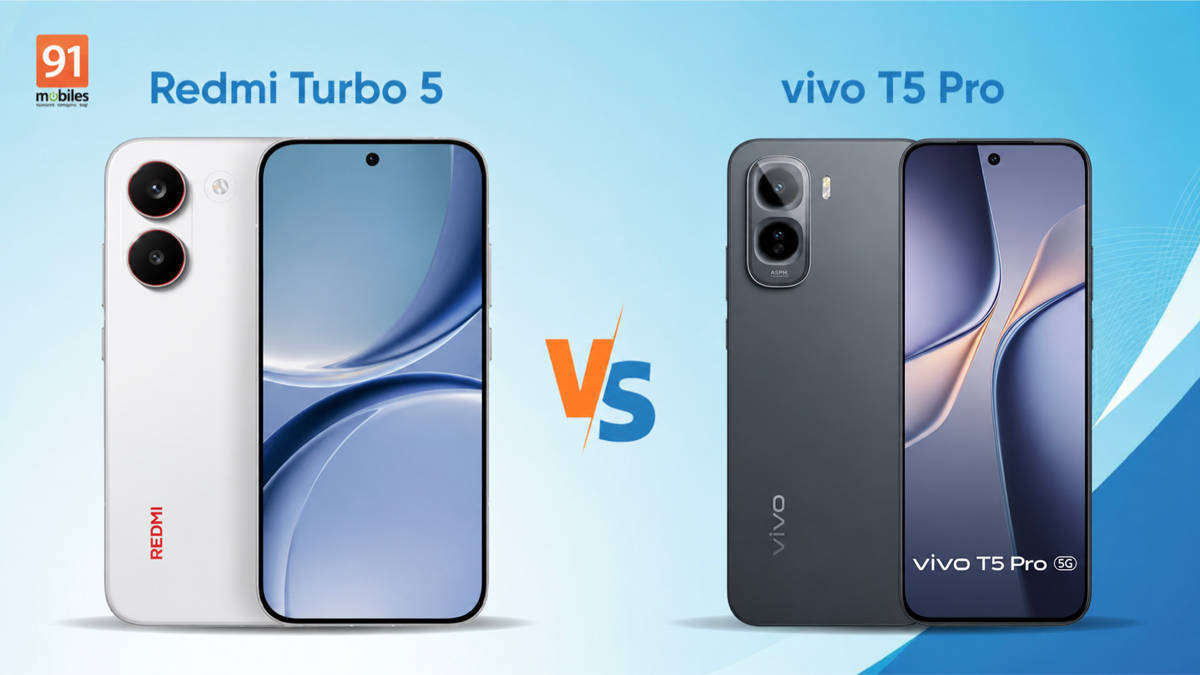
The Redmi Turbo 5 launched in India (review) as the company’s first Turbo-series smartphone in the country. A performance-focused device, the Turbo 5 brings the MediaTek Dimensity 8500-Ultra chipset, a large 7,540mAh battery, flagship-grade durability ratings, and several premium features. One of its closest rivals is the Vivo T5 Pro, a phone that has built its identity around battery life and display quality. It offers a massive 9,020mAh battery, a 144Hz AMOLED display, and the Snapdragon 7s Gen 4 chipset.
Both phones target buyers shopping under Rs 40,000, but they take very different approaches. Here’s a detailed comparison to help you decide which one fits your needs better.
Table of Contents
Redmi Turbo 5 vs Vivo T5 Pro: specs at a glance
| Specs | Redmi Turbo 5 | Vivo T5 Pro |
| Display | 6.59-inch 1.5K AMOLED display, 120Hz refresh rate, 3,500 nits peak brightness | 6.83-inch 1.5K AMOLED, 144Hz refresh rate, 5,000 nits peak brightness |
| Processor | MediaTek Dimensity 8500-Ultra | Snapdragon 7s Gen 4 |
| RAM and storage | Up to 12GB LPDDR5X RAM, 256GB UFS 4.1 storage | Up to 12GB LPDDR4X RAM, 256GB UFS 3.1 storage |
| Rear cameras | 50MP + 8MP ultra-wide | 50MP + 2MP |
| Front camera | 20MP | 32MP |
| Battery, charging | 7,540mAh, 100W HyperCharge | 9,020mAh, 90W charging |
| Software | Android 16-based Hyper OS 3, 4+6 years | Android 16-based OriginOS 6 |
| Durability | IP66, IP68, IP69, IP69K | IP68, IP69 |
Redmi Turbo 5 vs Vivo T5 Pro: price
The Redmi Turbo 5 starts at Rs 37,999 for the 8GB + 256GB variant, although it’s currently available at an introductory price of Rs 35,999. The higher-end 12GB + 256GB model costs Rs 40,999.
The Vivo T5 Pro launched at a lower starting price of Rs 29,999, but recent price hikes have narrowed the gap. The 8GB + 128GB variant now costs Rs 32,999, while the 8GB + 256GB version is available for Rs 36,999. Vivo’s 12GB variant appears to have been discontinued.
| Variant | Redmi Turbo 5 | Vivo T5 Pro |
| 8GB + 128GB | NA | Rs 32,999 |
| 8GB + 256GB | Rs 37,999 | Rs 36,999 |
| 12GB + 256GB | Rs 40,999 | Unavailable now |
Redmi Turbo 5 vs Vivo T5 Pro: design, display
The Redmi Turbo 5 and Vivo T5 Pro target different customers. Redmi sticks to a flat display and flat-frame design, giving the phone a more practical and gaming-oriented appearance. It also features an aerospace-grade aluminium frame, Gorilla Glass 7i protection, and a glass back. A unique element is Redmi’s Pixel Matrix lighting system around the rear cameras, which can be customised for notifications, music playback, and alerts. The Redmi Turbo 5 comes in three colour options – Turbo White (with subtle red accents on the camera rings and power button), Nitro Blue, and Asphalt Black.
The Vivo T5 Pro takes a more premium route with its AMOLED display and sleeker aesthetics. It’s available in Glacier Blue and Cosmic Black finishes.
Display is an area where Vivo has an advantage on paper. Its 6.83-inch 1.5K AMOLED panel offers a faster 144Hz refresh rate and higher 5,000 nits peak brightness. The Redmi’s 6.59-inch 120Hz AMOLED display remains sharp and vibrant, but Vivo’s larger screen feels more immersive for content consumption and gaming.
Redmi Turbo 5 vs Vivo T5 Pro: performance and battery
This is where the Redmi Turbo 5 establishes its biggest advantage. The Dimensity 8500-Ultra is a significantly more powerful chipset than the Snapdragon 7s Gen 4, making the Redmi the stronger option for gaming, multitasking, and demanding workloads. The phone also benefits from LPDDR5X RAM, UFS 4.1 storage, and Redmi’s 3D Ice Loop cooling system for better sustained performance. For gamers and heavy users, the difference is likely to be noticeable.
Battery life, however, is a different story. The Vivo T5 Pro packs a huge 9,020mAh silicon-anode battery, one of the largest batteries available in this segment. It comfortably exceeds the Redmi’s still impressive 7,540mAh battery capacity. Redmi does offer faster 100W charging and 27W reverse wired charging, but Vivo is likely to last longer between charges. If performance matters most, Redmi wins this round. If endurance is your top priority, Vivo takes the lead.
Redmi Turbo 5 vs Vivo T5 Pro: cameras
Interestingly, both phones use the same 50MP Sony IMX882 primary sensor with OIS, which means their main camera performance should be fairly similar in most conditions. The difference lies in the supporting cameras. Redmi includes an 8MP ultrawide lens, making it more versatile for landscapes and group shots. Vivo instead uses a basic 2MP secondary sensor.
On the front, Vivo gains an advantage with its 32MP selfie camera compared to Redmi’s 20MP shooter. Redmi offers a more flexible rear camera setup, while Vivo may appeal more to users who frequently take selfies.
Redmi Turbo 5 vs Vivo T5 Pro: software
The Redmi Turbo 5 runs Android 16-based HyperOS 3, which offers extensive customisation options, ecosystem integrations, and productivity features. The Vivo T5 Pro ships with Android 16-based OriginOS 6. The Redmi also gains extra points for premium additions such as Wi-Fi 7, Bluetooth 6.0, NFC, and Dolby Atmos stereo speakers.
Summing up
On paper, the Redmi Turbo 5 stands out with its more powerful chipset, stronger gaming credentials, ultrawide camera, richer connectivity features, and durability ratings. It’s the better choice for gamers and buyers who want the most capable all-round hardware.
The Vivo T5 Pro, meanwhile, delivers exceptional battery life, a larger display, and a slightly lower entry price. It’s better suited for users who prioritise multimedia consumption, long battery life, and everyday convenience. If performance and versatility are your priorities, the Redmi Turbo 5 is the stronger pick. But if your goal is maximum battery life paired with a premium display experience, the Vivo T5 Pro remains an excellent alternative.