Vivo S50, S50 Pro mini launch in China with a new design, Snapdragon chipsets, and 6,500mAh batteries


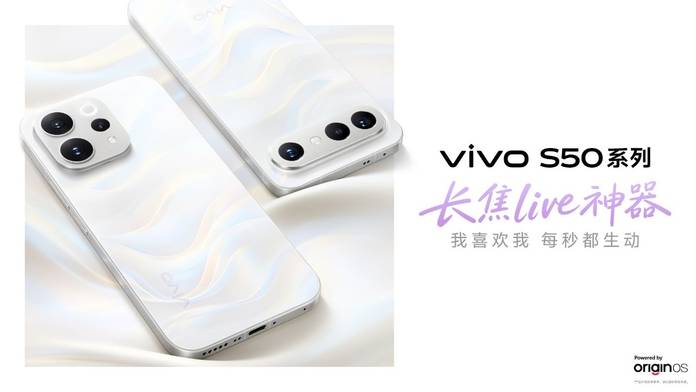
Vivo has refreshed its S-series lineup in China with the launch of the Vivo S50 and the more premium Vivo S50 Pro mini, marking a clear shift in both design philosophy and hardware choices. The new models replace the Vivo S30 and S30 Pro mini and are now available for purchase through Vivo’s official online store in China.
Visually, the S50 Pro Mini diverges from the vertical camera design of the S30 lineup, as a horizontal camera strip stretches across the back, featuring three sensors and an LED flash. The regular S50 features a square camera module. The S50 Pro mini will arrive in three shades: Confession, Inspiration Purple, and Space Grey, while the standard S50 comes in four finishes, including Serene Blue.
Show Full Article

One of the biggest changes in the S50 lineup is Vivo’s decision to go all-in on Qualcomm chipsets. The Vivo S50 Pro mini is powered by the latest 3nm Snapdragon 8 Gen 5 SoC, paired with an Adreno 829 GPU, LPDDR5x Ultra RAM, and UFS 4.1 storage. This is a notable shift for Vivo’s S-series, which has relied on MediaTek chipsets, especially for its premium lineup. The standard Vivo S50, meanwhile, runs on the Snapdragon 8s Gen 3 chip, offering flagship-adjacent performance at a lower price point. It’s interesting to see how much of a difference this would make in terms of performance. The OnePlus 15R is also launching with the same chipset in India on December 17th.

Both phones run Android 16 with Vivo’s OriginOS 6 skin on top. The Vivo S50 features a 6.59-inch AMOLED display (1,260×2,750) with a 120Hz refresh rate, while the Pro Mini opts for a smaller 6.31-inch AMOLED panel (1,216×2,640 pixels). Camera hardware remains a strong focus. The Vivo S50 and S50 Pro mini both come with triple rear cameras, led by a 50MP Sony primary sensor and a 50MP Sony periscope telephoto lens, alongside an ultra-wide camera. On the front, both devices feature a 50MP selfie camera, continuing Vivo’s emphasis on portrait and social photography.
Battery capacity is identical on both models, with 6,500mAh cells and 90W fast charging support. The Pro mini, however, gets an added advantage with 40W wireless charging, a feature missing on the standard S50. In terms of build, the Vivo S50 is slimmer and lighter at 7.59mm and 197g, while the Pro Mini is slightly thicker at 8.10mm but lighter at 192g.
The Vivo S50 starts at CNY 2,999 (Rs 39,000 approx) for the 12GB RAM and 256GB storage variant, going up to CNY 3,599 (Rs 46,000 approx) for the top-end 16GB + 512GB option. The Vivo S50 Pro Mini sits higher in the lineup, starting at CNY 3,699 (Rs 48,000 approx) and CNY 4,299 (Rs 55,000 approx) for the top-end 16GB RAM and 512GB storage model. For users in China looking for a powerful, camera-centric phone at this price point, the S50 Pro Mini offers a compelling package.
For global markets, including India, the Vivo S50 Pro Mini is expected to launch as the Vivo X300 FE, in line with Vivo’s usual rebranding strategy. If priced competitively, the X300 FE could be an attractive option for users seeking a compact, premium Android phone with flagship-level performance, capable cameras, and fast charging. The Vivo X200 FE had already set a strong benchmark with its lightweight design, excellent multimedia experience, reliable cameras, and solid battery life. Building on that foundation, the X300 FE is expected to offer meaningful upgrades, making it a device well worth waiting for.