Vivo T5 Lite vs Realme P4R: which phone offers more value under Rs 20,000?


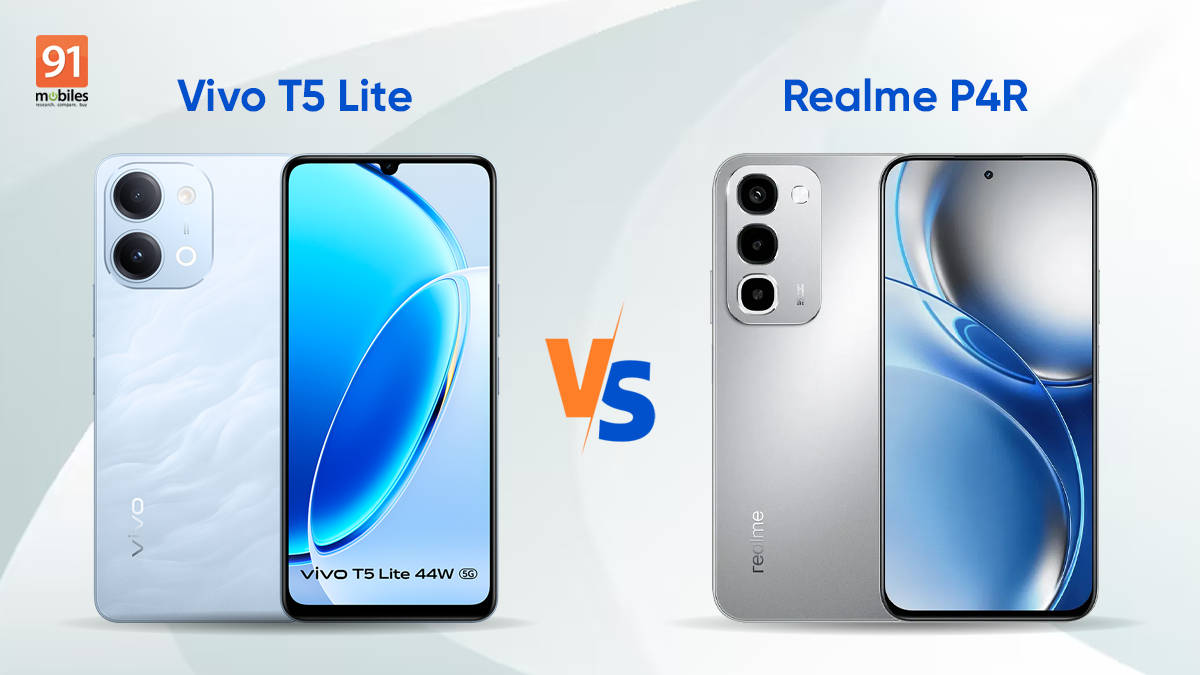
The Vivo T5 Lite is yet another 5G-capable entrant in the sub-Rs 20,000 segment to feature the MediaTek Dimensity 6300. Featuring a 6.75-inch display, a large 6,500mAh battery, and an IP65 rating, it takes the fight to the Realme P4R, which has been in the limelight recently for boasting a massive 8,000mAh cell. So, is the Realme P4R the clear winner for its battery prowess, or does the Vivo T5 Lite offer strong competition under Rs 20,000? Find out in this quick comparison.
Before diving into the comparison, here’s a quick look at the specifications of both smartphones:
| Spec | Vivo T5 Lite | Realme P4R |
| Display | 6.75-inch HD+ LCD, 120Hz | 6.8-inch HD+ LCD, 144Hz |
| Processor | MediaTek Dimensity 6300 | MediaTek Dimensity 6300 |
| RAM and storage | Up to 6GB LPDDR4X RAM, 256GB UFS 2.2 storage | Up to 6GB LPDDR4X RAM, 256GB UFS 2.2 storage |
| Rear cameras | 50MP | 50MP + 2MP depth |
| Selfie camera | 5MP | 8MP |
| Battery | 6,500mAh | 7,000mAh |
| Charging | 44W | 45W SUPERVOOC |
| Software | OriginOS 6 2+4 years | Realme UI 7 2+3 years |
| Durability | IP65, MIL-STD-810H | IP65, MIL-STD-810H |
Table of Contents
Vivo T5 Lite vs Realme P4R: price
The Vivo T5 Lite’s base variant with 4GB RAM + 128GB storage retails for Rs 19,999, Rs 1,000 more expensive than the Realme P4R with the same storage configuration. Similarly, the 6GB + 128GB variant of the Vivo T5 Lite is priced higher than the Realme P4R’s similar storage option, making the P4R an ideal pick for offering the same memory at lower prices.
| Vivo T5 Lite | Realme P4R | |
| 4GB + 128GB | Rs 19,999 | Rs 18,999 |
| 6GB + 128GB | Rs 21,999 | Rs 20,999 |
| 6GB + 256GB | Rs 24,999 | Rs 22,999 |
Design
With flat-edged frames in tow, both Vivo T5 Lite and Realme P4R boast military-grade resilience alongside an IP65 rating. This structural sealing keeps dust out and prevents damage from accidental water spills, while protecting the phones against drops to a certain extent.


The T5 Lite sports a squarish camera module, while the P4R settles for an elongated rectangular camera deco. Interestingly, both phones feature ring-shaped LEDs around the camera modules that notify users of incoming calls and notifications when the devices are placed face down. The T5 Lite comes in two colour shades, Wave Blue and Twilight Shadow, while the Realme P4R features Silver Glare, Titanium Glare, and Lavender Glare, all with plastic back panels.
The Vivo T5 Lite weighs 209g, while the Realme P4R is heavier at 224g. A major advantage the T5 Lite carries is the inclusion of a 3.5mm headphone jack and stereo speakers, both of which are lacking on the Realme P4R.
Display
The Vivo T5 Lite features a 6.74-inch HD+ LCD display with a 120Hz refresh rate, up to 1,200 nits of high brightness, and eye-comfort certifications to avoid or mitigate strain caused by the blue lights emitted from the display. The Realme P4R uses a slightly larger 6.8-inch HD+ LCD panel but increases the refresh rate to 144Hz. It also supports up to 1,200 nits of high brightness and features Panda-1681 glass for added panel protection.
Since both smartphones offer HD+ resolution, videos and text details should appear similarly. However, the Realme P4R’s higher 144Hz refresh rate could make scrolling and interactions in supported games feel smoother. Since the P4R sports a punch-hole camera, it should offer an immersive content viewing experience over the T5 Lite’s dew drop notch display, which takes a tad bit more display space.
Performance
The Vivo T5 Lite is powered by the MediaTek Dimensity 6300 5G chipset, paired with up to 6GB of LPDDR4X RAM and up to 256GB of UFS 2.2 internal storage. The Realme P4R utilises the same hardware configuration, drawing power from the identical MediaTek Dimensity 6300 processor along with up to 6GB of LPDDR4X RAM and up to 256GB of UFS 2.2 storage.


Since both smartphones share the same processor and memory configuration, users can expect identical day-to-day processing speeds, app loading times, and overall multitasking capabilities. However, the Realme P4R could hold an advantage during prolonged usage and heavy gaming sessions thanks to its massive 5,300 square mm vapour chamber cooling system, which may prevent thermal throttling better than the Vivo T5 Lite’s standard cooling setup.
In our testing of the Realme P4R, the Dimensity 6300 offered AnTuTu and Geekbench multi-core scores of 6,03,216 and 1,957, respectively, and the T5 Lite could output similar numbers. Either way, expect both and other smartphones with the Dimensity 6300/6400 to deliver similar results in games.
Battery and charging
The Vivo T5 Lite features a large 6,500mAh battery paired with 44W FlashCharge support. The Realme P4R steps things up even further, packing a massive 8,000mAh battery, the biggest in its segment, while slightly increasing the charging speed to 45W.
Since both smartphones boast large battery capacities, users can expect multi-day endurance under light to moderate workflows. However, the Realme P4R should fare better due to the sheer advantage in terms of battery capacity, potentially resulting in better backup. On the other hand, the Vivo T5 Lite’s slightly smaller 6,500mAh battery makes the device noticeably lighter, which could matter more to some people.
Cameras
The Vivo T5 Lite features a 50MP primary rear camera accompanied by an auxiliary lens, along with a modest 5MP front camera for selfies. The Realme P4R also uses a 50MP main camera on the back but pairs it with a 2MP depth sensor, while stepping up the front-facing sensor to an 8MP selfie camera.
Since both smartphones deploy a 50MP main sensor with an f/1.8 aperture, daytime photos and general point-and-shoot outputs should deliver similar results. For video recordings, both handsets are limited to 1080p resolution at 30FPS. In terms of AI imaging, the Realme P4R seems to have an advantage with the inclusion of multiple features, such as AI Portrait Glow, AI Eraser, and AI Reflection Remover, while the T5 Lite carries AI UHD to make images clearer and more detailed.
Software
The Vivo T5 Lite runs on OriginOS 6 based on Android 16, integrated with Google Gemini capabilities and custom productivity tools like vivo DocMaster. The Realme P4R features Realme UI 7, also based on Android 16 with its own look and feel. While both smartphones are promised two OS upgrades, the Vivo T5 Lite should fare better in the long term since it’s set to receive four years of security updates, while the P4R is limited to three years.
As for which UI is better, it all comes down to preferences. While OriginOS 6 and Realme UI 6 share many similarities, such as featuring dynamic island-like interfaces to view real-time information from the status bar, they are unique in their own ways. Both custom skins have their own design language, customisation options, and productivity features.
Why choose the Vivo T5 Lite?
- Lighter at 209g (vs 224g) and slimmer at 8.4mm (vs 8.8mm), making it comfortable to hold for long sessions.
- Comes with a 3.5mm headphone jack alongside stereo speakers.
- Longer security patch support of four years compared to the P4R’s three years.
Why choose the Realme P4R?
- Smoother 144Hz refresh rate in supported games.
- Considerably larger 8,000mAh battery for better endurance
- Slightly faster 45W charging.
- More affordable pricing for all storage variants.
While both smartphones will suffice for your needs in casual to medium use cases if you’re coming from a two to three-year-old budget smartphone, the main advantage the Realme P4R has over the Vivo T5 Lite is its larger 8,000mAh battery for strong endurance. On the other hand, if you seek a lightweight smartphone with better media experiences, the T5 Lite is worth considering for its stereo speaker setup.