Vivo T5 vs Realme P4s: which mid-ranger is right for you?


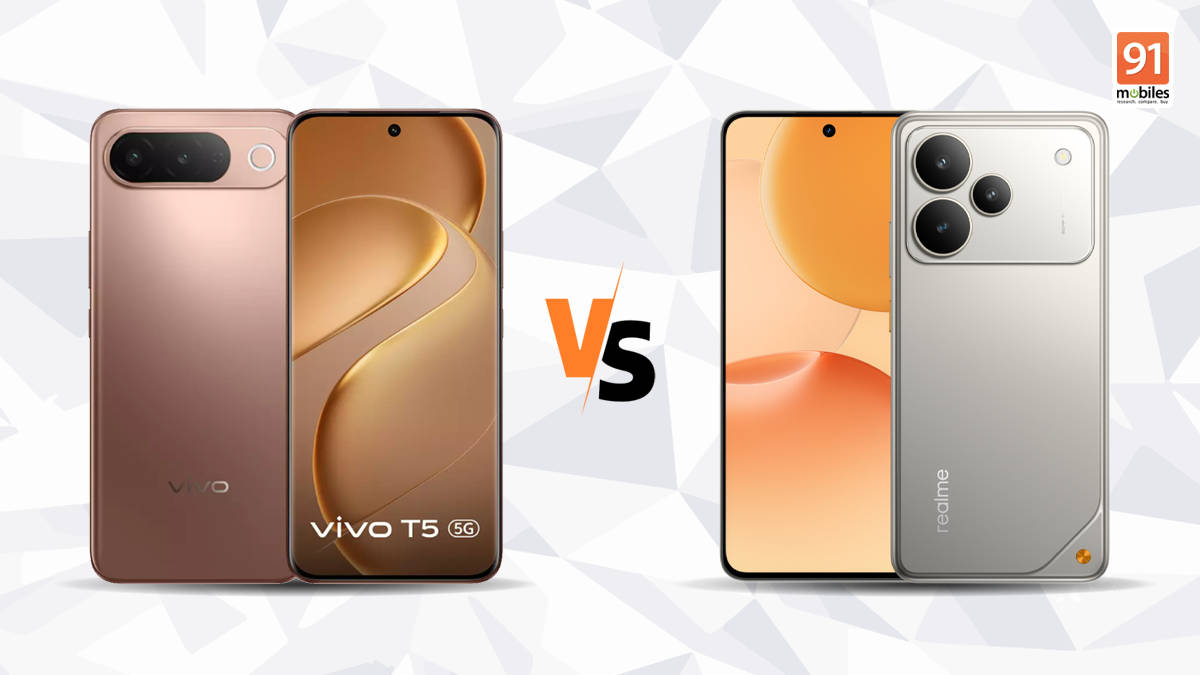
The new mid-range battleground for the Indian smartphone market in 2026 is the Rs 35,000-45,000 segment. This is the price point where you can expect phones to offer most of the basics we were used to in 2025, including an AMOLED panel, a capable mid-range processor, decent RAM and storage options, and an acceptable camera system. The vivo T5 and realme P4s sit at the very start of this segment and cost about the same.
However, the two phones take different approaches. The realme P4s 5G focuses more on gaming and battery life, while the vivo T5 5G aims for a more balanced experience across performance, cameras, display and design. Both offer strong hardware for around Rs 35,000, but their priorities are quite different. In this comparison, we’ll look at how they stack up based on their specifications alone.
Table of Contents
Vivo T5 vs Realme P4s: design
The realme P4s 5G and vivo T5 5G have very different approaches when it comes to design. The realme P4s has a flat frame and a more youthful, quirky look, while the vivo T5 goes for curved edges and a more elegant design. The vivo is also lighter and thinner at 199g and 8mm, compared with 208g and 8.6mm on the realme, so it should feel a little easier to carry and hold.


Both phones offer pretty decent dust and water resistance, although realme has a slight advantage with IP66, IP68 and IP69 protection, while the vivo T5 gets IP68 and IP69. Overall, this one comes down largely to personal preference, with the realme likely to appeal more to younger users looking for a distinctive design, while the vivo should work better for those who prefer a more classic look.


Vivo T5 vs Realme P4s: display
Both phones use 144Hz AMOLED panels, but the Vivo T5 5G has a slight advantage when we look at the specifications. It uses a 6.78-inch Samsung M14 AMOLED panel with a 1272 × 2772-pixel resolution, 240Hz touch sampling rate, up to 1,400 nits HBM (6,500 nits peak) and 100 percent DCI-P3 coverage.
The vivo T5 has a slightly larger 6.83-inch AMOLED display with a 1260 × 2800-pixel resolution, DCI-P3 support and a 300Hz touch response rate. It lists 2,000 nits HBM (3,000 nits peak), giving it an advantage in brightness.
Both should offer a largely similar experience thanks to their high-resolution AMOLED panels and 144Hz refresh rates. While the vivo T5 has an edge in some specifications, it would be difficult to notice much difference in everyday use given how closely matched the two displays are.
Vivo T5 vs Realme P4s: performance
The vivo T5 5G has the better processor here with the MediaTek Dimensity 7500, which sits above the realme P4s 5G’s Dimensity 7400 Ultra in MediaTek’s lineup. Both use 4nm octa-core chips with a maximum clock speed of 2.6GHz, so the difference isn’t going to be massive, but the newer vivo chipset should deliver roughly 10-15 percent better performance based on the positioning of the two platforms.


Both phones use LPDDR4X RAM and UFS 3.1 storage, but the realme starts with 8GB RAM, while the vivo T5 also offers a 6GB option. Both top out at 12GB RAM and 256GB storage, with no microSD expansion. The realme phone therefore has a slight advantage in the base configuration, but the vivo offers more choice across its variants. Overall, the vivo T5 has the edge performance-wise, although the difference should remain relatively modest in everyday use.
Vivo T5 vs Realme P4s: battery
The realme P4s 5G has a clear advantage here, with a much larger 8,000mAh battery compared with the 7,050mAh unit on the vivo T5 5G. It also supports 80W charging, while the vivo T5 maxes out at 44W. This gives the realme a substantial advantage both in battery capacity and charging speed.
The realme P4s should therefore last longer between charges, especially for users who spend a lot of time gaming or watching content. The vivo T5’s 7,050mAh battery is still quite large for a phone in this segment, but realme wins this round comfortably.
Vivo T5 vs Realme P4s: cameras
The camera setups on the realme P4s 5G and vivo T5 5G are largely similar, with both offering a 50MP primary camera and an 8MP ultrawide camera on the back. The vivo T5 has an advantage on the front, though, with a higher-resolution 32MP selfie camera compared with the 16MP sensor on the realme.
Overall, there isn’t a major difference between the two setups on paper, but the vivo T5 gets the edge thanks to its higher-resolution front camera.
Vivo T5 vs Realme P4s: software
Talking about software, both offer three major OS upgrades, but the vivo T5 5G gets an extra year of security updates, with five years of security support compared with four years on the realme P4s 5G. This gives the vivo a slight advantage if you plan to keep the phone for several years.
Both also offer a similar set of AI tools and software extras, although realme puts more emphasis on gaming-focused features and controls. That should make the P4s more appealing to gamers, while the vivo T5’s longer security support gives it the advantage for long-term use.
Vivo T5 vs realme P4s: Which one should you buy?
The realme P4s 5G and vivo T5 5G might be priced similarly but in essence, they cater to different audiences. The realme P4s is better suited to gamers and heavy users, with its larger 8,000mAh battery, faster 80W charging, 8GB RAM in the base variant and gaming-focused software features. Its design also has a more youthful character, which may appeal to users who want something a little different.
The vivo T5 is the more balanced option for most general users. It has a slightly more powerful processor, a larger and brighter display, a lighter and slimmer design, a 32MP selfie camera and longer security support. It is suitable for users who want a phone that does a bit of everything without heavily prioritising one particular area.