Acer Aspire 5 A514-54H Review: All the Performance Without the Premium


Review Summary
Expert Rating
Here’s what Acer is attempting with the Aspire 5 A514-54H: take a chip that usually sits inside Rs 90,000-plus ultrabooks, stuff it into a familiar slab chassis that’s been around in various forms since the Tiger Lake era, and sell it at a price that undercuts the competition by a meaningful margin. On paper, it’s a strange proposition. Intel’s Core Ultra 5 125H is a Meteor Lake part with a hybrid 14-core architecture, a dedicated NPU, and Intel Arc integrated graphics that, in theory, can handle light gaming. None of that is typical Aspire 5 territory.

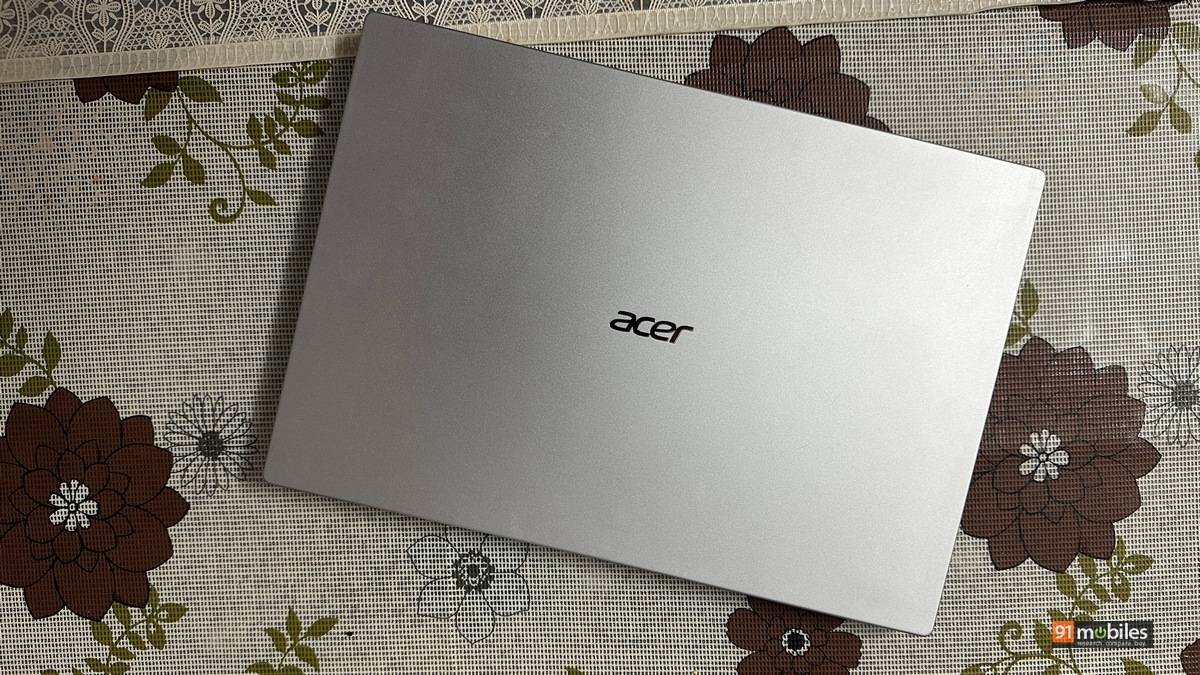
In practice, the A514-54H turns out to be one of the more interesting budget laptops to land in India this year. It is a machine that is bluntly utilitarian on the outside but quietly competent on the inside, backed by performance benchmark results that punch well above its class. Whether the compromises are acceptable is a different question.
Specifications at a Glance
- Processor: Intel Core Ultra 5 125H (14 cores, 18 threads, up to 4.5GHz)
- RAM: 16GB DDR5
- Storage: 512GB PCIe Gen 4 NVMe SSD
- Display: 14-inch FHD IPS, 1920×1080, Anti-glare
- GPU: Intel UHD Graphics
- Battery: 50Wh
- OS: Windows 11 Home Single Language (64-bit, Build 26200)
- Weight: 1.2kg
- Price (India): Rs 79,999
Table of Contents
Design, Build & Connectivity
Let’s be clear about what this laptop is and is not. It is not a premium machine. The Aspire 5’s chassis is unchanged in all the ways that matter: a plastic lid, a silver-grey body, and build quality that feels adequate rather than inspiring. The lid flexes when you press on it, and the base chassis has a bit of give around the keyboard deck. Nothing creaks, nothing rattles, but there’s no mistaking this for a ThinkPad or a Dell XPS.

What it does well is remain genuinely portable. At 1.2kg and measuring 312 × 218 × 17.5mm, it’s thin enough to slide into a bag without thought, and light enough that you’ll forget it’s there on a short commute. The hinge opens with one hand from the front, which is a small but appreciated quality-of-life detail, and it lifts the rear of the chassis slightly when opened, improving airflow and giving the keyboard a mild tilt.
The port situation is better than you’d expect. On the left spine, you get a USB-A 3.2 Gen 1, a USB-C (which supports display output and charging), a Kensington Lock, and an HDMI 2.1 port. On the right, there are two more USB-A ports, a 3.5mm audio combo jack, and a microSD card slot. Ethernet, however, is absent, a meaningful omission for anyone who needs a reliable wired connection in an office. Wireless connectivity is handled by Wi-Fi 6 (802.11ax) and Bluetooth 5.3, and both performed reliably throughout testing.

The webcam is a 720p unit that produces acceptable but not impressive video quality in well-lit conditions. In low light, it softens noticeably. There is no IR camera for Windows Hello facial recognition, but a fingerprint reader is embedded in the power button and works quickly and consistently.
Display
The 14-inch FHD IPS panel here is the compromise that most clearly separates this machine from the tier above. At 1920×1080, it’s a 16:9 display with an anti-glare treatment, narrow bezels, and adequate brightness for indoor use. Acer doesn’t publish a nits rating for this specific panel, but it falls within the 250–300 nits range typical for this segment, which means outdoor legibility is limited to overcast conditions at best. Direct sunlight is not this screen’s friend.

Colour reproduction is serviceable for productivity but nothing more. The IPS panel covers a reasonable portion of the sRGB spectrum for an entry-level offering, making it fine for document work, coding, browsing, and light photo review. Creatives working with colour-sensitive material will find the gamut limiting and should look elsewhere. Viewing angles are solid, as expected of IPS, and there’s no significant colour shift when moving off-axis.
The panel is not the display story of this laptop. That story is the processor and what it can push through it, which we’ll get to.
Keyboard and Trackpad
The keyboard is one of the Aspire 5’s stronger points. The full-sized layout with numeric keypad gets a comfortable amount of key travel, tactile feedback, and a backlight that’s adjustable between two brightness levels. It’s not the springiest keyboard in the category. We think that the Lenovo IdeaPad Slim 5 and HP Victus 15 both edge it out, but for a day of sustained typing, it is genuinely comfortable. Key placement is conventional, and the layout avoids the cramped function row that plagues some 14-inch competitors.

The trackpad is a smooth surface, large enough for comfortable multi-finger gesture use, and integrates well with Windows 11’s precision touchpad implementation. Scrolling, pinching, and three-finger swipes all register cleanly. It won’t be confused with a MacBook trackpad, but it sits near the top of what’s achievable in this price band.

Performance and Graphics
This is where the A514-54H makes its most compelling argument. Intel’s Core Ultra 5 125H is a Meteor Lake chip with 6 Performance cores (P-cores, up to 4.5GHz), 8 Efficient cores (E-cores, up to 3.4GHz), and a dedicated NPU. It is the kind of architecture that was still considered mid-to-upper-midrange just twelve months ago. Acer has given it 16GB of DDR5 RAM and a PCIe Gen 4 NVMe SSD, both of which remove two common bottlenecks that plague budget machines at this price point.
The benchmark results across our suite of tests are measurably strong for the segment.
- Cinebench R23 returned a multi-core score of 9,350 points and a single-core score of 1,709 points, placing it solidly in the current tier of capable H-series laptop chips. The MP ratio of 5.47x is consistent with a chip that’s not being aggressively power-limited by the chassis.
- Cinebench 2024 showed 527 points multi-core and 100 points single-core (5.29x MP ratio), which aligns with typical Core Ultra 5 125H performance in a ventilated 28W-class chassis.
- Cinebench 2026, Maxon’s latest iteration, pushed the chip to 2,169 points multi-core and 557 points single-core, with a 5.34x MP ratio that indicates consistent, sustained performance.
- Geekbench 6 results tell a similar story: 2,256 single-core / 8,309 multi-core. These are numbers that sit comfortably above what you’d see from an Intel Core i5-1235U or even most AMD Ryzen 5 7430U configurations in this price range.
- On CrossMark, the overall score of 1,552 broke down into Productivity: 1,545, Creativity: 1,557, and Responsiveness: 1,561, giving a balanced result that reflects the chip’s suitability for multitasking workflows.
- The SSD deserves a special mention. CrystalDiskMark clocked sequential reads at 7,040 MB/s and writes at 5,245 MB/s (Q8T1), numbers that are frankly remarkable for a laptop in this class. Real-world transfers, application launches, and cold boot times reflect this. The system feels fast in a way that many Rs 80,000+ laptops with cheaper NVMe drives simply do not. The Q1T1 sequential results of 4,956 MB/s read / 5,228 MB/s write confirm this isn’t a queue-depth fluke.
- PCMark 10 delivered a score of 7,118 in the standard benchmark, with Essentials at 10,365, Productivity at 11,353, and Digital Content Creation at 8,316. The Extended test came in at 6,589, with a Gaming sub-score of 3,732 that reflects the integrated graphics ceiling. Spreadsheets (17,015) and Photo Editing (13,465) particularly stand out for productivity-heavy use cases.
On the graphics side, the integrated Intel UHD Graphics in the Core Ultra 5 125H delivers performance that is more than satisfactory for an integrated service.
- 3DMark Time Spy scored 2,450 overall (Graphics: 2,207, CPU: 6,549), which is below the 3,365 average for this hardware category, while Time Spy Extreme came in at 1,130 (Graphics: 1,017, CPU: 3,099).
- 3DMark Fire Strike returned 4,571 (Graphics: 4,962, Physics: 20,115, Combined: 1,663), Fire Strike Extreme scored 2,279, and Fire Strike Ultra came in at 1,318, both telling the same story: the iGPU has headroom the chassis doesn’t fully exploit.
- 3DMark Night Raid, designed specifically for integrated graphics workloads, was the most flattering test at 18,327 (Graphics: 22,070, CPU: 9,347), sitting below the 24,183 average for comparable hardware but well within daily-use gaming territory for lighter titles.
- Geekbench 6 Compute returned 24,535 (OpenCL) and 25,054 (Vulkan), confirming the iGPU has genuine compute capability for GPU-accelerated tasks.
- Geekbench AI produced two runs: the first showed Single Precision: 2,342 / Half Precision: 1,165 / Quantised: 4,944; the second returned Single Precision: 2,267 / Half Precision: 2,307 / Quantised: 5,770. The variance across runs is typical for NPU workloads. The numbers indicate the NPU is functional for on-device AI tasks like background blur and noise cancellation, but won’t run serious local inference on large models.
What does all this mean in practice? The A514-54H handles everyday office work, browser-heavy multitasking, video calls, and even moderate creative workloads like Lightroom adjustments, 1080p video timelines, without complaint. For casual gaming: titles like Valorant, CS2, and older esports games run at 1080p with settings tuned to medium with acceptable frame rates. Don’t expect the UHD GPU to keep up in Cyberpunk or anything demanding at full settings.

Fan noise during sustained load is noticeable but not aggressive. The machine warms up under extended CPU stress, although the keyboard deck stays comfortable, but the bottom can get warm to the touch.
Audio and Battery
The dual-speaker setup on the Aspire 5 delivers sound that is adequate for calls and YouTube but unimpressive for music. Midrange clarity is reasonable at moderate volumes, but bass is essentially absent, and at high volume, treble can get harsh. There’s no DTS or Dolby processing on this model to compensate. Headphones are the obvious solution, and the combo audio jack supports them well.

Battery life, by contrast, is a genuine strength. PCMark 10’s Video playback test, which loops a video from 100% to 4% with display at a standardised brightness, ran to 11 hours 15 minutes. Real-world mixed usage (browsing, documents, occasional video) consistently delivered 8–9 hours in our testing. This is comfortably all-day battery territory, and it’s a direct result of the Meteor Lake chip’s improved efficiency at typical laptop TDP levels. Recharging via USB-C is supported, and the included adapter charged the laptop to full in approximately 90 minutes.


Final Verdict
The Acer Aspire 5 A514-54H is not a laptop that tries to be everything. The display is merely acceptable, the build quality is functional rather than premium, the speakers are forgettable, and the lack of Ethernet means it’s not the ideal desk-bound workhorse. None of that is surprising for the price.

What is surprising, and what makes this machine worth paying attention to, is what Acer has put inside it. The Core Ultra 5 125H is a legitimately capable processor that delivers Cinebench R23 multi-core numbers in the 9,000+ range, integrated graphics that handle tasks older iGPUs couldn’t, and a PCIe Gen 4 SSD with 7GB/s sequential reads that is a genuine outlier for this segment. Battery life crossing 11 hours in a standardised test is the icing on top.
For a student, a first-time professional laptop buyer, or anyone who needs a capable daily driver without spending Rs 90,000+, the Aspire 5 A514-54H makes a strong case. Just plan on using headphones.
Editor’s Rating: 7.8 / 10
Pros:
- Intel Core Ultra 5 125H delivers well above-average performance for the price
- Exceptional NVMe SSD speeds
- Great battery life
- Good keyboard with comfortable travel and backlight
Cons:
- FHD IPS panel is serviceable but unambitious
- Plastic chassis feels budget-grade
- Speakers lack bass and sound flat at volume