ASUS ProArt GoPro Edition PX13 (HN7306) review: Powerful, portable, but priced at a premium


Review Summary
Expert Rating
ASUS launched the ProArt PX13 almost two years ago, essentially reworking the ROG Flow X13 into a more creator-focused machine. This year, the company has doubled down on that vision by partnering with action camera manufacturer GoPro to introduce a refreshed version of its compact powerhouse. The new “GoPro Edition” retains the same sleek and versatile design with subtle visual changes, but more importantly, it brings a significant performance boost courtesy of AMD’s latest Strix Halo chip.
Aimed squarely at content creators, vloggers, and professionals who need a portable yet powerful editing machine, the ProArt GoPro Edition PX13 also leans into software and workflow integrations that complement action camera content creation. On paper, it looks like a well-rounded upgrade that builds on an already strong foundation. But with an eye-watering price tag of Rs 3,34,000, driven in part by rising memory costs, does it actually justify the premium, or is it simply too expensive for what it offers?

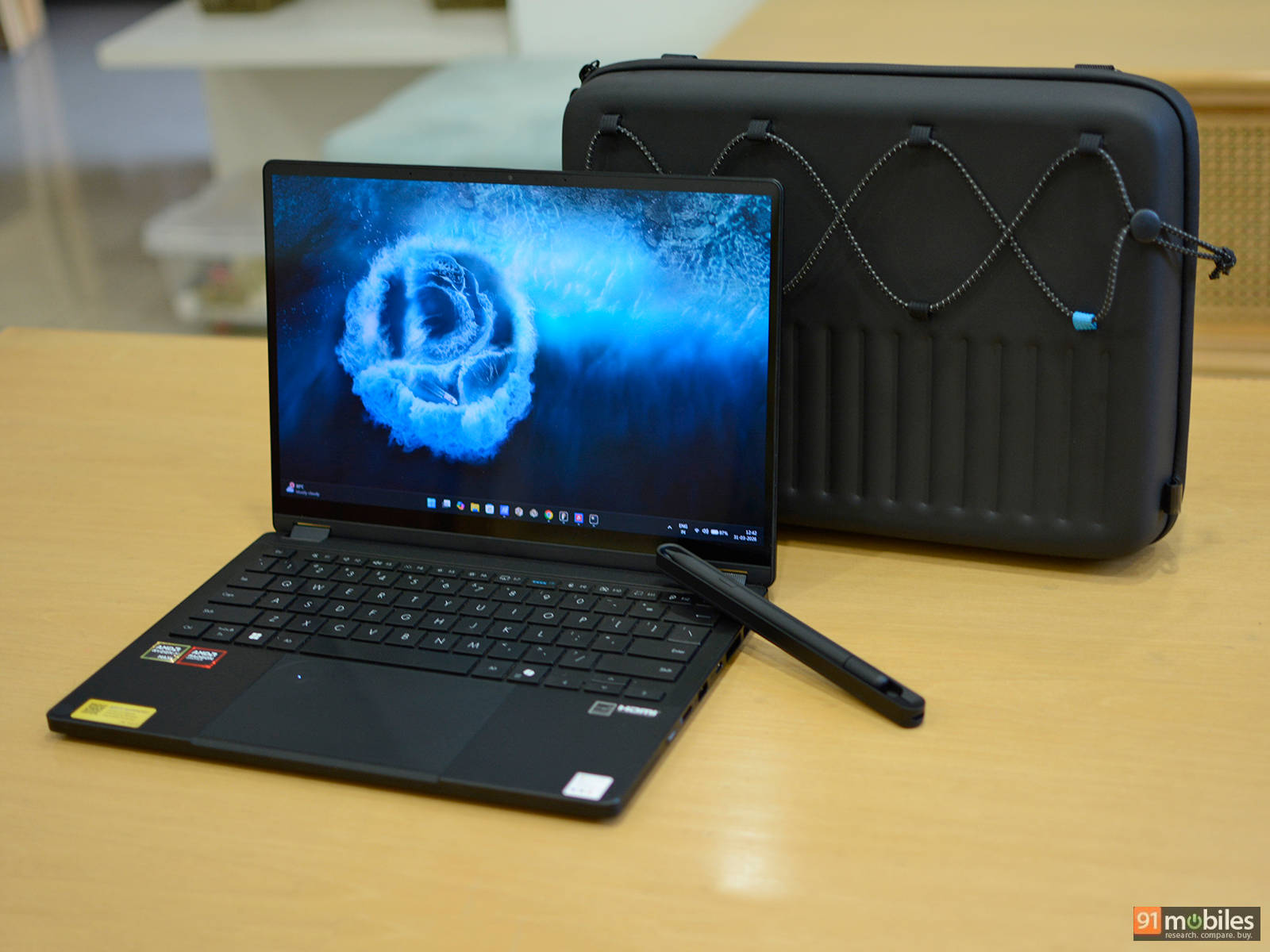
Table of Contents
Design and build
At first glance, the GoPro Edition of the ASUS ProArt PX13 doesn’t reinvent the wheel, and that’s largely intentional. The core chassis design remains identical to the original model, retaining its clean, creator-focused aesthetic with a minimalist matte finish. Compared to the original PX13, the changes are mostly cosmetic rather than structural. ASUS has added subtle GoPro-inspired touches, including a ribbed pattern on the lid and ridges around the edges and hinge, similar to some of the latest GoPro cameras. There’s even a dedicated GoPro hotkey on the keyboard, highlighted in a bright blue colour.

For a performance-focused creator machine, the new PX13 remains impressively portable. It weighs just 1.39kg and measures between 15.8mm to 17.7mm in thickness, making it easy to carry around for on-the-go editing workflows. The compact 13.3-inch form factor, combined with its 360-degree hinge, allows it to be used in multiple modes, including laptop, tent, and tablet, which adds a layer of flexibility for creators working in different environments. These modes are particularly useful for graphic designers, especially when paired with the included ASUS Pen, which offers solid haptic feedback and comes with its own dedicated charging cradle.

ASUS has also ensured that the laptop is built to withstand more demanding use cases. The laptop meets MIL-STD-810H military-grade durability standards, meaning it can handle minor drops, vibrations, and temperature variations. This aligns with its positioning as a device for outdoor creators and action shooters. The overall build quality feels solid, with a sturdy metal chassis that doesn’t flex easily.

In terms of connectivity, the PX13 offers a well-rounded selection of I/O ports, including two USB 4.0 Type-C ports (with support for display output and power delivery), a USB 3.2 Gen 2 Type-A port, a full-size HDMI 2.1 port, and a 3.5mm audio jack. There’s also a microSD card reader, which is particularly useful for creators working with cameras and action cams.

That said, the absence of a full-size SD card slot may still be a minor inconvenience for some professional workflows. For wireless connectivity, the laptop continues to offer a Wi-Fi 7 and Bluetooth 5.4 combo card.

The internal layout is identical to the previous model and includes a single M.2 2230 SSD slot, a wireless card, a 72WHr battery, and a dual-fan cooling system with three cooling pipes. As with most modern thin and light notebooks, the memory is baked into the system and is not replaceable/upgradable.

As a side note, we wanted to highlight the unique packaging of this laptop, which includes special Velcro straps around the box. Additionally, you get a rugged carrying case with bungee cords on the outside that can be used to carry GoPro accessories, such as a small selfie stick.
Display and audio
The ProArt GoPro Edition PX13 continues to carry over the same display panel as the standard PX13, which is by no means a drawback. It features a 13.3-inch OLED touchscreen with a 3K (2880 x 1800) resolution and a 16:10 aspect ratio, making it ideal for both content consumption and creation. Being an OLED panel, it delivers excellent contrast with true blacks, along with vibrant colors and wide viewing angles. ASUS has also tuned the display for creators, with 100% DCI-P3 color gamut coverage and factory calibration, ensuring accurate color reproduction for photo and video work.

The panel supports HDR True Black 500, which enhances dynamic range when working with HDR content or simply streaming compatible media. Additionally, the glossy finish and touch support, combined with stylus compatibility, make it versatile for sketching, annotations, or quick edits in tablet mode.
The 500-nits rated brightness is generally sufficient for indoor use, although like most glossy OLED panels, reflections can become noticeable under harsh lighting conditions. That said, the overall visual experience is top-tier for a device in this form factor, balancing sharpness, color accuracy, and fluidity.

One notable drawback, carried over from the previous model, is that the panel is limited to a 60Hz refresh rate. While this may not be a dealbreaker for most creators focused on color accuracy and resolution, one expects a high-refresh rate when spending well over Rs 3,00,000.
On the audio front, the new PX13 is equipped with bottom-firing speakers tuned by Harman Kardon. The speakers deliver clear mids and highs, making dialogue and vocals stand out, which is particularly useful when editing video or reviewing content. However, as expected from a compact 13-inch chassis, bass response is limited, and the overall soundstage isn’t as expansive as larger laptops.
Keyboard, touchpad, and webcam
The keyboard on the GoPro Edition PX13 is the same as last year, with a standard chiclet-style design with adequately spaced keys, making it easy to adapt to even during longer typing sessions. Key travel is decent for a device this thin, although it doesn’t quite reach the tactile satisfaction of thicker creator laptops. The keyboard backlighting has been updated with blue LEDs, which again aligns with the GoPro branding. It is bright, evenly distributed, and useful in low-light environments, though we would have liked to see per-key customization, which can be pretty useful for creators who like their macros. ASUS has also included a dedicated GoPro hotkey that can be used to quickly fire up the GoPro Player app.

Moving to the touchpad, it is a generously sized touchpad that feels smooth and precise in everyday use. Tracking is accurate, and Windows gestures are handled reliably, making navigation effortless. The DialPad integrated into the touchpad can be activated by swiping diagonally from the top right corner to provide contextual controls in supported creative applications like Adobe Photoshop and Premiere Pro. It’s an interesting feature that can help speed up workflows for creators who rely on fine adjustments such as brush sizes, timeline scrubbing, or zoom controls. It can even be used to simply adjust the volume or display brightness. That said, like most virtual implementations, it does take a bit of time to get used.

The laptop includes a full HD 1080p webcam, which is similar to what we saw on the original PX13. The image quality isn’t the best, especially if you are not sitting in a bright, well-lit room, which results in washed-out colours and loss of details. On the plus side, though, it offers support for Windows Studio Effects, while the Windows Hello facial recognition works fast and accurately.
Performance
At the heart of the laptop is AMD’s Ryzen AI Max+ 395 processor, the same chip we previously tested on the ASUS ROG Flow Z13 Kojima Edition, where it delivered promising results across both gaming and productivity workloads. This high-end mobile processor features a 16-core, 32-thread configuration, offering strong multi-core scalability alongside excellent single-threaded performance with boost clock speeds of up to 5.1GHz. It also integrates an NPU to accelerate AI-driven tasks with up to 50 TOPS of performance, making it well-suited for modern creative and productivity workflows.
On the graphics side, the processor integrates the Radeon 8060S iGPU, which comes with 40 compute units (CUs) based on AMD’s latest RDNA architecture. This makes it one of the most powerful integrated GPUs currently available, capable of handling GPU-accelerated creative workloads such as video editing, color grading, and even light 3D work without the need for a dedicated GPU.
The Ryzen AI Max+ 395 also comes with 128GB of LPDDR5X unified memory, which is shared between the CPU and GPU. This is a key highlight of this platform, where users can manually allocate more memory as VRAM via the MyASUS or ProArt Creator Hub apps, depending on workload requirements. By default, the system dynamically adjusts memory allocation, which is how we conducted most of our testing.

For storage, the laptop comes with a 1TB PCIe Gen 4 SSD, which delivers excellent results. We recorded sequential read speeds of up to 6,941MB/s and write speeds of 6,256MB/s in CrystalDiskMark, which is right in line with what you’d expect from a high-performance Gen 4 drive.
Compared to the previous-generation ASUS ProArt PX13, the new PX13 shows a significant improvement in multi-core performance. In Cinebench R23, the score jumps from 16,900 to 28,576, while Cinebench R24 improves from 832 to 1,558, which suggests a major boost in rendering and other heavily threaded workloads. Single-core performance, however, remains largely similar, with only minor gains across benchmarks.
| Laptop | ASUS ProArt GoPro Edition PX13 (2026) | ASUS ProArt PX13 (2025) |
| CPU | AMD Ryzen AI MAX+ 395 | AMD Ryzen AI 9 365 |
| GPU | AMD Radeon 8060S | NVIDIA GeForce RTX 4050 |
| RAM | 128GB | 24GB |
| Cinebench 2026 MT | 6350 | NA |
| Cinebench 2026 ST | 454 | NA |
| Cinebench R24 MT | 1558 | 832 |
| Cinebench R24 ST | 112 | 113 |
| Cinebench R23 MT | 28576 | 16900 |
| Cinebench R23 ST | 2003 | 1956 |
| PCMark 10 | 10313 | 7572 |
| PCMark 10 Extended | 12451 | 9278 |
| CrossMark - Overall | 2217 | NA |
| Geek Bench 6 ST | 2905 | 2793 |
| Geek Bench 6 MT | 18994 | 14175 |
| CPU - ONNX - Single Precision | 5880 | NA |
| CPU - ONNX - Half Precision | 2238 | NA |
| CPU - ONNX - Quantized Score | 10704 | NA |
| CPU - OpenVINO - Single Precision | 6372 | NA |
| CPU - OpenVINO - Half Precision | 6448 | NA |
| CPU - OpenVINO - Quantized Score | 18180 | NA |
| Puget benchmark - DaVinci Resolve | 6231 | NA |
In Geekbench 6, multi-core performance increases from 14,175 to 18,994, while single-core sees a small bump. System-level performance also sees an improvement, where the laptop scored 10,313 as opposed to 7,572 in PCMark 10 while the extended score went from 9,278 to 12,451, indicating better overall responsiveness in day-to-day and productivity tasks.
| Laptop | ASUS ProArt GoPro Edition PX13 (2026) | ASUS ProArt PX13 (2024) |
| CPU | AMD Ryzen AI MAX+ 395 | AMD Ryzen AI 9 365 |
| GPU | AMD Radeon 8060S | NVIDIA GeForce RTX 4050 |
| RAM | 128GB | 24GB |
| Geek Bench OpenCL | 88920 | 80950 |
| Geek Bench Vulcan | 86043 | 41984 |
| 3DMark Time Spy Extreme | 4898 | 3505 |
| 3DMark Time Spy | 9705 | 7503 |
| 3DMark Fire Strike Ultra | 6092 | 3837 |
| 3DMark Fire Strike Extreme | 11856 | 8900 |
| 3DMark Fire Strike | 23342 | 15830 |
| 3DMark Night Raid | 59144 | 39126 |
When it comes to GPU performance, the Radeon 8060S holds its own remarkably well for an integrated solution. Compared to the low-watt Nvidia RTX 4050 dedicated GPU solution on the previous model, the new ProArt PX13 scored 9,705, up from 7503, while Time Spy Extreme improved from 3,505 to 4,898. The advantage continues in the Fire Strike suite, with Fire Strike Ultra rising from 3,837 to 6,092, Fire Strike Extreme from 8,900 to 11,856, and standard Fire Strike from 15,830 to 23,342. In Geekbench OpenCL, the score goes up from 80,950 to 88,920, while Vulkan performance is more than double, jumping from 41,984 to 86,043.
Now this machine is not really meant for gaming, but the iGPU solution offers enough juice to run demanding AAA titles. In our testing, lighter esports titles like Valorant ran exceptionally well, delivering up to 376 FPS at 1080p. More demanding games like Cyberpunk 2077 were also playable, with 76 FPS at 1080p native, scaling up to 95 FPS with upscaling. Similarly, Forza Horizon 5 performed well with 94 FPS at 1080p native and around 60 FPS at 1440p, while heavier titles like Black Myth: Wukong hovered between 30–39 FPS depending on settings and upscaling.
The hardware also shows strong capabilities when it comes to AI-accelerated workloads. In Geekbench AI (ONNX) tests, the system scored 5,880 (single precision), 2,238 (half precision), and 10,704 (quantized), which translates into solid performance across different inference workloads. In OpenVINO-based tests, the system achieved 6372 (single precision), 6448 (half precision), and 18,180 (quantized score). These results focus on the platform's ability to efficiently handle optimized AI workloads, particularly those that benefit from lower precision and quantization, which are common in real-world applications like image enhancement, background processing, and AI-assisted editing.
Overall, the combination of the Ryzen AI Max+ 395 and Radeon 8060S iGPU delivers a powerful and efficient performance package. With its high core count and massive unified memory pool, the PX13 strikes an excellent balance between portability and performance for demanding creative workflows.
Battery and power
ASUS continues to offer the same 73Wh battery paired with a 200W charging brick as the previous model. In day-to-day usage scenarios like web browsing and document editing, the laptop delivers roughly 8 hours of battery life. In our PCMark 10 video battery test, the new PX13 GoPro Edition lasted 8 hours and 21 minutes, which is slightly lower than the original PX13, likely due to the more power-hungry processor.

That said, battery life remains respectable for everyday workloads, although it still falls short of the efficiency offered by devices like Apple's MacBook lineup or systems powered by Intel's newer Panther Lake chips.
Verdict
The ASUS ProArt GoPro Edition PX13 builds on a solid foundation and pushes it further with a meaningful performance upgrade. The introduction of AMD's Ryzen AI Max+ 395 brings a massive jump in compute performance, significantly stronger integrated graphics, and capable AI acceleration, all within a compact and versatile 13-inch form factor. Add to that the colour-accurate 3K OLED display, flexible 360-degree hinge design, and thoughtful creator-centric features like the DialPad and stylus support, and the PX13 continues to stand out as a highly portable yet powerful machine for content creators.
However, there are some compromises. The 60Hz panel feels limited at this price point, the webcam quality is below average, and battery life, while decent, doesn't quite match the efficiency of competing platforms. The lack of a full-size SD card slot may also be a concern for some professional users.
At a steep asking price of Rs 3,34,990, the ProArt GoPro Edition PX13 clearly sits in the premium segment. It's not a device for everyone, but for creators who specifically need a compact, versatile machine with strong CPU performance, capable graphics, and a large pool of unified memory. For what it's worth, it offers a unique combination that's hard to find elsewhere.
Editor's rating: 7.5 / 10
Pros:
- Solid build quality
- Punchy 3K OLED display
- Best in class performance
- 128GB of unified memory
- Solid keyboard and touchpad
Cons:
- 60Hz refresh rate
- Loud fans under load
- Very expensive
- Poor webcam performance