Intel Core Ultra 7 270K Plus Review: The new mid-range king?


Intel’s new Core Ultra 200S Plus lineup marks a subtle but important shift in strategy. Instead of pushing only top-end silicon, the company is now betting big on its mid-range chips, and we’ve got the Core Ultra 7 270K Plus in for testing. Interestingly, Intel itself positions this as the processor most gamers should buy, not the flagship. On paper, it brings a refreshed architecture, more cores, faster memory support, and even some software-level tricks to boost performance. But does all of that actually translate into real-world gains? Let’s find out.
Table of Contents
Intel Core Ultra 7 270K Plus: What’s New?
At the heart of the Core Ultra 7 270K Plus is a 24-core (8 Performance + 16 Efficiency cores) design, which is a big deal because this configuration was previously reserved for the flagship tier. In simple terms, what used to be “Ultra 9 territory” has now trickled down into a much more affordable bracket. As a result, it comes with more multitasking muscle and offers better background handling without the user paying a premium.

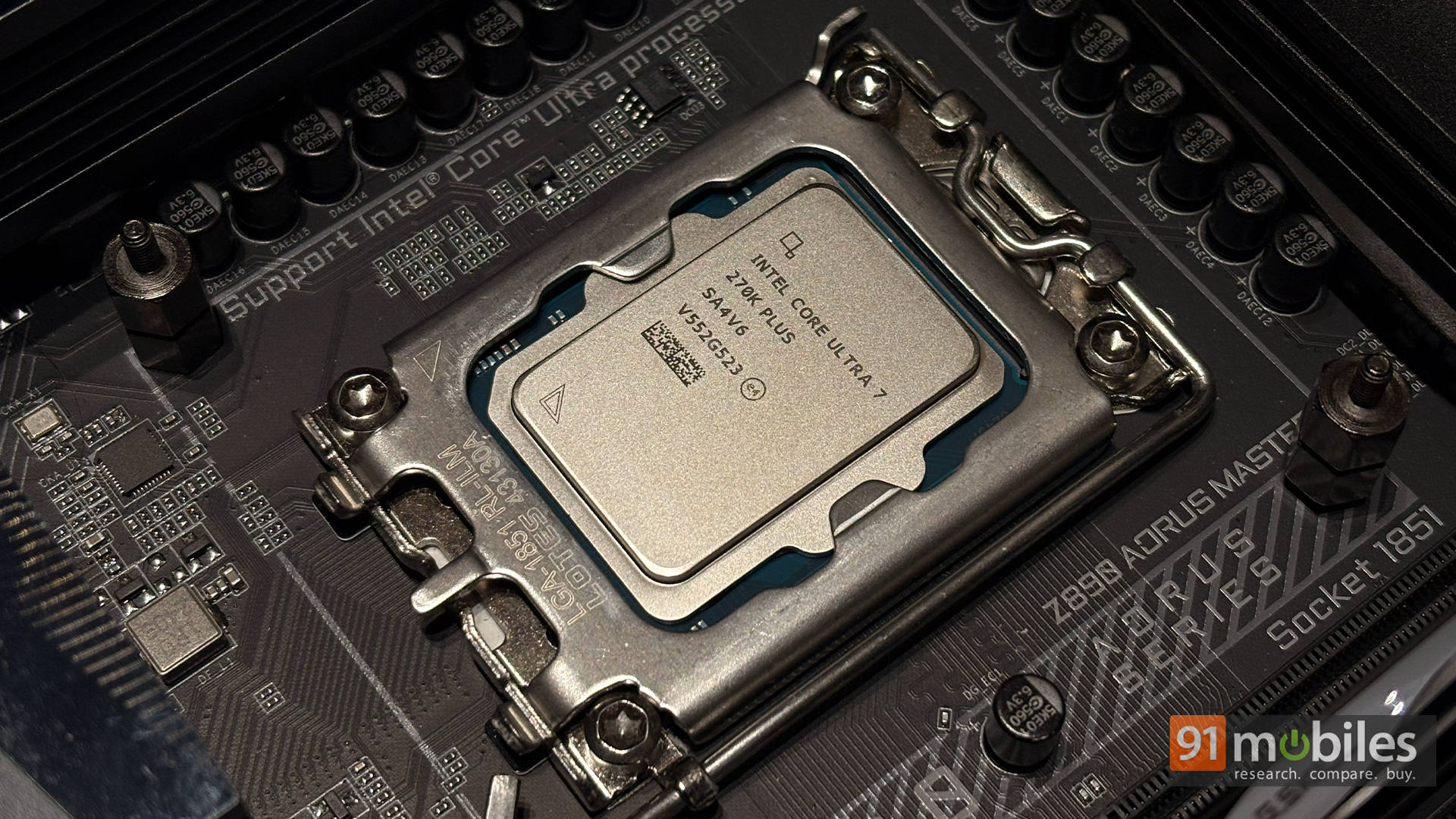
Intel has also doubled down on memory and platform improvements. The chip officially supports DDR5-7200, with even higher speeds possible via overclocking. There’s also better interconnect speeds internally, which helps reduce latency. That’s something that directly impacts gaming smoothness, even if it doesn’t always show up in raw FPS numbers.
Then there’s the software side of things, which is honestly the most interesting part this time. Intel Application Optimization (APO) and the new Intel Binary Optimization Tool aim to improve how games and apps run on the CPU. Think of it as Intel trying to “fix” how software uses its hardware, without developers needing to update anything. It sounds futuristic, and in some ways it is, but as we’ll see later, the real-world impact is still evolving.
Test Bench Explained
Before diving into performance, here’s the setup we used for testing:
CPU Cooler: MSI MAG Coreliquid i360 Black
A 360mm AIO cooler that keeps thermals well under control even under sustained loads. It’s more than capable of handling high-end CPUs like the 270K Plus without thermal throttling.
Motherboard: Gigabyte AORUS Z890 Master
A premium Z890 board with robust VRMs and excellent memory support. It ensures stable power delivery and unlocks the full potential of Intel’s latest platform.
RAM: 32GB G.Skill Trident Z5 RGB 7200MT/s
Fast DDR5 memory that aligns perfectly with Intel’s push for higher memory frequencies. Helps in squeezing out better performance in both gaming and productivity.
SSD: 2TB Kingston NV3 NVMe PCIe 4.0
A reliable Gen4 SSD offering fast load times and smooth data access, ensuring storage never becomes a bottleneck during testing.
GPU: ZOTAC GeForce RTX 5090 ARCTICSTORM AIO
This is as flagship as it gets. The RTX 5090 ensures that GPU bottlenecks are virtually eliminated, allowing the CPU to stretch its legs fully. The ARCTICSTORM AIO cooling keeps thermals in check even under extreme loads, while delivering top-tier gaming performance across resolutions. Simply put, this GPU ensures we’re testing the CPU—not the graphics card.
PSU: MSI MAG A1000GL Black
A 1000W power supply that provides stable and efficient power delivery, crucial for high-end components.
Cabinet: MSI MAG PANO 100R PZ Black
A spacious and well-ventilated case that allows optimal airflow and accommodates high-performance hardware comfortably.
Intel Core Ultra 7 270K Plus: Performance Analysis
Starting with synthetic benchmarks, the Core Ultra 7 270K Plus delivers impressive numbers. In Cinebench R24 multi-core, it scores 2532, comfortably beating the Ultra 9 285K and even edging past AMD’s Ryzen 9 9950X3D. Single-core performance is equally solid. While the differences aren’t massive, the 270K Plus holds its ground and even slightly edges ahead in Cinebench R23 and Geekbench single-core tests.
In Geekbench multi-core, the gap widens further, with the 270K Plus hitting 24,630 compared to 22,623 on the Ultra 9. That’s a meaningful jump, especially for workloads that scale across cores. What’s even more interesting is Cinebench 2026, where the 270K Plus posts a multi-core score of 10,228 and a single-core score of 598. These are strong numbers for a mid-range chip and reinforce Intel’s claim that this isn’t just a minor refresh.
Moving to gaming, the differences between the Ultra 7 270K Plus and Ultra 9 285K are surprisingly close. Though in many cases, the 270K Plus either matches or slightly outperforms the flagship. In Cyberpunk 2077, for example, the 270K Plus delivers 149 FPS at 1080p compared to 144 FPS on the Ultra 9. Similar trends continue across resolutions, with marginal but consistent gains.
In Forza Horizon 5 and Assassin’s Creed Shadows, the performance is nearly identical, which tells us something important: at high-end GPU levels, CPU differences start to shrink. However, in esports titles like CS2, the 270K Plus pulls ahead more clearly, hitting 786 FPS versus 748 FPS on the Ultra 9.
Now, here’s the kicker: this is a $300 processor (MSRP) outperforming a chip that costs nearly $560. That’s a massive win in terms of value. As for AMD, we haven’t yet tested the Ryzen 9 9950X3D with the RTX 5090 in our lab, so we can’t comment on direct gaming comparisons just yet. However, based on synthetic benchmarks alone, Intel is looking very competitive, especially when you consider AMD’s chip retails for around $675. We’ll be updating this review once gaming data for AMD is available.
Intel’s Software Tricks: Real or Gimmick
Intel’s new software layer, APO and Binary Optimization Tool, is one of the most talked-about additions, and setting it up is fairly straightforward. Installation is simple, and enabling the feature requires switching to Advanced Mode, which is a one-time process. As for how it actually performs, well, it’s a mixed bag.

Looking at Geekbench, there’s a noticeable improvement. The single-core score jumps from 3346 to 3512, and the multi-core score goes from 23,786 to 24,630. That’s a decent uplift and shows that the optimization layer is doing something meaningful at a system level.


However, in real-world gaming, the difference is far less impressive. In Cyberpunk 2077, the results are practically identical: 149 FPS with optimization versus 152 FPS without at 1080p. Though at higher resolutions, the gap is negligible or non-existent.

Another limitation is game support. At launch, only about a dozen titles are supported, and most of them aren’t exactly new releases. While it’s understandable that Intel is starting small, it does feel like a missed opportunity to showcase this tech with newer AAA titles.
That said, the idea itself is promising. The ability to improve performance at the software level, without needing patches from developers, is genuinely exciting. Right now, the gains are inconsistent, but if Intel continues to expand support and refine the technology, this could become a much bigger deal in the future.
Verdict: Worth It?
On paper, the Core Ultra 7 270K Plus didn’t seem like a massive leap. After all, this is technically a refresh, not a full-blown next-gen upgrade. But in practice, it delivers a surprisingly strong performance uplift. The fact that it consistently matches or even beats the Ultra 9 285K is impressive on its own. Add to that competitive numbers against AMD’s top-tier chip, and suddenly this mid-range processor starts looking like one of the most compelling options in the market.
Does it live up to Intel’s claim of being one of the best gaming CPUs out there? For the most part, yes. While AMD’s X3D chips may still hold an edge in certain scenarios, the overall value-for-money proposition here is hard to ignore. You’re essentially getting flagship-level performance at a much lower price, and that alone makes the Core Ultra 7 270K Plus a very easy recommendation for gamers and power users alike.
Editor’s Rating: 8.8 / 10
Pros:
- Excellent price-to-performance ratio
- Beats Ultra 9 285K in many scenarios
- Strong multi-core performance
- Future-facing software optimizations
Cons:
- Limited game support for the Binary Optimization Tool