The real focus of Nvidia DLSS 5 isn’t AI slop, it’s adoption


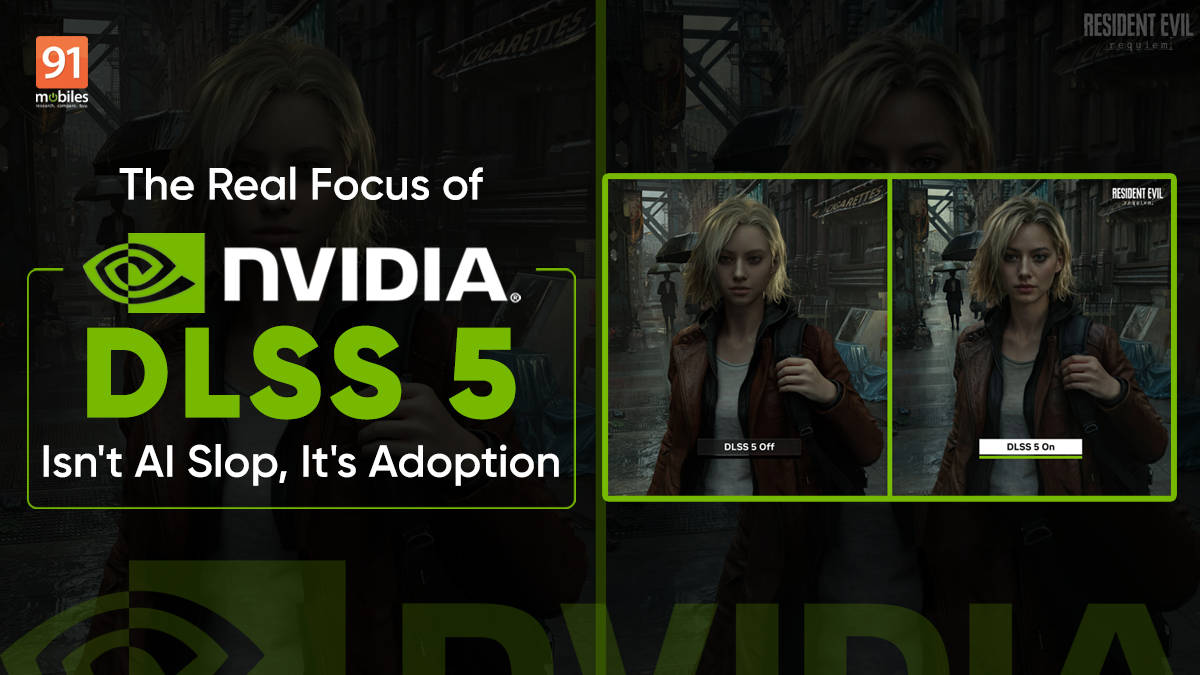
To say that everyone on the internet was displeased by Nvidia’s latest technological showcase of DLSS 5 would be an understatement. Minutes after Jensen Huang went on stage and announced that DLSS 5 will infuse generative AI to uplift textures, lighting, and materials in a scene, everyone reached for their X profiles and tweeted about how Nvidia is slapping AI slop into video games.
But everyone missed the bigger picture.
The reality is that if DLSS 5 becomes widely accepted by the developers to save time in production like it did with Ray Tracing, it will lock the developers into creating videogames for Nvidia’s hardware and that will inevitably force everyone to switch to Nvidia the way games that make Ray Tracing mandatory like Doom: The Dark Ages and Indiana Jones and the Great Circle are doing.
The undeniable truth about Ray Tracing is that it’s said to save developers time from manually and painstakingly creating and orchestrating baked-in lighting. Ray Tracing technology handles the shadows, reflections, and global illumination in real-time, so it streamlines workflows. This has given rise to games like Doom: The Dark Ages and Indiana Jones and the Great Circle, where the game developers have mandatory requirements for hardware that supports Ray Tracing.
When I tested the AMD RX 9070 XT and Nvidia RTX 5070 Ti, the bottom line was that Nvidia did Ray Tracing better than AMD GPUs. Open world games like Assassin’s Creed: Shadows make Ray Tracing mandatory, but thankfully, it did so by plugging the technology in optional scenes to give you more flexibility for your performance. This still forces you to look at the possibility of the technology in ‘Hideout’ only setting, and it will turn off Global Illumination and restrict Ray Tracing to the Hideout, where the character takes a break from the open world activities and interacts with the base building elements of the game. If you enable hideout only for Ray Tracing, the AMD GPU performs better than the Nvidia during open-world gameplay. However, if you turn on Global Illumination, the AMD GPU suffers heavily from bad frame times and lower FPS than Nvidia.

If you’re thinking, well, AMD should just get good, then you’re absolutely right, and they’re catching up. But DLSS 5 is going to give us another benchmark for comparison, which will portray AMD and others as ‘worse’. And I say this because, honestly, Ray Tracing hasn’t changed my opinion to buy a game or to play one, it just made me buy an Nvidia GPU to safeguard myself for the future if Ray Tracing became mandatory… AND IT DID!
But if you turn off Ray Tracing in Cyberpunk 2077, the cheaper RX 9070 XT performs as well as, and sometimes even better than, the Nvidia RTX 5070 Ti. It’s only when you turn on Ray Tracing in Cyberpunk that the FPS on AMD drops to its knees with 22FPS average at 1440p native with no upscaling, and Nvidia nicely chugs along at 34FPS average.
DLSS 5 will have the same long term impact as Ray Tracing if developers start using it to save time in the development process. You see, DLSS 5 isn’t the same as the AI chatbot that Altman and others are peddling. It’s not a data scraping tool which applies a filter to a hypothetical face on a character. No, this is a ML model that understands lighting, textures and materials, and developers can technically bypass the traditional laborious lighting techniques. Developers will still have to manually tweak the model to their game engine and assets. For example, it’s a known fact that Polyphony Digital, the devs behind Gran Turismo have real life data of each and every vehicle, if that data is run through DLSS 5, in an ideal scenario, the output should be similar to real life with texture, lighting and materials that don’t require manually applying shading and lighting. However, since it’s running through a predictive model which is DLSS 5, the output is going to vary unless the developer steps in and fine tunes for each and every aspect as per their artistic style. Something that is not clear at the moment. Nvidia hasn’t given any details about whether game developers will be able to feed their own datasets into DLSS 5 and fine tune it to their assets. My assumption is that otherwise the trained model dataset can largely exceed the requirements for one size fits all approach.
All the discourse about AI slop filters is pointless because it’s not going to predict something that doesn’t exist in the game engine itself. Even if the AI bubble pops, DLSS 5 is not going to disappear as a technology because it’s primarily an ML tool marketed as “GPT moment for graphics”. Poor choice of words from Jensen Huang given the sentiment of people around AI on the internet. Grace Ashcroft won’t look like a Studio Ghibli trend. But coming back to the parallel with Ray Tracing. I think it’s not about realistic lighting, faces and textures anymore, it’s about how many games can make the technology mandatory at launch so gamers and reviewers like me will inevitably look to team green for a stable performance for all our games. AMD GPUs are thoroughly capable in raster performance but DLSS 5 will force an unfair comparison if AMD and Intel don’t move fast enough to fight with Nvidia’s AI-first approach.
Let’s get one thing straight: I don’t think DLSS 5 is a bad technology. Leon’s hair in the demo looks shockingly real to me, and if it’s happening in real-time and on-device, then sure, this is some good tech. And yes, the Grace Ashcroft demo looked terrible because it looks like those AI girlfriend videos you see on the internet. However, racing and simulator games like Forza Horizon and Assetto Corsa will benefit deeply from it, where the purpose of the game is also to highlight the cars in their most ‘real’ avatar. Even games like Microsoft Flight Simulator and Snowrunner, which are my personal favourites, may work in favour of this AI technology that uses neural rendering with rasterization.
Simply treating it as an AI slop is not enough. The technology is coming, and developers have signed the deed. It’s when these developers push out games using DLSS 5, where faces and scenes look drastically different from what they do in raster performance, that will determine the fine line between AI slop and AI improvement. Are you telling me my game character will look different on Nvidia and AMD GPUs? Now that’s the question I am more scared of.