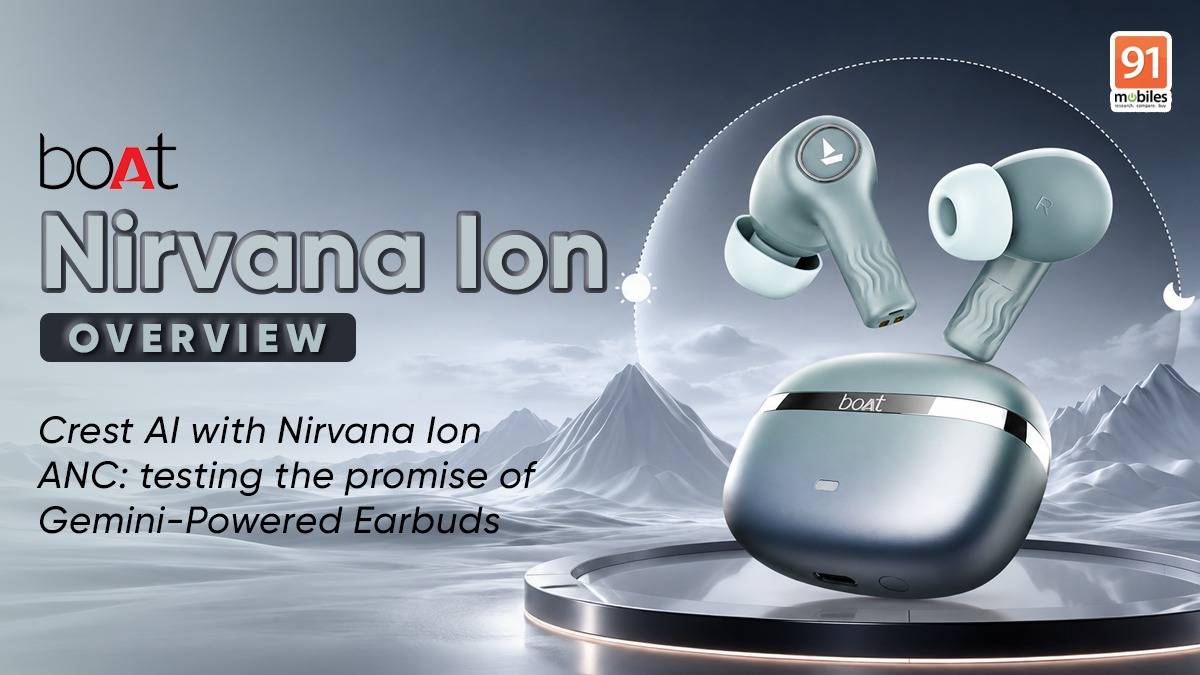
boAt Crest AI overview with Nirvana Ion ANC: testing the promise of Gemini-Powered Earbuds


For the last few years, most new pairs of “smart” earbuds roughly offer the same features: noise cancellation, better mics, possibly a companion app with an equaliser. The idea of earbuds that can actually think, hold a conversation, translate on the fly, or manage your inbox while you’re mid-walk, has largely stayed in the realm of flagship devices from Google and Apple, priced well out of reach for most buyers. That’s the gap boAt is trying to close.
The company’s latest platform, Crest AI, is built with Google Gemini through a partnership with Google Cloud, and boAt is pitching it under the phrase: “Intelligent Ears.” Not earbuds that just play music, but ones that listen, understand, converse, and assist. No doubt, it’s a big claim, and a slightly unusual one coming from a brand that built its reputation on affordable, bass-forward audio rather than software smarts. So the real question isn’t whether boAt can offer such a promising tech at an affordable price point, it’s whether the experience holds up once you’re actually using its product and the technology it brings along.
We’ve spent the last week or so living with the boAt Nirvana Ion ANC, the mid-priced pair in boAt’s first Crest AI lineup, to find out. At a price that undercuts every other Gemini-equipped earbud on the market by a wide margin, this felt like the right pair to put through daily use and see how much of the promise sticks.
Table of Contents
Familiar hardware gets a breath of fresh air
Before getting to the AI part, it’s worth pointing out that the Nirvana Ion ANC was already a proven pair of earbuds before Crest AI showed up. These have been on sale since the end of 2023, so what is new here is the software layer rather than the hardware under it. The 10mm drivers, tuned for what boAt calls Crystal Bionic Sound, lean warm and bass-forward on the Signature preset, though the Balanced preset in the boAt Hearables app is the better pick for podcasts and long listening sessions.
While it is worth pointing out that the ‘up to 32dB’ ANC will not wipe out the world around you in a way a flagship pair might, but it flattens the lows, effectively tackling sounds that wear you down over a day: bus engines, AC hum, the general rumble of a commute. Whenever you feel like you need to listen to something important, a long press hands you into Ambient mode.
Battery is where this pair pulls ahead of almost everything else at the price. boAt rates it at up to 120 hours in total, closer to 100 with ANC running, and roughly 24 hours from the buds themselves before the case gets involved. In practice that meant charging it once in a week of heavy use, and with ASAP Charge for quick top-ups, battery anxiety simply isn’t a thing here. The fit is light and stayed comfortable through multi-hour workdays, and the smaller touches are all present: in-ear detection that pauses playback when you pull a bud out, dual-device pairing, a 60ms low-latency mode for gaming, and an IPX4 rating that covers sweat and the odd drizzle.


Call quality got a real test too, thanks to the quad-mic ENx setup. On a call from a moving auto and another from a crowded café, the person on the other end said our voice came through clean, with the background noise mostly scrubbed out rather than just lowered in volume. It held up well indoors and in most everyday settings. The one place it started to strain was a genuinely loud, open-air market, where a bit of ambient noise still crept through, though even there it stayed intelligible. For calls made on the move, which is most calls, it’s a clear step up from what earbuds at this price usually manage. None of this is new information if you’ve followed boAt’s earbuds before, but it matters because this is the foundation the AI layer sits on top of, and a shaky foundation could have undercut everything else.
Crest Ask: talking instead of typing
The first Crest AI feature we tried out was Crest Ask, essentially a conversational assistant you summon with a tap rather than by pulling out your phone. Walking to the metro station with a half-formed question in our head (On which date is GTA VI coming out?), we asked it out loud instead of typing it, and the answer came back in a few seconds, spoken naturally, with the earbuds holding context when we followed up.


It’s a small thing, but it removes a genuine bit of friction from the day. The gap between wondering about something and knowing the exact answer shrinks from thirty seconds of unlocking, opening an app and typing, to five seconds of asking.
G-Assist: useful, but we kept one eye on our phone
G-Assist ties into Gmail, Google Calendar, and Google Tasks, and this is where the earbuds start doing actual work rather than just answering trivia. Asking it to summarise our inbox or schedule a meeting worked like a charm, and there’s real value in managing a chaotic morning without breaking stride to look at a Google screen. That said, we found ourselves instinctively checking our phone afterward to confirm what had actually happened, particularly with anything that involved sending a reply. Acting on your email by voice, with no screen to glance at before it goes out, is the kind of feature that needs a near-perfect hit rate to earn full trust, and a week isn’t enough time to fully hand that trust over. However, we must admit that the real-world performance did impress us a lot.
Crest Translate: the feature that actually surprised me
This is the headline act, and it’s also the one that impressed us the most. Crest Translate does real-time, two-way translation across the 25-odd languages boAt lists, and we tested it in a fairly ordinary situation: talking to a vendor near our building who’s more comfortable in Hindi than English.

The back-and-forth flowed reasonably naturally, with only a beat or two of lag between a sentence ending and the translation landing in our ears. It’s not instant simultaneous interpretation, and it occasionally stumbled on fast, overlapping speech or switching between languages mid-sentence, which is common in how people actually talk here. But for the price this device sells at, having usable two-way translation in your ear felt like a genuine step forward rather than a gimmick.
Things to keep in mind
There are a few things you need to keep in mind before you jump head-forward into the Crest AI experience. First, everything Crest AI does depends on an active Internet connection and the boAt companion app running quietly in the background, so on patchy mobile data in a basement parking lot or an elevator, you won’t be able to have a seamless experience.
Second, the AI features work with Android phones only at the moment, so iPhone users are left out for now. And third, Crest AI runs on a credit system rather than being switched on forever: the earbuds ship with 100K Crest AI units built in, after which a top-up pack costs ₹399 for another 12 months.
Is it worth it?
Here’s the number that actually matters: the Nirvana Ion ANC with Crest AI is priced at ₹2,399. Pixel Buds Pro 2, the closest thing to a direct AI comparison, sell for ₹22,900, which is close to ten times as much. boAt isn’t trying to out-engineer Google’s own earbuds. What it’s doing is putting a genuinely useful slice of Gemini’s conversational ability into the ears of people who do not intend to spend twenty thousand rupees on earbuds and bring it to a more affordable price point.


For hands-free questions on the move and translation that actually works often enough to be useful, that’s a meaningful upgrade over what a pair of earbuds at this price used to offer. It’s not flawless, and a week of use is early days for software that will presumably keep improving. But as a first swing at “Intelligent Ears” for the mass market, it lands more often than it misses.
FAQs
Q: What makes the boAt Nirvana Ion ANC stand out among budget ANC earbuds?
It pairs solid fundamentals, up to 32dB ANC, a 120-hour total battery life and quad mics with ENx for calls, with something almost no other earbud near this price offers: a built-in AI layer powered by Google Gemini. That combination of dependable hardware and genuine AI capability is what sets it apart.
Q: What exactly is boAt Crest AI?
Crest AI is boAt’s AI platform, built with Google Gemini through a partnership with Google Cloud. On the Nirvana Ion ANC, it powers three core experiences: Crest Ask for natural conversation, G-Assist for voice-driven productivity, and Crest Translate for real-time language translation, all accessible with a simple tap, no phone screen required.
Q: How well does the real-time translation actually work?
Crest Translate handles two-way conversations across the 25-odd languages boAt lists, and in everyday use it keeps up well with natural back-and-forth conversation. For earbuds at this price, having usable real-time translation at all is a genuinely impressive addition.
Q: Can the Nirvana Ion ANC help manage everyday tasks like email and calendar?
Yes. Through G-Assist, the earbuds tap into Gmail, Google Calendar and Google Tasks, so requests like summarising your day or drafting a reply can be handled by voice, cutting down how often you need to reach for your phone. Do note that the Crest AI features currently work with Android phones only.
Q: Does adding Crest AI compromise the earbuds’ core audio performance?
Not at all. The Nirvana Ion ANC still delivers the same up to 32dB ANC, 10mm Crystal Bionic Sound drivers and quad-mic ENx call clarity that made it a strong performer before Crest AI, so you get the AI features as an addition, not a trade-off.
Q: Is the Nirvana Ion ANC worth buying in 2026?
For anyone who wants Gemini-powered AI features without paying flagship prices, the Nirvana Ion ANC combines up to 32dB ANC, up to 120 hours of total battery life and Crest AI features including Crest Ask, G-Assist and Crest Translate. The AI features currently work with Android phones only, and Crest AI uses a credit system with 100K units included with the earbuds.