With the end of 2025 in sight and a new wave of flagship phones on the horizon, MediaTek has unveiled its next-generation all-powerful silicon, the Dimensity 9500. The new processor is designed on TSMC’s advanced N3P process and adopts ARM’s latest IP, including a rebranded core lineup. Let’s dive into what exactly these upgrades are and how the Dimensity 9500 is the best of what the Android chipset market has to offer.
Table of Contents
“All Big Core” Architecture Re-engineered
MediaTek continues its legacy with its “All Big Core” architecture, which ditches smaller, less powerful efficiency cores in favour of an all-performance core setup. This design is optimised to deliver higher sustained performance while also improving power efficiency.
The big news is Arm’s rebranded core lineup, which is:
- 1x Arm C1-Ultra @ 4.21GHz: This is the Prime core for the most demanding tasks.
- 3x Arm C1-Premium @ 3.5GHz: These handle high-performance duties.
- 4x Arm C1-Pro @ 2.7GHz: These are your performance cores for everyday tasks.
The chipset features a 100% larger L1 cache on the cores compared to its predecessor. A large 16MB L3 cache and 10MB of SLC (System Level Cache) are shared across the CPU complex. The revamped core lineup can be thought of as a simple succession:
- The C1-Ultra replaces last year’s Cortex-X925 core.
- The C1-Premium takes over from the Cortex X4 series.
- The C1-Pro is the successor to the Cortex A7xx series cores.
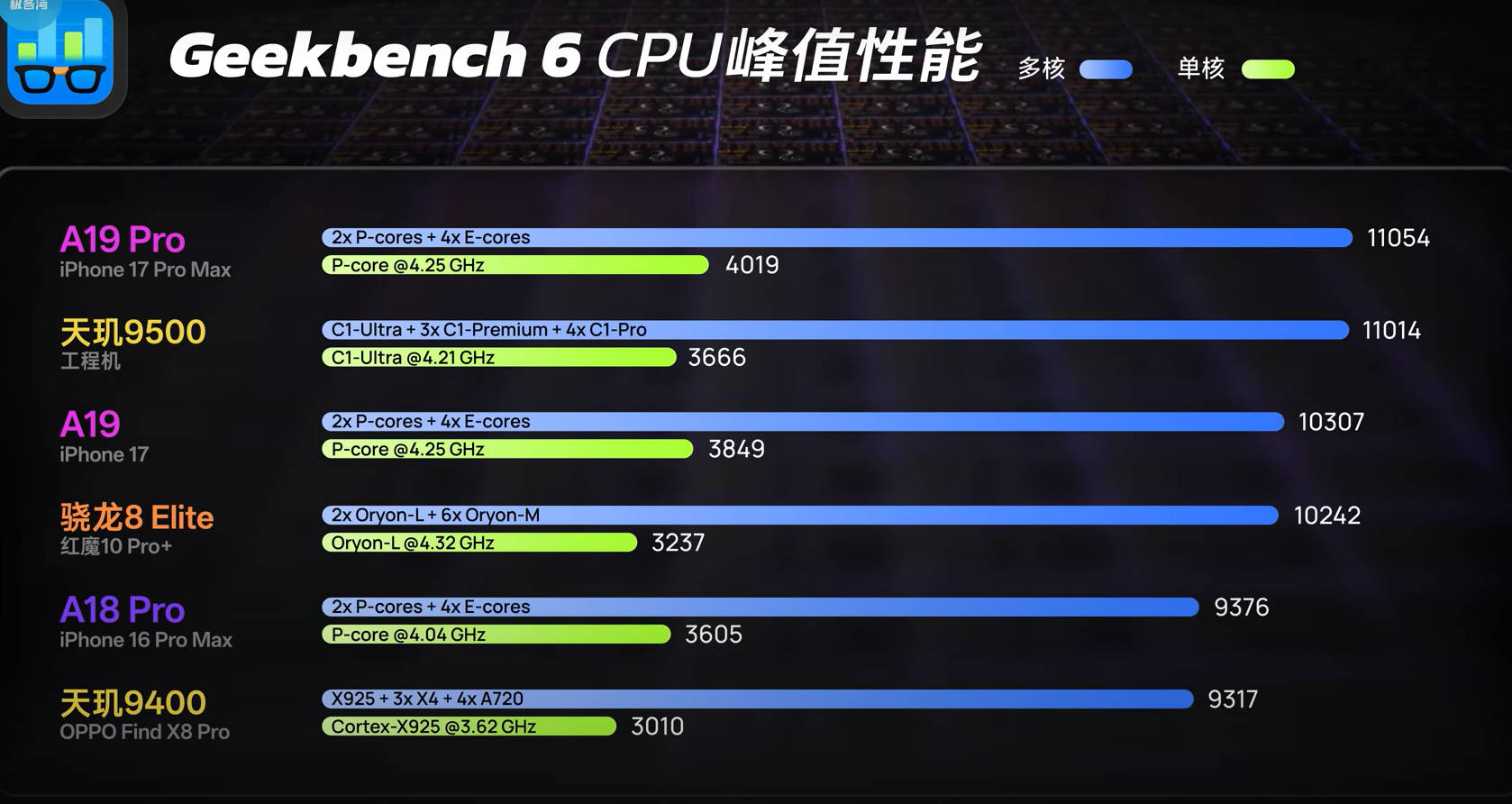
With the new and improved cores in tow, the MediaTek Dimensity 9500 achieves up to 29% higher single-core and a 16% boost in multi-core performance compared to its predecessor. This translates directly to a faster, more responsive experience across the board, from launching apps to intensive multitasking. Check it out below:
And it’s not just about raw power. The Prime Arm C1-Ultra core is up to 55% more power-efficient than its predecessor. For day-to-day scenarios the chip is up to 37% more power-efficient on the whole, leading to longer battery life during demanding use.
A key element of the CPU’s design is the inclusion of ARM’s Scalable Matrix Extension 2 (SME2), an instruction set that significantly accelerates common on-device AI workloads. What’s interesting is that this SME2 unit sits outside the main CPU cores, unlike Arm’s SVE extensions that are built into the CPU. It acts as a shared, power-efficient accelerator that can be shut down when not in use.
While the heavy lifting for generative AI is handled by the dedicated NPU, SME2 essentially delivers a “free” performance boost for smaller AI tools that run on the CPU. It helps in tasks such as improving speech recognition and speeding up token encoding for LLM models. It ensures that even tasks not optimised for the NPU can benefit from hardware-level AI acceleration, making the entire chip more intelligent and efficient.
To support all this raw power, the Dimensity 9500 is the first to include 4-lane UFS 4.1 storage support and LPDDR5X RAM running up to 10667 MHz. The storage has essentially double sequential speeds compared to UFS 4.0, which you’ll feel when launching large apps, saving high-resolution videos, or loading game levels.
The GPU: Console-Level Gaming Arrives on Mobile
The Dimensity 9500’s graphics are powered by Arm’s new flagship Mali G1-Ultra GPU, which succeeds the Arm Immortalis G925 and brings various architectural upgrades. At its core is a new 2nd Gen Ray Tracing Unit (RTUv2), which adds a full Vulkan Ray Tracing Pipeline to mobile, similar to desktop graphics cards.
This moves beyond the simpler “Ray Query” method used previously, making complex lighting and shadows far more efficient. The Dimensity 9500’s ray tracing performance is a whopping 2x its predecessor. You can look at it below:
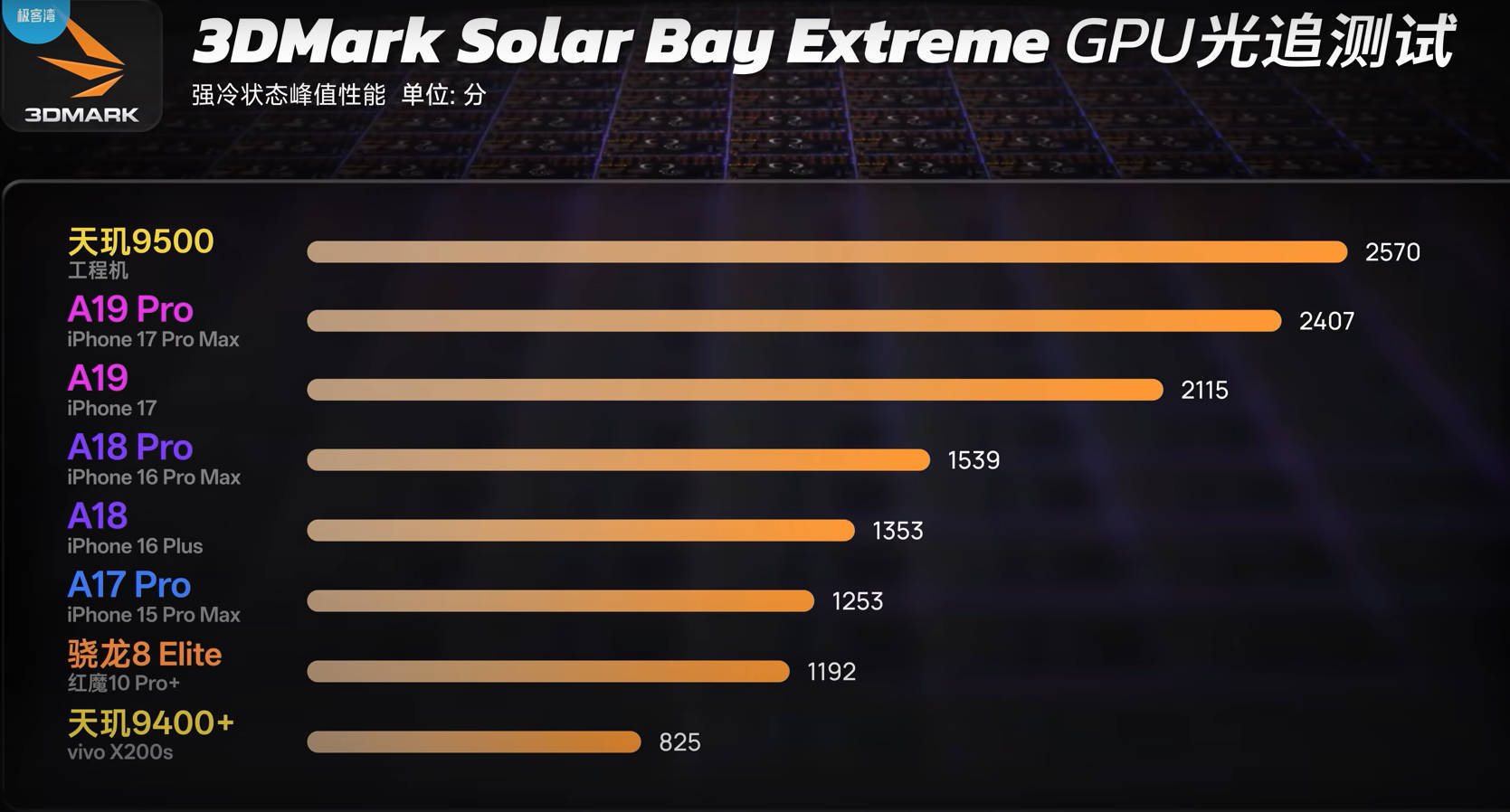
Image Credit: Geekerwan
The GPU also features native Unreal Engine 5.5+ integration, allowing developers to use console-tier visual technologies like MegaLights and Nanite directly on mobile.
- MegaLights: Enables more dynamic, shadow-casting area lights for richer environments.
- Nanite: Allows for massive leaps in geometric complexity and object density in real time.
These upgrades make 120 FPS ray-traced gaming possible for the first time on a smartphone. For games that don’t natively support such high frame rates, MediaTek’s MRFC 3.0 technology also intelligently boosts native 60 FPS games up to 120 FPS.
The architecture is also smarter and more efficient than ever before. Dual-stack shader cores double the GPU’s internal bandwidth to reduce data bottlenecks, while a new feature called Image Region Dependencies (IRD) allows the GPU to work on different parts of the screen simultaneously, maximising hardware use.
These advancements lead to some pretty substantial real-world improvements. The Arm Mali G1-Ultra delivers 33% better overall graphics performance, all while being 42% more power-efficient than its predecessor at peak performance.
A Dual Engine NPU for On-Device AI
The Dimensity 9500 shows a major overhaul of its AI capabilities, all centred around the new MediaTek NPU 990 and a second-generation GenAI Engine. The architecture moves to a dual-NPU design, which combines the high-performance NPU 990 with an industry-first Super Efficient NPU.
This second unit is based on a Compute-in-Memory (CIM) architecture, allowing it to run certain AI models continuously with minimal power draw for a more proactive, always-on AI experience.
The new NPU is twice as powerful as the previous generation and delivers over 2x faster token generation speed for AI assistants and enables on-device 4K resolution text-to-image generation.
It includes specialised hardware circuits to accelerate Transformer models, the foundation of modern LLMs, and reduces peak power consumption by up to 56% compared to its predecessor.
The increased power and specialised hardware mean that complex generative AI tasks, which previously required cloud processing, can now run directly on the device. The CIM-based NPU could also power predictive AI features, like anticipating your next app launch or optimising settings in the background, without a noticeable impact on battery life.
A Cinematic Visual Experience
The Dimensity 9500 improves its image capture and display quality through its new MediaTek Imagiq 1190 Image Signal Processor (ISP). A key upgrade is its ability to perform RAW-domain pre-processing, allowing for more accurate detail and colour capture before image compression. The ISP supports up to 200MP photo capture and enables cinematic 4K 60FPS portrait video, assisted by a new portrait engine and a 30fps continuous focus tracking system powered by AI.
On the display side, the chipset features MiraVision Adaptive Display technology. This new feature dynamically adjusts contrast and colour based on ambient light and on-screen content, ensuring a clear and vibrant picture in bright sunlight while also providing comfortable, eye-safe viewing in dark environments. The new transparency compensation technology also enables the display to dim as low as 1 nit, ensuring clear readability in ultra-low light settings while reducing eye strain.
Intelligent and Efficient
The Dimensity 9500 features a comprehensive connectivity suite where AI plays a central role in improving speed, reliability, and power use. These new AI-powered communication technologies deliver up to 10% lower power consumption on 5G and 20% lower power on Wi-Fi. The chipset also supports 5CC carrier aggregation, boosting available 5G bandwidth by 15% for faster, more stable connections.
For gamers and video callers, AI is used to predict network congestion, which can reduce network latency by up to 50%. And rounding it all off, AI-assisted positioning offers 20% higher accuracy in navigation and enables faster switching between networks.
MediaTek Dimensity 9500 vs Snapdragon 8 Elite Gen 5
The rivalry between the two chipmakers and their top-tier chipsets has been playing for a while now. Even though the Snapdragon 8 Elite Gen 5 may be a powerful rival, the Dimensity 9500 carves out a distinct advantage by prioritising next-generation experiences. With its industry-first support for a full Ray Tracing Pipeline and four-lane UFS 4.1 storage, MediaTek has a clear advantage in delivering console-level gaming visuals and faster data throughput. This, combined with its powerful dual-NPU architecture for on-device AI, makes the Dimensity 9500 the go-to choice for users who value cutting-edge gaming and generative AI performance.
A New Benchmark for the Flagship Experience
The Dimensity 9500 is a decisive statement from MediaTek, representing a comprehensive architectural overhaul engineered for next-generation mobile experiences. By integrating its refined “All Big Core” CPU with the industry’s first four-lane UFS 4.1 storage, MediaTek has laid the foundation for a new level of fluid performance.
This is most evident in its gaming and AI capabilities. The ARM Mali G1-Ultra GPU, with its full Vulkan Ray Tracing Pipeline, is capable of delivering true console-level visuals on a smartphone. The powerful dual-NPU architecture is also a strategic leap, enabling complex generative and predictive AI tasks to run directly on the device with remarkable speed and efficiency. A testament to which is the ability to generate 4K images from text prompts.
With the Dimensity 9500, MediaTek has engineered a chipset that stands at the forefront of the smartphone market. It is not only capable of powering today’s most demanding applications but also simultaneously provides the hardware necessary for the intelligent experiences of tomorrow.
This is a promotional post done as part of a brand collaboration.