Samsung has spent the last few Galaxy S generations trying to close the gap between its Exynos chips and Qualcomm’s Snapdragon processors. The Exynos 2700 could be its most ambitious attempt yet, with a reported 2nm design and a new 10-core CPU layout. Early benchmark results now suggest Samsung may have a much stronger flagship chip on its hands.
Exynos 2700 Geekbench score
A new Geekbench 6.7.1 result (via) reportedly shows the Exynos 2700 scoring 4,328 in single-core and 14,700 in multi-core tests. That is a sizeable jump over an earlier public result from April, which recorded 2,603 and 10,350 respectively. The two results were produced on different Geekbench versions, however, so they should not be treated as a direct comparison.
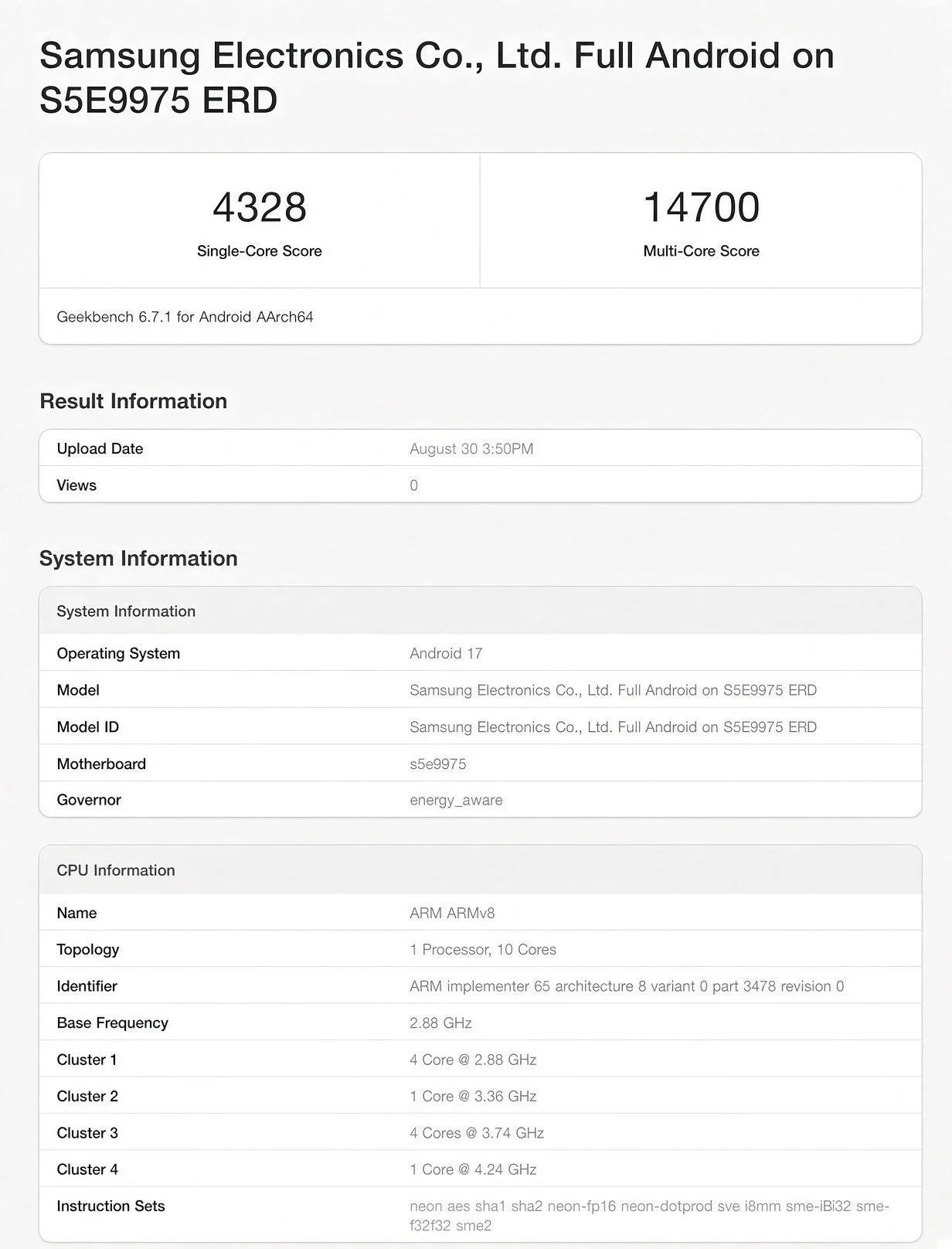
The chip is expected to use a 10-core CPU with two C2 Ultra cores and eight C2 Pro cores. The Ultra cores reportedly reach 4.24GHz, while the Pro cores are split between 3.74GHz and 2.88GHz speeds. Samsung is also said to be giving the chip around 40MB of combined cache, which put it ahead of the 24MB cache on Qualcomm’s Snapdragon 8 Elite Gen 5 and MediaTek’s Dimensity 9500, although Apple’s A19 Pro has 54MB.
The early Exynos result looks strong, but Samsung will not be competing against last year’s chips. A reported Dimensity 9600 Pro engineering sample has reached around 4,200 – 4,300 in single-core and 12,000 – 12,500 in multi-core. That test reportedly used prime cores capped at 2.8GHz, despite claims that the chip can reach up to 4.55GHz.
Qualcomm’s Snapdragon 8 Elite Gen 6 is also still being tested. An early iQOO prototype reportedly scored 3,434 in single-core and 9,334 in multi-core, below the Snapdragon 8 Elite Gen 5’s reported 3,649 and 10,682. Prototype hardware makes these figures difficult to use as a final ranking.
The Exynos 2700 is also expected to bring an Xclipse 970 GPU, a larger NPU and support for LPDDR6 memory. Those additions could matter just as much as Geekbench when the chip reaches an actual phone, because cooling, battery limits and Samsung’s software tuning will all influence real-world performance.
For buyers considering the Galaxy S27 series, the sensible move is to wait for retail-unit testing. If the Exynos 2700 can retain anything close to this performance once Samsung puts it inside a finished phone, it could give the Galaxy S27 a strong answer to Snapdragon and Dimensity-powered rivals.