More Than Just a Big Battery: What Gives POCO X8 Power 5G the Edge


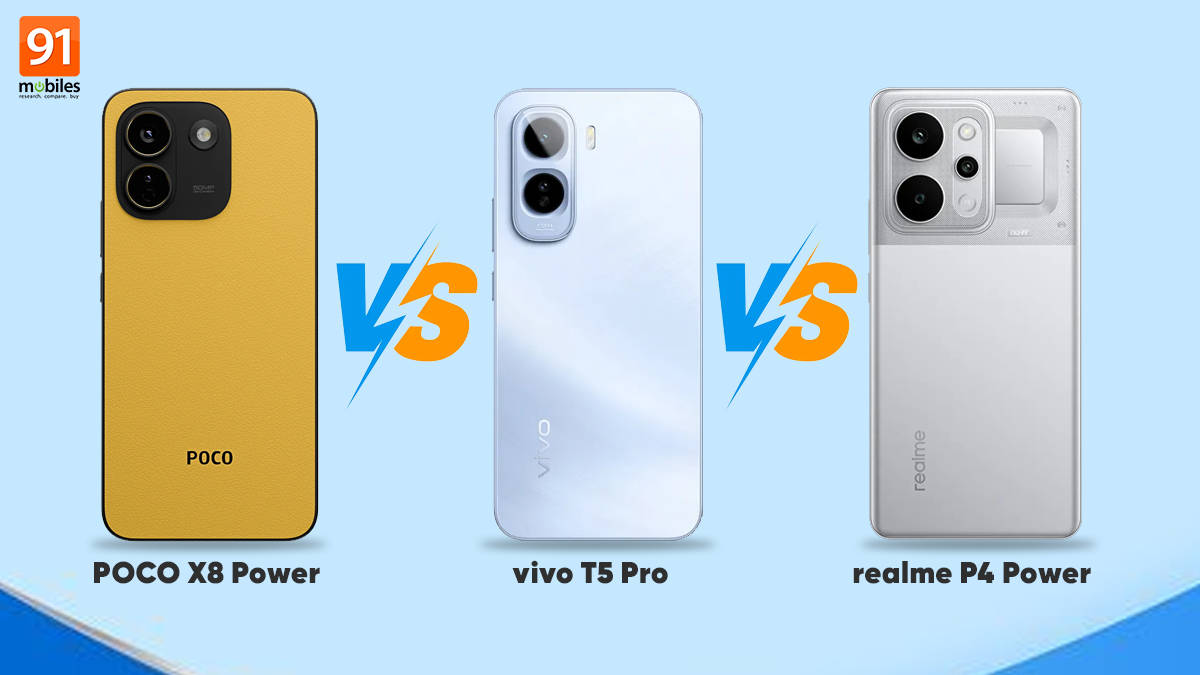
Phone buyers in India have been asking the same question for years: why does a full day of use still feel like an achievement? Screens got bigger and mobile data got faster, but the battery underneath most phones in the ₹30,000-₹35,000 range kept hovering around the same 5,000mAh ceiling, as if everyone had collectively agreed that was enough. Three phones arriving in close succession have decided it isn’t.
The POCO X8 Power 5G, the vivo T5 Pro 5G, and the Realme P4 Power 5G all feature cells large enough to make nightly charging feel like a choice rather than a necessity, and all three are competing for the same buyer in roughly the same price range. On the headline numbers, they look like a three-way tie. The closer you look, the less true that is. Let us explain how.
Battery is Where the Numbers Stop Being Enough on Their Own
The POCO X8 Power 5G carries a 10,000mAh battery with 100W wired charging and 27W reverse wired charging. The Realme P4 Power 5G matches the capacity almost exactly at 10,001 mAh but charges at 80W. The Vivo T5 Pro 5G sits slightly behind on capacity at 9,020 mAh with 90W charging.
Raw capacity is only one part of the equation. Charging speed determines how quickly a dead phone becomes usable, and POCO’s 100W advantage over the Realme P4 Power 5G’s 80W is a meaningful real-world gap, not a footnote. A 10,000 mAh cell charging at 100W offers a higher peak charging rate than the same-capacity cell at 80W, which matters on the specific kind of day when someone hasn’t charged overnight and is leaving the house at 30%. The Realme P4 Power 5G’s 80W charging is still fast, but the POCO X8 Power 5G doesn’t sacrifice speed to achieve its capacity lead.

A phone with a 10,000mAh battery that can also charge a pair of earbuds, a smartwatch, or a friend’s phone turns the POCO X8 Power 5G into a portable power bank when a physical one isn’t within reach. Both the POCO X8 Power 5G and Realme P4 Power 5G claim roughly 3.5 days of typical usage. The Vivo T5 Pro 5G, with a smaller cell, lands at around two days of real-world endurance. The gap between two days and three and a half days; you wonder? The very difference between a phone that extends the charging routine and one that unapologetically changes it.

POCO backs the POCO X8 Power 5G’s battery with a 6-year health-life claim, meaning the cell is engineered to retain meaningful capacity well past the two-to-three-year mark, when most lithium-ion batteries start to degrade noticeably. Neither the Vivo T5 Pro 5G nor the Realme P4 Power 5G makes an equivalent cell-specific commitment, which matters for anyone planning to hold onto the phone for three or four years and expecting it to still deliver the endurance it launched with.
Performance: Three Chipsets, Three Different Bets
The POCO X8 Power 5G runs the Snapdragon 6 Gen 5, paired with LPDDR5X RAM and UFS 4.1 storage. The Vivo T5 Pro 5G runs on the Snapdragon 7s Gen 4 and uses UFS 3.1 storage. The Realme P4 Power 5G runs on the MediaTek Dimensity 7400 Ultra, the slowest of the three under sustained workloads. The Snapdragon 6 Gen 5 in the POCO X8 Power 5G is a newer chip than the Snapdragon 7s Gen 4 in the Vivo T5 Pro 5G, built on a more advanced process node and designed with efficiency as the primary objective rather than peak performance.
In a phone with a 10,000mAh battery, that efficiency advantage compounds over a full day of use because a chip drawing less power under sustained load extends real-world endurance beyond what the battery capacity figure alone predicts. The POCO X8 Power 5G’s UFS 4.1 storage is also a generation ahead of the Vivo T5 Pro 5G’s UFS 3.1, translating to faster app loads, quicker file operations, and a phone that feels more responsive in the everyday interactions that largely determine how a user feels about their phone.
Camera Is The One Area That Separates Them Most
All three phones feature a 50MP main sensor with OIS, putting them on equal footing for primary shooting. Where the POCO X8 Power 5G sets itself apart is in everything around the primary lens. The vivo T5 Pro 5G pairs its 50MP Sony IMX882 with a 2MP depth sensor, effectively a single usable rear camera. There’s no ultrawide, which means that if you intend to take a group shot in a tight space, you’ll need to step back further or cut people out. At a price point where both rivals include an ultrawide as standard, its absence on the Vivo T5 Pro 5G isn’t a minor omission.
The Realme P4 Power 5G includes an 8MP ultrawide alongside its main sensor, matching the POCO X8 Power 5G on rear camera versatility. The gap opens up on the front. The Realme P4 Power 5G’s 16MP front camera is fine for casual selfies but falls noticeably short of the POCO X8 Power 5G’s 32MP lens in detail and clarity, especially for video calls and front-facing content where the camera is doing serious work rather than just capturing a face. On a phone this capable elsewhere, a 16MP front camera starts to feel like a compromise the buyer didn’t agree to. The POCO X8 Power 5G is the only phone in this group offering a 50MP camera, an 8MP ultrawide, and a 32MP front camera in one device. That combination covers every realistic shooting scenario without asking the buyer to work around any gaps in the system.
Durability: Where the Segment Standard Gets Raised
Most phones in this price bracket ship with IP68 as the headline durability claim, covering submersion up to 1.5 meters for 30 minutes. The vivo T5 Pro 5G carries IP68 and IP69 ratings. The Realme P4 Power 5G adds IP66 alongside IP68 and IP69. The POCO X8 Power 5G matches both on IP66, IP68, and IP69 but arrives with a sleeper cell – the Corning Gorilla Glass Victus 2! Let’s understand why that matters.
IP69 certification is shared across all three phones and covers high-pressure water jets and full submersion beyond what standard IP68 alone guarantees. The Realme P4 Power 5G’s additional IP66 rating adds resistance to directional high-pressure water jets, a marginal practical addition over IP68 and IP69 combined. What separates the POCO X8 Power 5G in terms of durability isn’t the certification numbers but the build quality behind those ratings: Gorilla Glass Victus 2 and a reinforced chassis engineered for a phone designed to be taken everywhere. It is Corning’s most advanced glass and is rated to withstand drops onto rough surfaces from up to 1 meter, offering four times the scratch resistance of standard tempered glass.
Software and Ecosystem: Where POCO Pulls Ahead Quietly
All three phones run Android 16, but the software experience sitting on top of it tells a different story. The POCO X8 Power 5G runs HyperOS 3 with Hyper AI built in, Xiaomi’s most capable software platform, bringing on-device AI tools, smart resource management, and Xiaomi Interconnectivity that lets the phone work fluidly alongside other Xiaomi and POCO ecosystem devices. Hyper AI handles everything from intelligent performance optimization during gaming to smart charging decisions that extend the 6-year battery health lifespan POCO is targeting.


The Vivo T5 Pro 5G runs OriginOS 6, a capable platform, but one with a smaller device ecosystem and a software support commitment of 3 years of OS updates, a full year shorter than the POCO X8 Power 5G’s 4-year Android update promise. The Realme P4 Power 5G runs Realme UI 7.0, which includes its own AI tools, including Google Gemini integration, but is powered by the Dimensity 7400 Ultra, which creates a bottleneck for sustained AI performance.

The POCO X8 Power 5G’s longer update window, 4 years of Android plus 6 years of security patches, means the phone stays current, protected, and capable of running new features well past the point where both rivals have been left behind. On a phone designed for multi-year ownership, that’s not a minor footnote. It’s part of why buying the POCO X8 Power 5G makes more sense in the long run than either alternative.
The Case for the POCO X8 Power 5G
The vivo T5 Pro 5G makes one argument well: thinness. At 8.25mm for a phone housing a 9,020 mAh cell, it’s an engineering achievement worth acknowledging. Its Snapdragon 7s Gen 4 also leads on raw benchmark numbers. But it launched at ₹29,999 and has since climbed significantly above that, which changes the value equation considerably. It also ships without an ultrawide camera, leaving a gap that shows up whenever a scene doesn’t fit a standard lens.
The Realme P4 Power 5G makes a simpler argument: maximum battery at minimum cost. A 10,001mAh cell at its price point is hard to argue with if endurance is the only criterion. The Dimensity 7400 Ultra doesn’t keep pace with either Snapdragon chip under sustained load, and the 16MP front camera falls short of what the segment now offers as standard, but for the buyer who has decided battery is everything, and price is the tiebreaker, it has a case.
The POCO X8 Power 5 G’s advantage lies in a combination of specifications that actually make a difference in your daily use. It wins because no other phone in this bracket puts all of these in the same box: 10,000 mAh charging at 100W, 27W reverse charging that turns the phone into a power bank, a 50MP sensor with an ultrawide the vivo T5 Pro 5G doesn’t offer, a 32MP front camera the Realme P4 Power 5G can’t match, the Snapdragon 6 Gen 5 on UFS 4.1 storage, Gorilla Glass Victus 2, and a 6-year battery health claim backed by 4 years of Android updates. At 35,999, that combination simply doesn’t exist anywhere else at this price.