MediaTek on Monday unveiled its next-gen flagship chipset, the Dimensity 9500. This chipset will power several flagship smartphones launching in late 2025, initially from companies such as OPPO and Vivo. Compared to the Dimensity 9400, the new processor offers enhancements in all areas, including high-end gaming, on-device AI, imaging, connectivity, and efficiency, through the introduction of new components. Even though it’s based on a 3nm process like the Dimensity 9400, MediaTek has ensured the chipset brings high-intensity power and delivers better experiences across the board in daily usage.
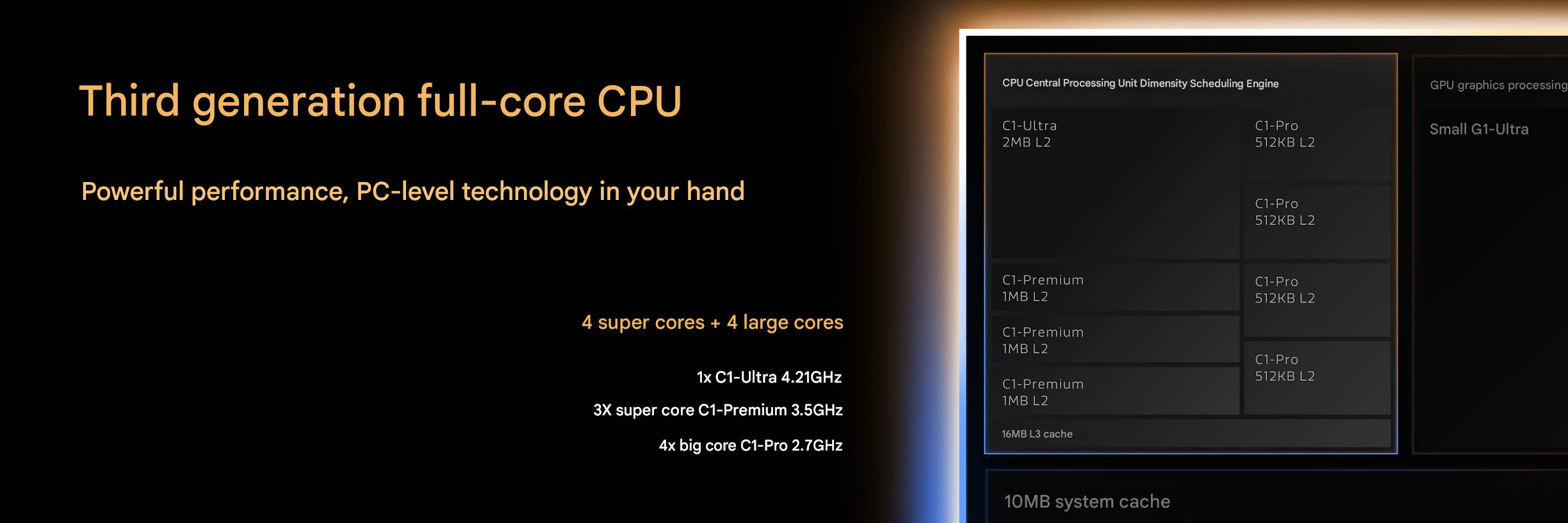
To begin with, the Dimensity 9500 brings the MediaTek exclusive 3rd generation all-big-core CPU structure. The cores include an ‘ultra’ core with up to 4.12GHz clock speeds, three premium cores, and four performance cores that are aided by the support for four-lane UFS 4.1 storage speeds. The Dimensity 9400’s single core was capped at 3.63GHz.
The Dimensity 9500’s CPU design is able to achieve 32 percent higher single-core and 17 percent higher multi-core performance than the Dimensity 9400. The single ultra core, on the other hand, alone achieves up to 55 percent lower power consumption at peak performance, thus enhancing the overall efficiency. Speaking of which, the chipset is fabricated on TSMC’s new N3P 3nm node compared to N3E of Dimensity 9400. This translates to improved power control and performance gains.
For daily usage involving multitasking between games and social audio call apps, the Dimensity 9500 is up to 30 percent more efficient. Now, regarding the GPU side of things, this flagship-grade processor features the Arm G1-Ultra, whereas the Dimensity 9400 features the Arm Immortalis-G925 GPU. The new GPU delivers up to 33 percent higher graphics performance and 42 percent better power efficiency with support for console-grade ray tracing, and frame rate interpolation up to 120FPS. MediaTek has collaborated with leading studios to bring Unreal Engine 5.6, which will enable immersive lighting effects in supported games.
The Dimensity 9500 also promises significant improvements in on-device AI applications. With MediaTek NPU 990 (NPU 890 was present on Dimensity 9400), this is the 2nd generation Gen-AI Engine that adds Super Efficient NPU, which enables always-on-AI for performing agentic AI tasks that perform processes for you in the background. While this feature was also present on the Dimensity 9400, the real-world applications were scarce, so we’ll have to see which apps take advantage of agentic AI. The new NPU supports the industry’s first image generation in 4K (through Generative AI Engine 2.0) and is two times faster for generating tokens, while consuming 56 percent less power during peak use.
For the photography side of things, the Dimensity 9500 brings Imagiq 1190, which brings support for RAW-domain pre-processing, up to 200MP capture, 30FPS continuous focus tracking, and, for the first time, cinematic 4K 60FPS portrait video. Furthermore, the Vivo X300 series is confirmed to be equipped with a 200MP sensor, which will ideally take advantage of the Imagiq 1190 ISP along with Vivo’s stellar imaging algorithms, just like what we saw on the Vivo X200 Pro.
The display and connectivity experience are also getting an upgrade with the Dimensity 9500 chip. Although it primarily depends on the hardware the phone is equipped with, MiraVision Adaptive Display technology on the new MediaTek chipset will deliver a clear viewing experience outdoors, while maintaining thermal temperatures in long durations. In terms of connectivity, the processor can deliver up to 10 percent lower consumption in 5G, 20 percent lower in WiFi usage, and boost 5CC carrier aggregation bandwidth by 15 percent.
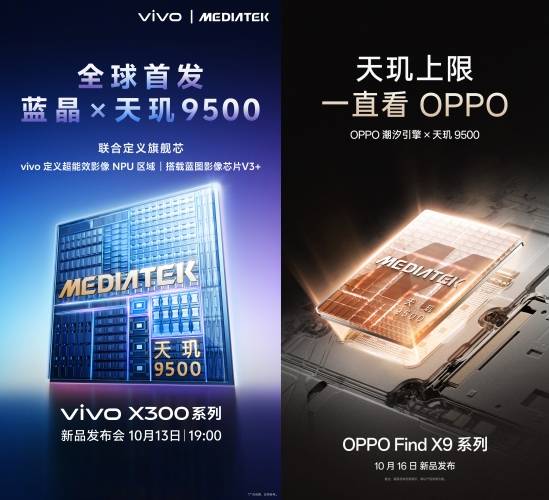
The first set of phones to be equipped with the Dimensity 9500 are confirmed to be the Vivo X300 series, consisting of Vivo X300 and Vivo X300 Pro, where the latter is confirmed to come with a large sensor-sized 200MP ZEISS APO periscope lens. These smartphones are set to launch in China on October 13th and may be introduced globally in countries like India in the coming months.
While the MediaTek Dimensity 9500 bring all-around improvements, especially in CPU and GPU performance, on-device AI, and battery efficiency, it could face tough competition from the Qualcomm Snapdragon 8 Elite Gen 5 (successor of Snapdragon 8 Elite), which will be announced on September 23rd in the US. Qualcomm’s next-gen flagship chipset is also expected to be based on a 3nm process and could bring immense improvements in CPU clock speeds through its custom Oryon cores and Adreno GPU. The Snapdragon chip will power the likes of Xiaomi 17 series, iQOO 15, and others.
With the Dimensity 9400, we saw a jump from 4nm to a 3nm TSMC process, which resulted in increased cost for smartphone players to adopt the chipset in their devices. The new Dimensity 9500 chipset is based on a 3nm process, too, but on a more advanced N3P node from TSMC. Since the architecture hasn’t seen a radical shift, the Dimensity 9500 should hopefully not see a significant jump in price. With AI applications being on a constant rise, the chipset boasts a high level of on-device AI prowess, with agentic AI in particular being a standout. If apps and systems are able to utilise this, the chipset could offer significant boosts in productivity.