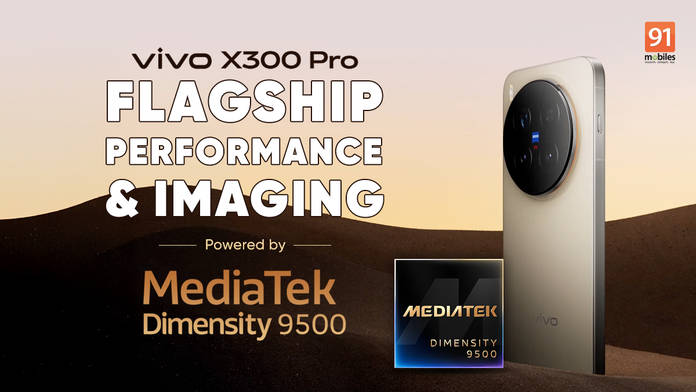
The vivo X-series has long cemented its place among the best camera flagships on the market. Known for their remarkable photography capabilities, refined design, and top-tier hardware, the X-series phones consistently set high standards in mobile imaging. The new vivo X300 Pro carries that legacy forward as the latest and most ambitious addition to the lineup. At its core lies the MediaTek Dimensity 9500 which drives the phone’s exceptional imaging performance, robust power efficiency, and seamless software experience with the all-new Origin OS 6. Let’s take a closer look at what this flagship brings to the table in terms of performance and camera prowess.
Table of Contents
Flagship performance redefined
While the camera system may be the biggest draw for most users and often defines the X-series in the public eye, the vivo X300 Pro’s performance output is nothing short of exceptional. The phone delivers immense power, thanks to MediaTek’s latest Dimensity 9500 chipset built on TSMC’s cutting-edge N3P (3nm) process. This processor sits at the heart of the device, driving every demanding task with precision. It features a reimagined Arm C1 CPU cluster and a powerful Arm Mali G1-Ultra GPU equipped with an advanced RTv2 unit for desktop-grade ray tracing.
Beyond the flagship processor, the vivo X300 Pro also packs premium hardware, including 16GB of blazing-fast LPDDR5X RAM and 512GB of UFS 4.1 storage. This combination ensures exceptional speed, multitasking efficiency, and a smooth user experience throughout. To move beyond specifications and gauge its real-world performance, we ran the phone through a series of demanding benchmark tests and an extended gaming session to truly see what it is capable of. Let’s check it out below:
Antutu
The AnTuTu benchmark test is one of the most widely used tools that helps measure the overall performance output of a smartphone. Powered by the MediaTek Dimensity 9500, the vivo X300 Pro achieves an impressive AnTuTu score of over 3.5 million, placing it among the top-performing smartphones on the market. It stands toe-to-toe with the Snapdragon 8 Elite Gen 5, another leading chipset in the market. The chipset also records a higher GPU score on Antutu, which means GPU-intensive tasks such as video rendering and gaming are areas where the Dimensity 9500 firmly outperforms the competition.

Geekbench
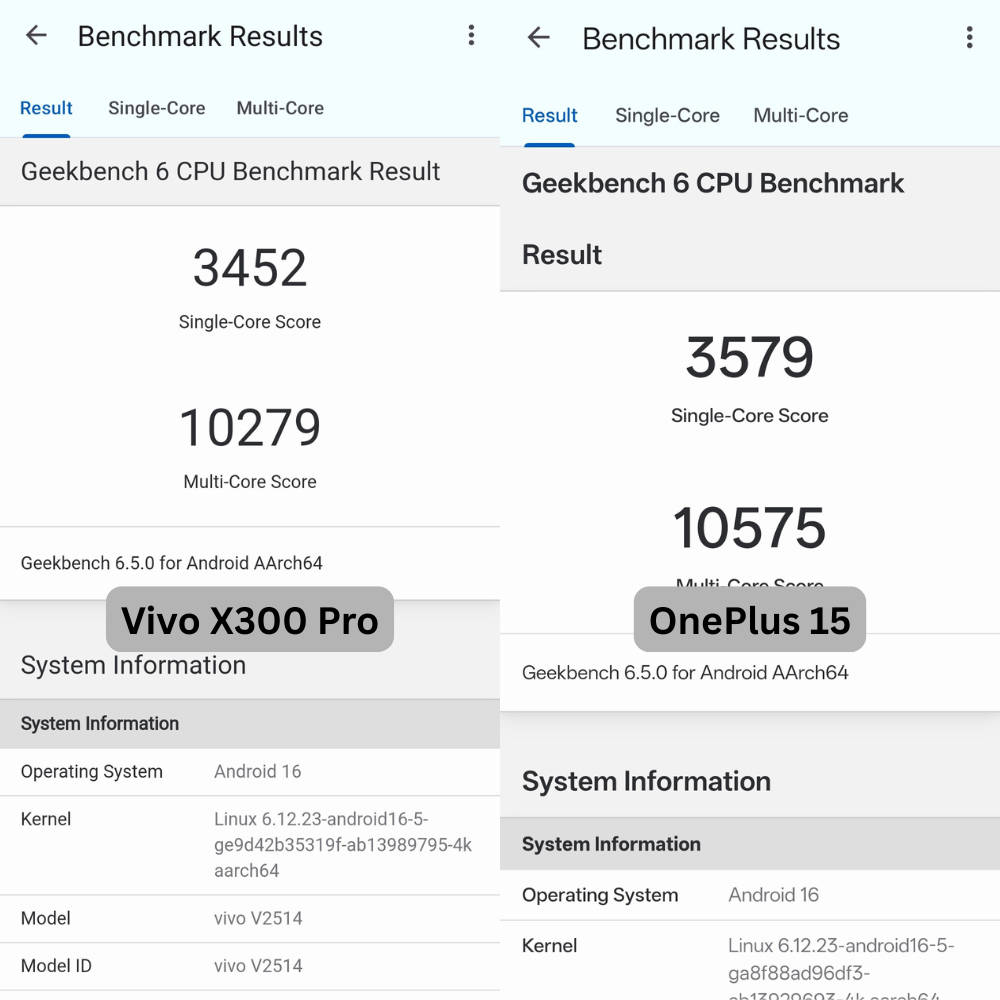
Geekbench provides us insight into the CPU capabilities of a chipset by testing single-core and multi-core performance. The vivo X300 Pro’s results here remain at the very top of the segment and are on par with the Snapdragon 8 Elite Gen 5-powered OnePlus 15. No matter the workload, the Dimensity 9500 ensures consistent performance so that even the most demanding tasks run smoothly and efficiently.
CPU throttle test
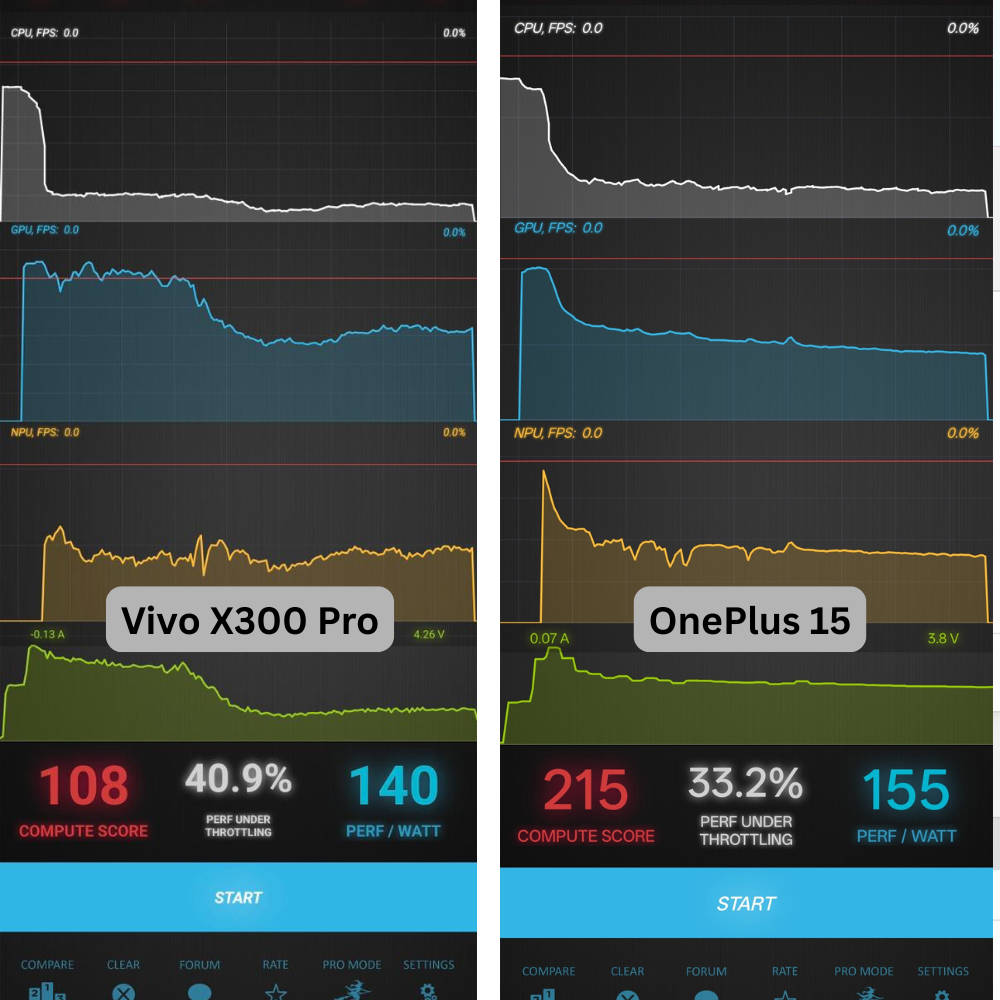
Sustained performance during demanding workloads is a key metric to gauge a phone’s real-world capability. In the Burnout benchmark, the vivo X300 Pro maintained roughly 41% of its total performance output, compared to the OnePlus 15’s 33% total output. This result highlights the efficiency of the MediaTek Dimensity 9500 and its thermal management system. It ensures that long gaming sessions or extended camera use remain smooth, without any lag.
AI Benchmark
This AI benchmark runs 78 neural-network and computer-vision tests that cover things like object and face recognition, camera scene detection, portrait depth, text prediction, OCR, denoising and super‑resolution. Together, they simulate the AI tasks that power features such as smarter camera modes, faster gallery search and on-device assistants. In this test, the vivo X300 Pro performs better than the OnePlus 15. The gap may not be huge, but it does suggest that the Dimensity 9500 has an advantage over the Snapdragon 8 Elite Gen 5 when it comes to AI-heavy workloads. This should help with quicker scene detection, faster background processing and more responsive AI features over time.

GPU Performance Benchmarks
Now let’s look at GPU-focused benchmarks for the Dimensity 9500. The MediaTek Dimensity 9500 uses the new Arm Mali G1-Ultra GPU, which has a unique advantage compared to its competitors, which makes it the top choice for gaming. Its advanced RTv2 unit brings hardware-level ray tracing similar to what is found in desktop graphics cards using the Vulkan Ray Tracing pipeline. In simple terms, this means that games with ray tracing support deliver better performance and richer visual quality on devices powered by the Dimensity 9500.
3DMark Steel Nomad Light
This benchmark evaluates performance in modern gaming technologies such as ambient occlusion, screen-space shadows, and TAA. These technologies play a key role in achieving realistic visuals in games. Ambient occlusion adds depth and realism to shadows in corners and edges, while screen-space shadows enhance lighting as you move through different environments. TAA (Temporal Anti-Aliasing) smooths out jagged lines and pixels around objects for cleaner, more natural visuals.
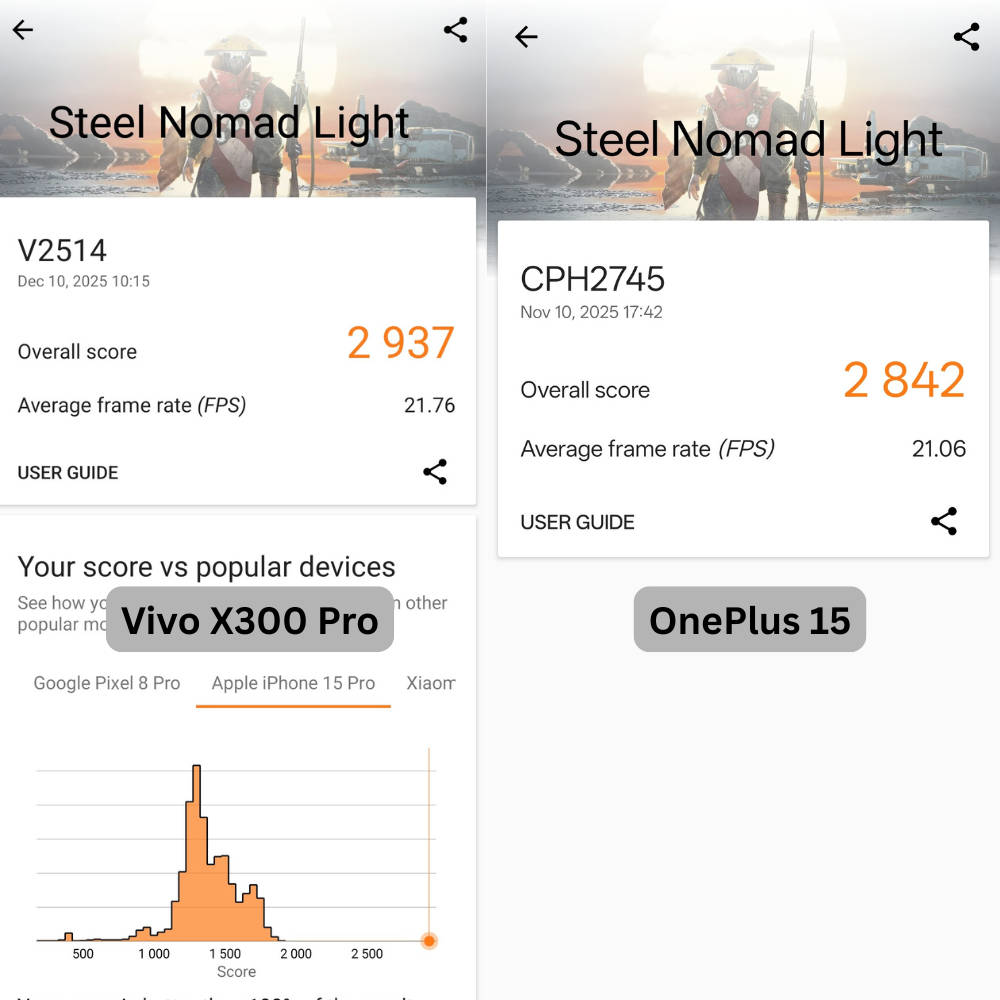
In this test, the vivo X300 Pro is ahead of the OnePlus 15, delivering higher performance that translates into smoother, more consistent frame rates in demanding titles.
3DMark Solar Bay
The 3DMark Solar Bay test focuses on ray tracing performance using the Vulkan 1.1 API, and here the vivo X300 Pro is ahead of the OnePlus 15 with a much higher overall performance and average frame rates. Here, the Dimensity 9500 has an advantage thanks to its second-generation Ray Tracing Unit (RTUv2). Ray tracing technology improves reflections, shadows, and lighting in modern games, making scenes look more lifelike.
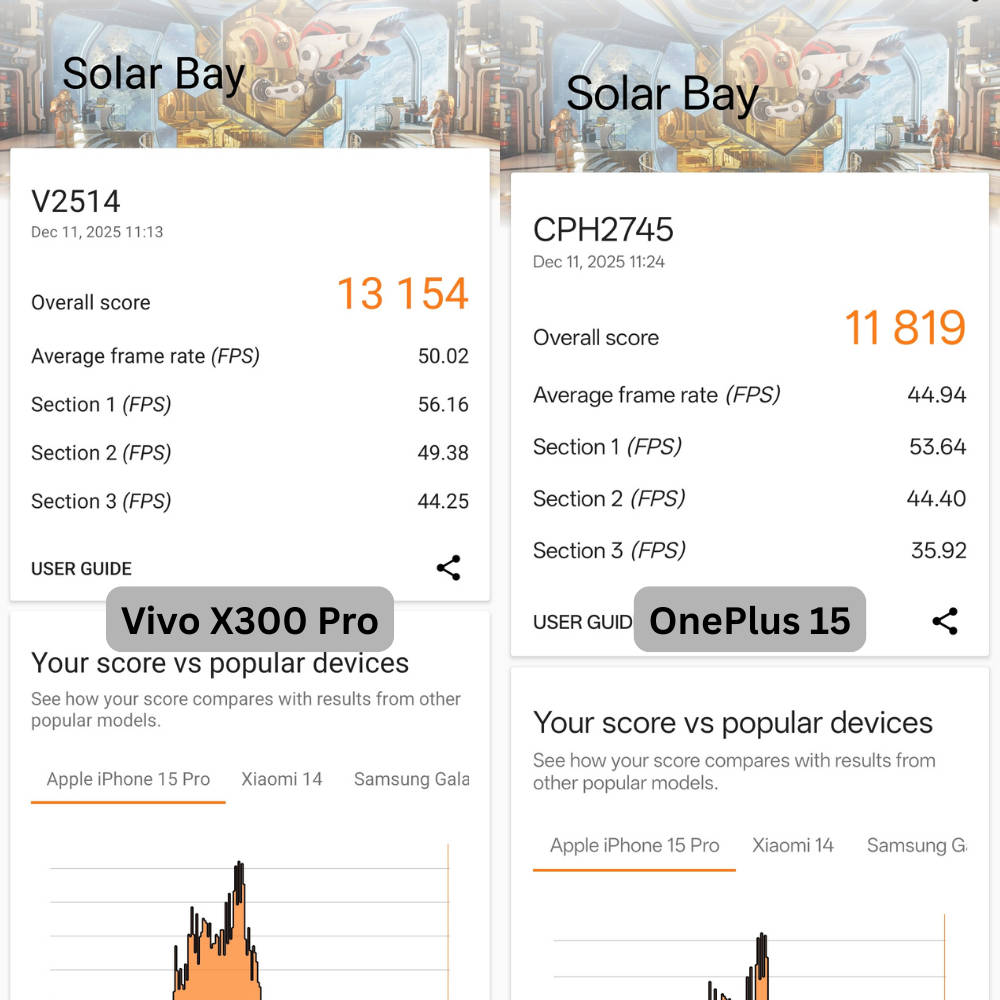
Surfaces such as water or glass reflect more accurately, shadows move naturally alongside objects, and lighting interacts with materials as it does in real life. These effects are very GPU-intensive, but the Dimensity 9500 ensures smooth frame rates and consistent visual quality. As a result, graphically demanding games look more impressive while staying fluid and responsive.
3DMark Wildlife Extreme
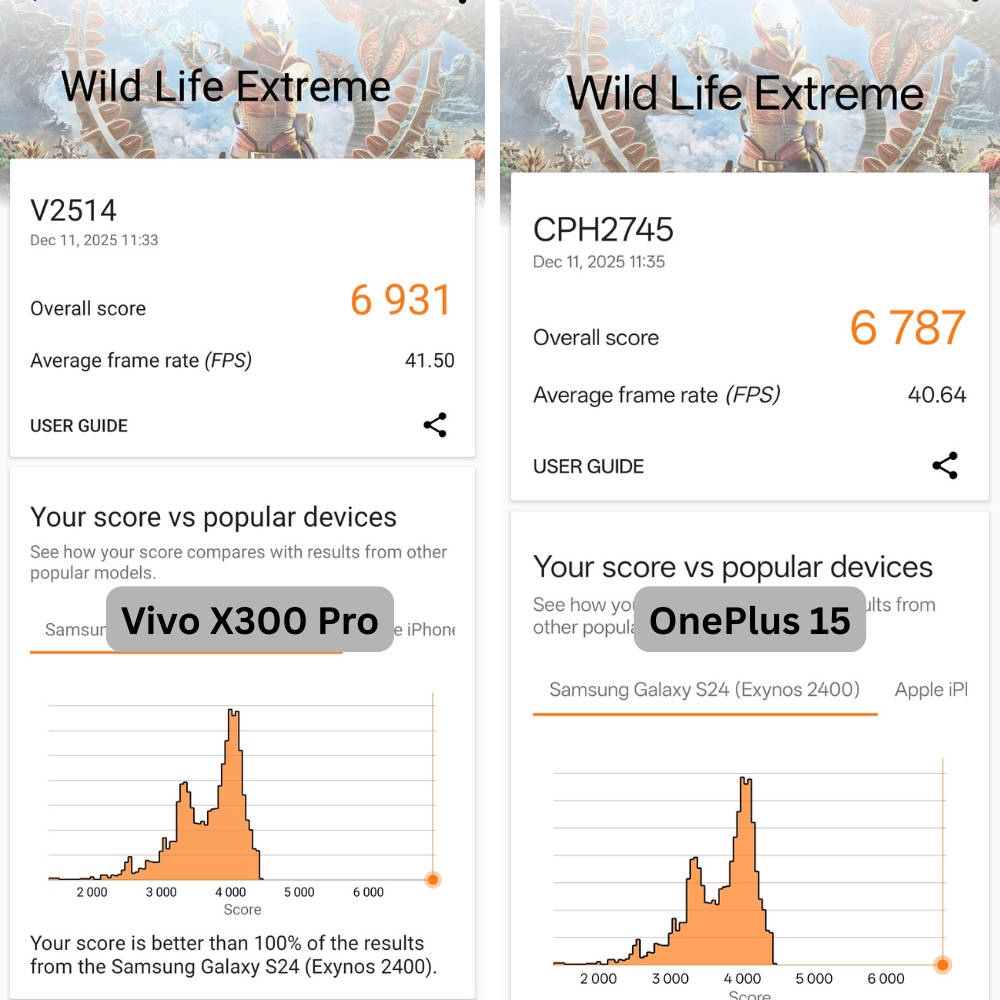
The Wildlife Extreme test measures GPU output during short but demanding bursts of performance. This benchmark can help us gauge the phone’s performance in moments of intense activity, such as high-quality cinematic cutscenes, heavy combat sequences, or complex video editing tasks. The vivo X300 Pro performs a lot better here compared to the OnePlus 15, showing that the Dimensity 9500 can handle sudden spikes in graphical workload without slowing down at all.
GFX Bench Manhattan & T-Rex
Similar to 3DMark, the GFXBench tests simulate demanding 3D scenes to measure a phone’s graphics performance. They are cross‑API tests that track frame rates, rendering quality and overall stability, which is essentially how heavy games will run on your device. The Manhattan run is a modern, high-intensity scene with complex lighting and effects, while T-Rex is a slightly lighter, older-style workload that still stresses the GPU at high frame rates. Together, they show how well a phone can handle both modern 3D titles and more mainstream games over longer sessions.
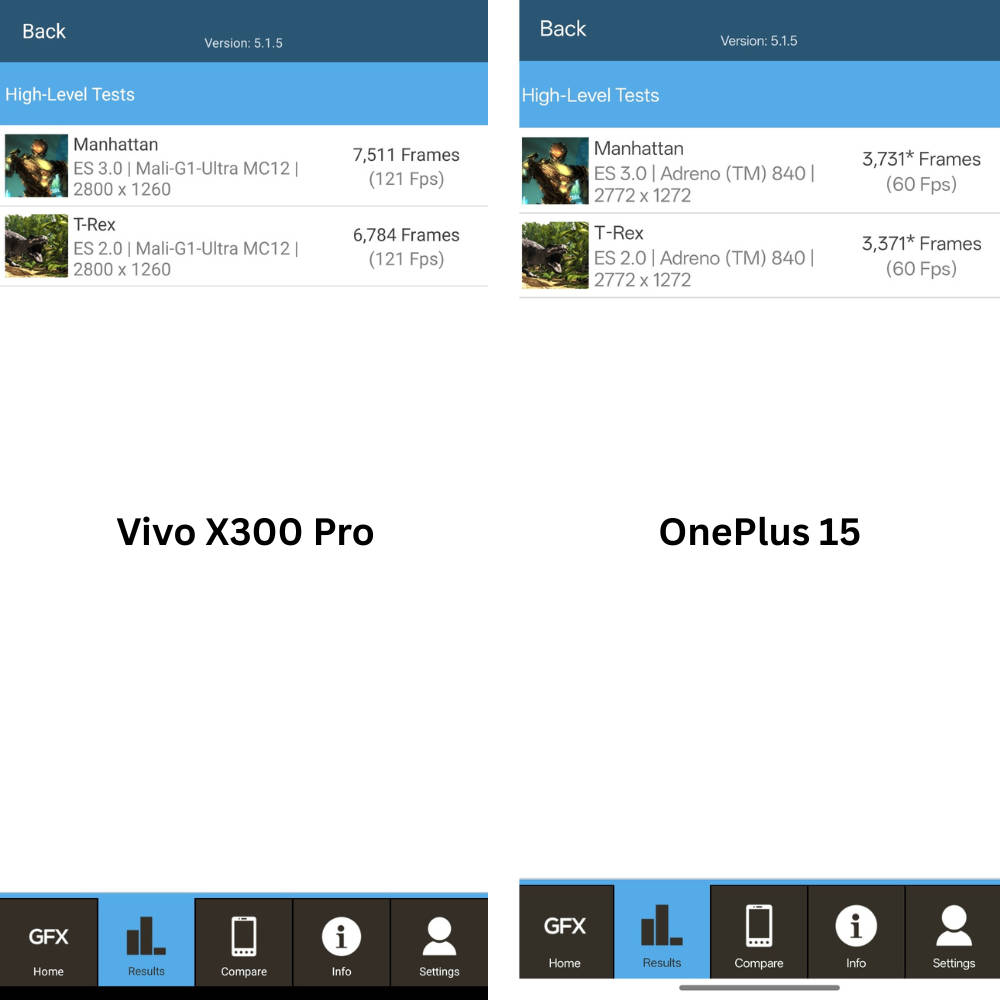
As you can see here, the MediaTek Dimensity 9500 maintains a firm lead in both tests, thanks to its powerful 12‑core GPU. Its output is close to double that of the Snapdragon 8 Elite Gen 5 in these runs, which clearly shows how far ahead the Dimensity 9500 currently is in pure graphics performance.
Gaming performance
Wuthering Waves
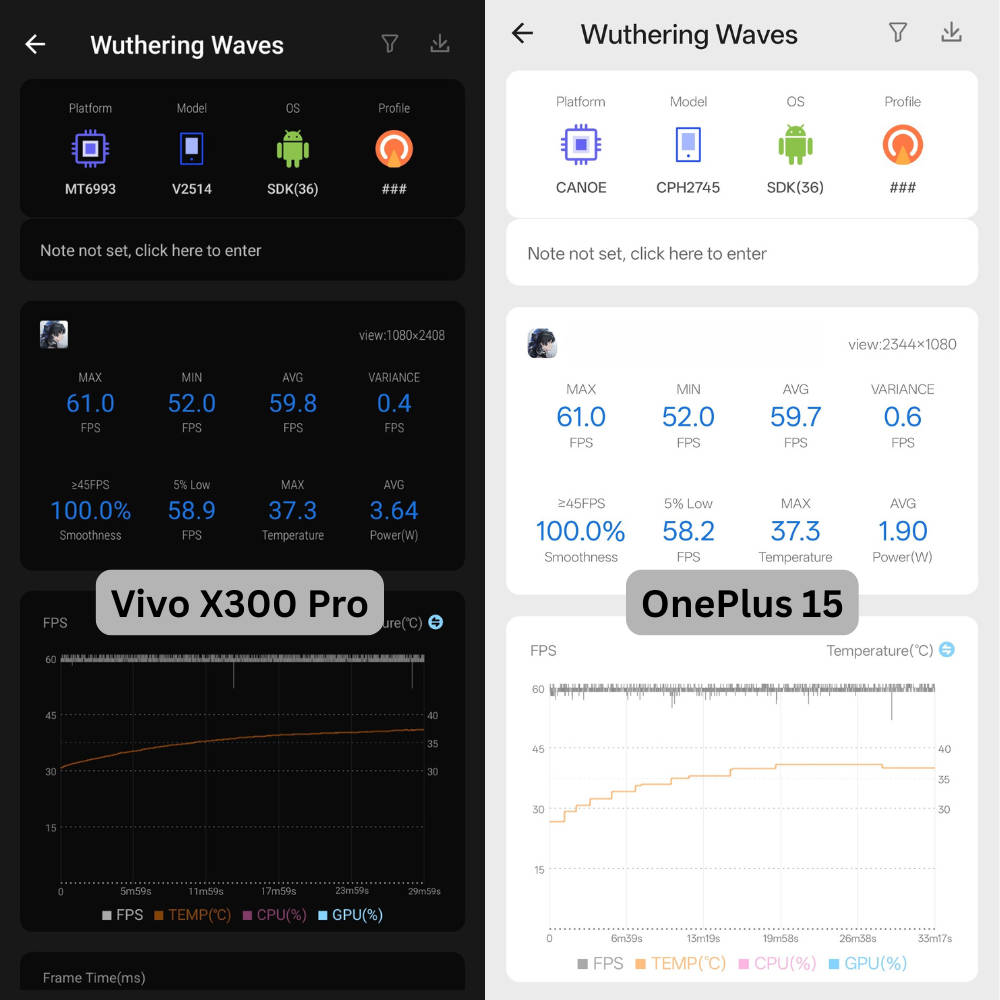
Wuthering Waves is demanding on both CPU and GPU, and the vivo X300 Pro manages it quite nicely. Frame rates stay near 60fps with low variance, so camera movement and combat remain smooth. The OnePlus 15 is not far behind, but the vivo’s frame rate is more stable since its lowest 5% drops are better than the OnePlus 15, which means better long-term performance.
Genshin Impact
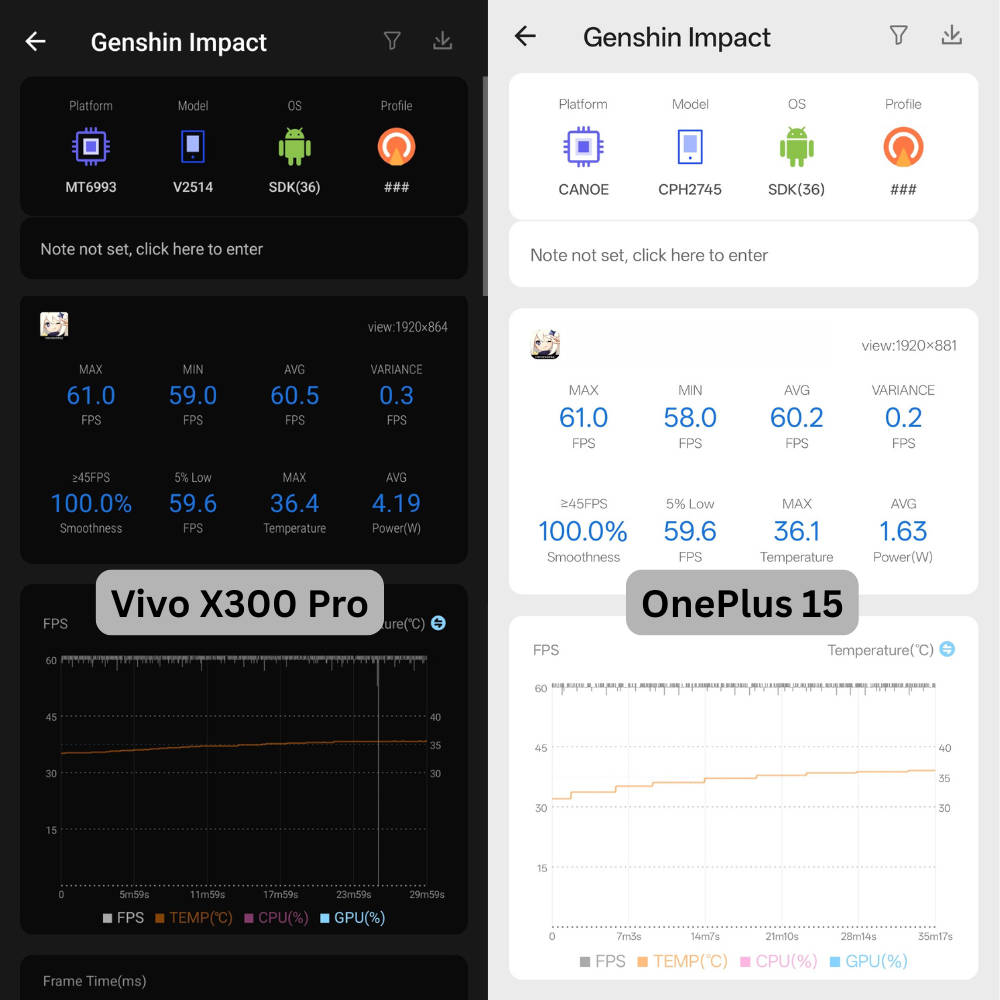
In Genshin Impact, both phones consistently deliver a steady 60fps and stay close in average numbers, with vivo in the lead with higher minimum FPS. The vivo X300 Pro maintains a stable frame rate with similar temperatures, which helps the game look and feel smooth even when there is a lot happening on screen. The OnePlus 15 performs well too, but the vivo’s temperature line is a bit more consistent over time.
BGMI
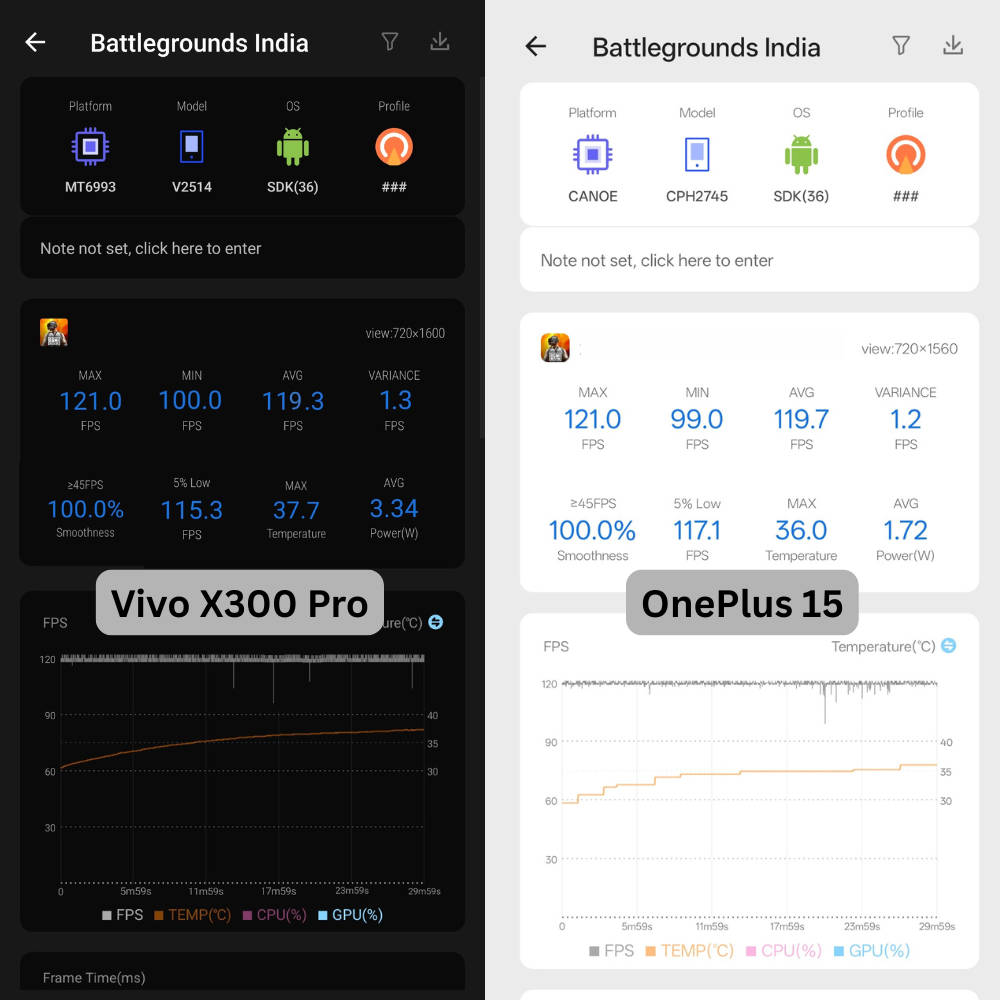
BGMI needs consistent, smooth frame rates, and the Dimensity 9500 in the vivo X300 Pro handles that very well. It keeps the game at 120fps with very small dips, so the action feels stable and responsive throughout. The OnePlus 15 also runs the game smoothly, but the vivo has slightly better minimum FPS so the gameplay is more stable comparatively in longer runs.
Cameras that’ll make you go, ‘Woah!’
The camera system on the new vivo X300 Pro is nothing short of exceptional, featuring large sensors and high-resolution lenses on every front. It includes a 50MP Sony LYT 828 primary sensor, a powerful 200MP ZEISS APO telephoto camera with 3.5x optical zoom, and a 50MP JN1 wide-angle lens that doubles as both the ultrawide and selfie camera. Backed by ZEISS, the system captures lifelike colours and offers multiple photographic styles to suit different preferences.
The vivo X300 Pro relies more on its imaging hardware than on software-based artificial background processing. The phone features an exclusive VS1 Pro chip that improves RAW image data handling and helps with multi-frame fusion, motion stabilisation and noise reduction, without adding any shutter lag. The V3+ chip works in tandem and helps the device fine-tune colours, detail, and low-light textures so photos look sharp and vibrant straight out of the camera.
This lineup alone makes for an impressive hardware setup, but the real magic lies in how it performs. The vivo X300 Pro delivers the kind of stunning imaging quality that has become synonymous with the X-series. To make things even better, vivo includes a dedicated vivo ZEISS 2.35x Telephoto Extender kit with an extended 8.8x optical zoom lens, allowing you to capture distant subjects with remarkable clarity and ease. Let’s now see how the camera performs in real-world scenarios:
Daylight
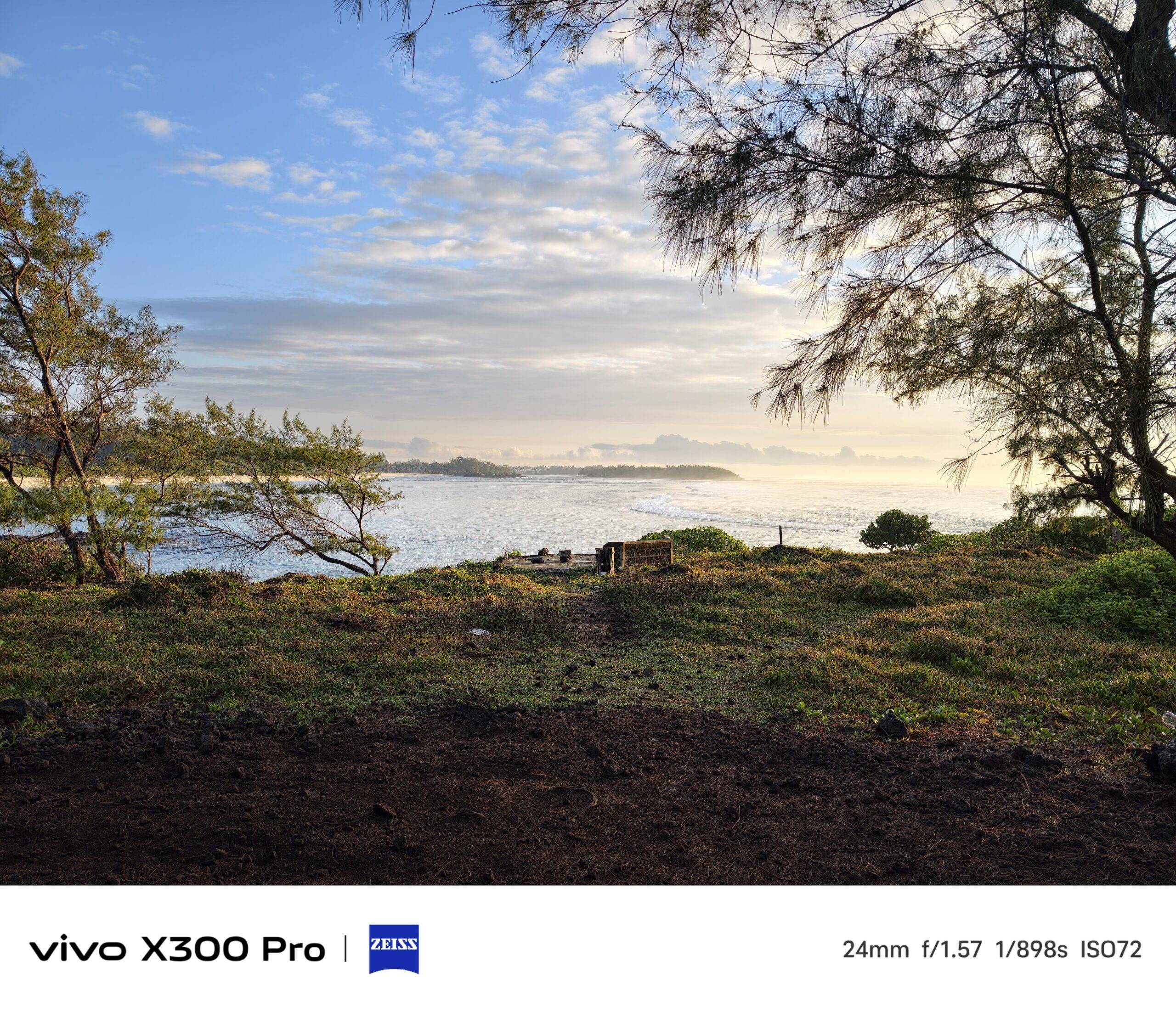
The daylight image shot on the vivo X300 Pro shows excellent dynamic range with a good balance between the bright sky and the darker foreground, so you get plenty of detail across the frame. Colours look slightly punchy in a pleasing way, which makes the shot ready to post on social media, with realistic greenery, blue hues in the sky, and a warm sunset tone that ties it all together. The frame also manages sharpness really well across the scene, especially around the trees and grass, while keeping noise virtually non-existent. The vivo X300 Pro delivers DSLR-like results that do not need much tweaking, so your picture-perfect moments stay ready to share at a moment’s notice.
Macro
Taking great macros usually needs a fair bit of skill, but the vivo X300 Pro helps reduce that effort with its super short 15cm focusing distance. This lets you move in very close and still capture your subject with ease, revealing fine details like the yellow striations on the leaf stem and the tiny textures in the water droplet. The colours look quite pleasing, and the image maintains excellent sharpness across the frame. With results like this, capturing impressive macro shots becomes something you can proudly show off to your friends using the vivo X300 Pro.

Ultrawide
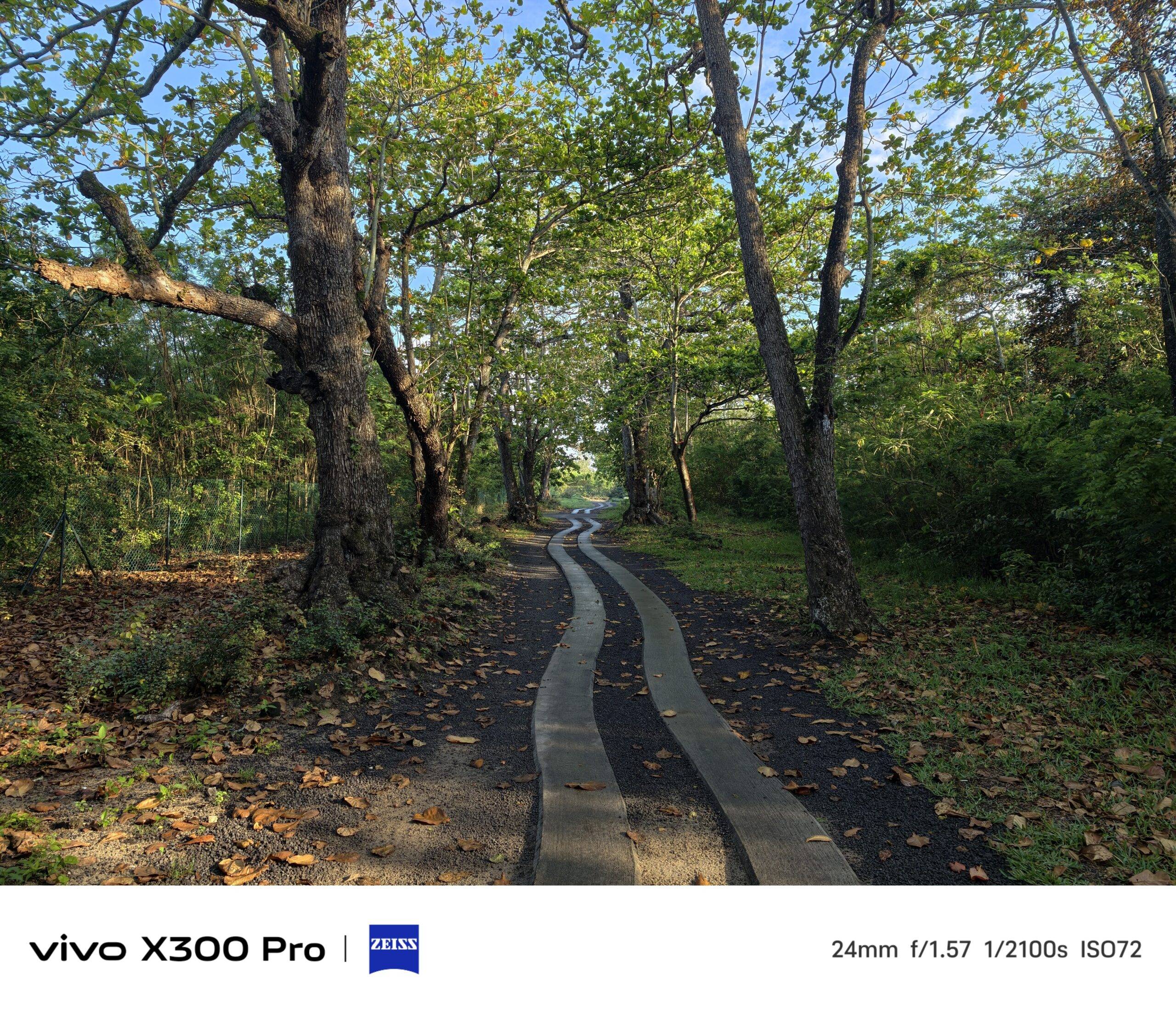
If you enjoy shooting scenic landscapes or group photos, the vivo X300 Pro’s ultrawide camera will definitely keep you satisfied. In the image below, the lens captures a vibrant forest scene with rich colours and a strong sense of depth. The gravel road and its texture are rendered very cleanly, and the added contrast gives the shot a nice punch without being overdone. The edge detail also holds up really well, with smaller leaves and thin tree branches appearing crisp instead of smudged. The camera preserves highlights in the sky nicely too, with the clouds clearly visible through the gaps in the forest canopy, which rounds off an excellent ultrawide output.
Portraits
The vivo X300 Pro’s portraits are its strongest trait, thanks to its exceptional telephoto lens. It delivers great performance both in terms of subject detail and background blur. Skin tones look natural, the shirt’s texture and hair strands are sharp, and the phone keeps the face in crisp focus without smoothing out the facial details. The background bokeh looks clean, with the hanging umbrellas and lights rendering in a soft, pleasing blur that still keeps their colours intact. Edge detection around the shoulders and arms is also very precise, which gives the portrait a very polished, DSLR-like look.

With Teleconverter kit
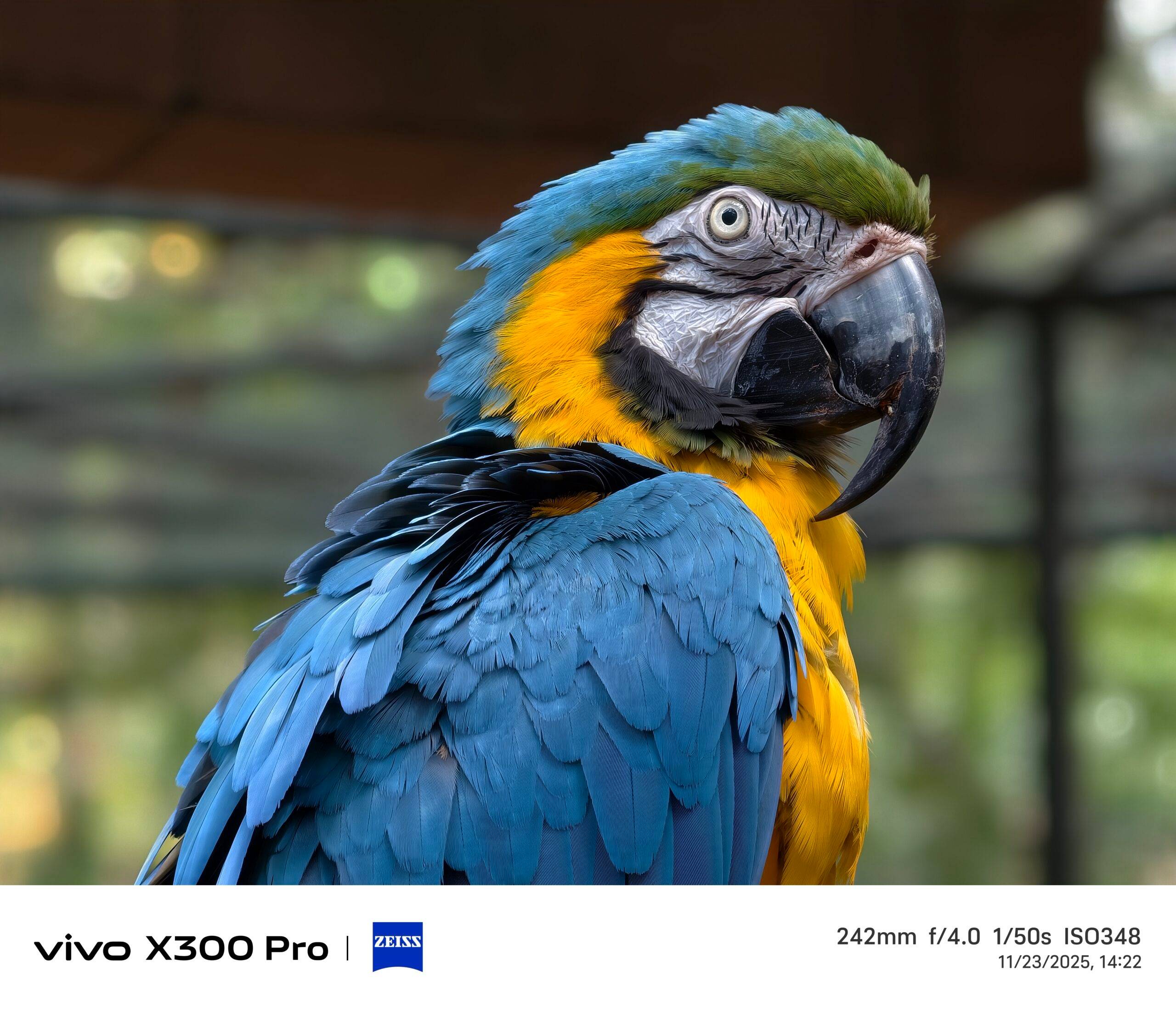
With the added teleconverter kit, the vivo X300 Pro is your personal DSLR camera and makes it easy to capture distant subjects with striking clarity. In this shot, you can clearly see the individual feathers and the texture on the parrot rendered with excellent sharpness and rich, saturated colours that look straight out of a wildlife documentary. Edge detection holds up really well and even tiny details like the fine hair around the beak and small scratches on the bill stay intact, which adds a lot of depth and realism. With this kit attached, you can comfortably take great zoomed shots that once felt out of reach, which makes it very approachable even for someone who does not consider themselves an expert photographer.
Low light
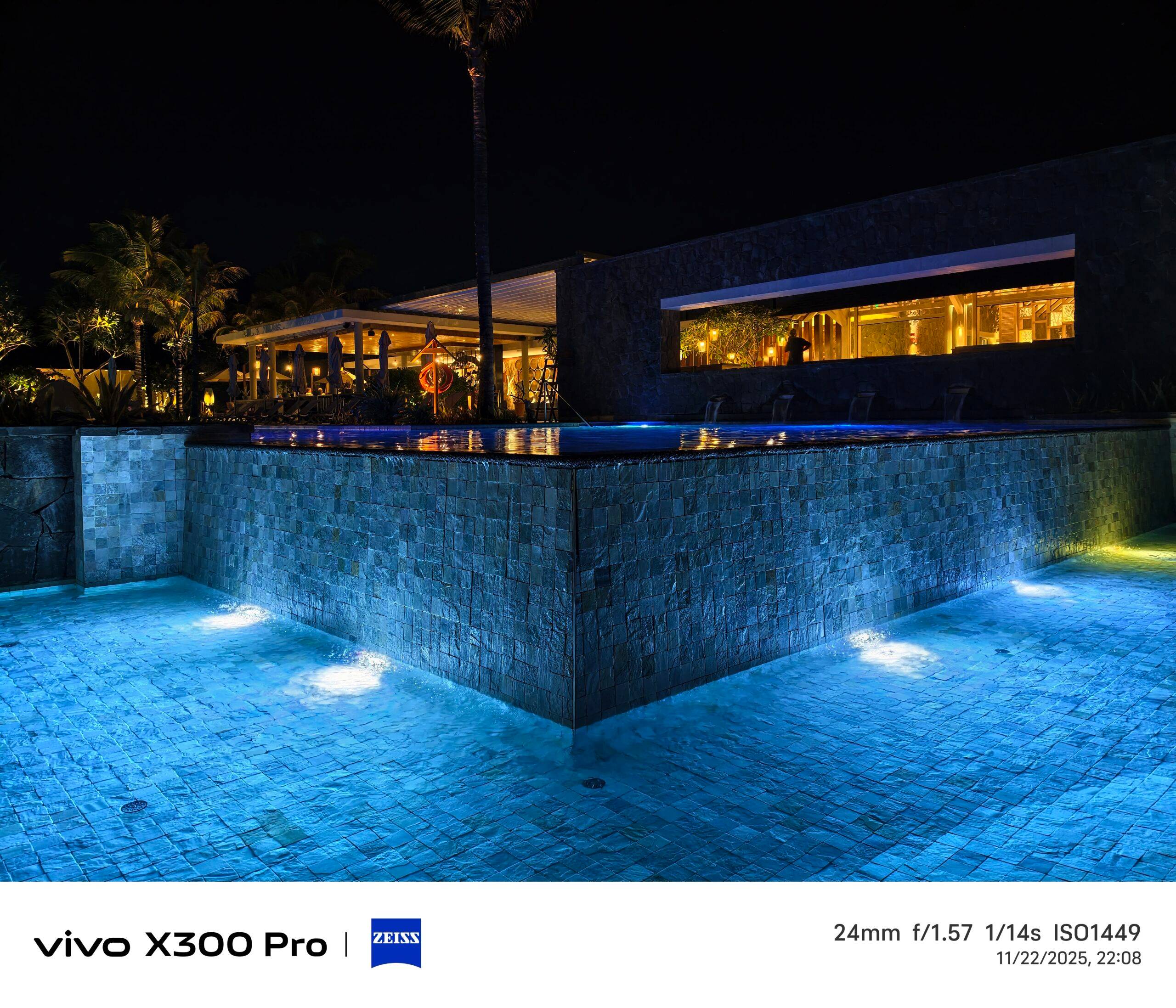
The vivo X300 Pro proves its low-light chops with this night shot, where it balances the deep blacks of the sky with the bright highlights from the pool and resort lights very cleanly. The phone preserves plenty of texture on the stone walls and pool tiles, while the blue pool lighting and warm indoor tones stay punchy without bleeding into each other. Noise remains well under control despite the challenging scene, and the overall image looks crisp and stable enough that you can comfortably use it as a ready-to-post shot for your socials.
The only flagship smartphone you’d ever need
There are very few occasions when a smartphone leaves such a strong impression that it genuinely feels special, but the vivo X300 Pro does exactly that. It ticks multiple boxes for different kinds of users and comes closest to what an actual “flagship” should be. With the Dimensity 9500 SoC, you never need to worry about performance, whether you are gaming, rendering heavy videos, juggling long multitasking sessions, or simply going through your everyday routine. It keeps the phone running effortlessly smooth across every use case.
Beyond raw power, the Dimensity 9500’s advanced ISP also drives the camera system on the vivo X300 Pro. The phone consistently captures exquisite shots in almost any lighting condition, with impressive clarity, pleasing colours, and strong technical detail even for the most inexperienced user, which turns it into a true point-and-shoot experience. Attach the teleconverter kit and you can comfortably rival results from seasoned photographers with just the vivo X300 Pro in hand. The device rounds off the package with a super smooth OriginOS 6 experience, an elegant design, and reliable long-term software support. What more can you ask for? The vivo X300 Pro is the only flagship smartphone you would ever need.
The vivo X300 Pro is priced at Rs 1,09,999 for the 16GB + 512GB variant. For photography enthusiasts, the vivo ZEISS 2.35x Telephoto Extender kit is also available separately at Rs 18,999 with an instant discount of Rs 4,000 on the bundle, bringing its effective price down to just Rs 14,999. Get your hands on this exceptional flagship and make your imaging dreams come true.
This is a promotional post done as part of a brand collaboration.