Samsung Galaxy Z Fold8 vs iPhone Duo: Why a Foldable Is More Than Just a Smartphone


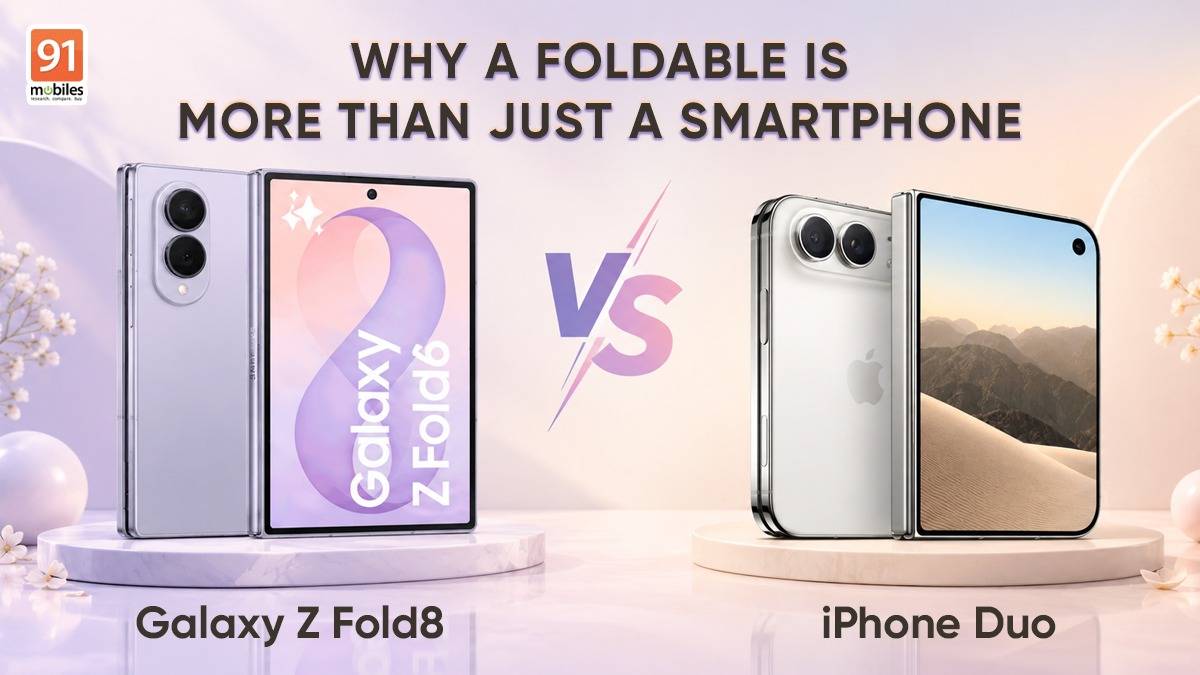
Apple has finally stepped into the foldable market with the iPhone Duo, its first phone that opens like a book. Samsung, meanwhile, is on its eighth generation of the Fold, and the Galaxy Z Fold8 arrives with an all-new, wider design. On paper, the two look remarkably similar. Both open to a 7.6-inch inner screen, both use a wide shape that feels more like a small tablet than a stretched phone, and both run on top-end chips.
A foldable, though, is rarely bought for its spec sheet. People choose one because they want a single device that works like a phone in the pocket and like a tablet when opened. What matters is how well the phone uses that extra screen: how many apps it can run at once, how comfortably it handles work and entertainment, and how easily it fits into a normal day. On each of those counts, the Galaxy Z Fold8 makes the stronger case, and the reasons go well beyond benchmark scores.
Table of Contents
Galaxy Z Fold8 vs iPhone Duo: Key Specifications
Specification | Galaxy Z Fold8 | iPhone Duo |
Main display | 7.6-inch Dynamic AMOLED 2X, 4:3, up to 120Hz | 7.6-inch Super Retina XDR OLED, up to 120Hz |
Cover display | 5.5-inch Dynamic AMOLED 2X, 10:16, up to 120Hz | 5.4-inch Super Retina XDR OLED, up to 120Hz |
Processor | Snapdragon 8 Elite Gen 5 for Galaxy | A20 Pro |
Split-screen multitasking | Two or three apps side by side, plus pop-up windows | Two apps side by side in Split View |
Thickness (folded, unfolded) | 9.7mm, 4.5mm | 11.3mm, 5.2mm |
Weight | 201g | 254g |
Rear cameras | 50MP wide and 50MP ultra-wide | 48MP Fusion Main and 48MP Fusion Ultra Wide |
Selfie cameras | 10MP (cover screen) and 10MP (main screen) | 12MP Center Stage (cover screen) and under-display FaceTime camera (main screen) |
Software | Android 17 with One UI 9; seven OS upgrades and up to seven years of security updates | iOS 27 |
Multitasking Across Multiple Apps
A typical workday on the move rarely involves just one app. A client’s email needs a reply, the numbers for it sit in a spreadsheet, and the team is waiting on a chat thread. On a regular phone, that means jumping between apps and losing track each time. A foldable should fix this, and both phones try to.


Apple’s approach is clean and simple. The iPhone Duo brings Split View to the iPhone for the first time, so two apps can sit side by side on the inner screen. Users can also save app pairs and open two windows of the same app, such as Safari. It is a sensible start, though for now it stops at two apps. App support is still growing, too. Apple’s developer guidance notes that apps not yet updated for the iPhone Duo open at their familiar iPhone size in the centre of the inner screen, so the larger display will become more useful as developers update their apps.


The Galaxy Z Fold8 goes further, and it has history on its side. Samsung’s first Galaxy Fold could already run three apps at once back in 2019, and seven generations of refinement show. The Fold8’s split screen runs two or three apps side by side, and the divider between them can be dragged to give each app the space it needs. Pop-up view adds a floating window that stays on top of everything else, so a calculator or a chat can hover over a spreadsheet and be moved aside when it is not needed. Optional swipe gestures open split screen or pop-up view without digging through menus.
That third app makes a bigger difference than it sounds. During a meeting, a video call, a shared document, and a notes app can all stay in view. While shopping online, two store apps can sit side by side to compare prices, with the family chat open in the third pane. A student can keep a lecture video, a PDF, and notes on screen together.
The Taskbar makes all of this quicker to manage. Much like the dock on a laptop, it sits at the bottom of the main screen with favourite apps, recently used apps, and App Pairs, so switching tasks takes a single tap with no trip to the home screen. Any combination of two or three apps can be saved as an App Pair and placed on the Taskbar, the home screen, or the Apps Edge panel, which means an entire work setup opens at once. For apps that do not support split screen on their own, a Labs setting can turn on Multi Window for all apps, so multitasking is not held back by app support.


Galaxy AI adds one more layer. Now Nudge recognises what is happening on screen and suggests a relevant next step, such as adding plans from a chat to the calendar, which saves yet another trip between apps.
Large-Screen Productivity and Entertainment
The biggest change in the Fold8 this year is its shape. Its 7.6-inch main screen now uses a wider 4:3 aspect ratio, which gives videos, documents, and apps more room. Rotate it to portrait, and the 3:4 view suits reading articles, e-books, and long web pages. The panel is a Dynamic AMOLED 2X display with an adaptive refresh rate of up to 120Hz, and its 3,000-nit peak brightness, along with Vision Booster and a low-reflection finish, keeps it easy to read outdoors.
For work, the extra width pays off in small but constant ways. A spreadsheet shows more columns before it needs scrolling, a slide deck can be reviewed at a size where the text is easy to read, and each app in split screen gets a usable amount of room. Samsung DeX extends this beyond the phone. Connected to a compatible external display, with a keyboard and mouse, the Fold8 switches to a desktop-style interface where apps open in separate windows, much like a computer. For someone who travels with just a phone, that covers a lot of what a laptop is needed for, from emails to documents and presentations.
Galaxy AI helps here too. Transcript Assist turns a recording into text and can summarise or translate it with a tap, which is useful after a long meeting or lecture. Gemini Notebook, one of the AI tools Samsung highlights for its new Z series, can take a PDF of meeting minutes or an audio recording and turn it into a summary of key points, and then into slides, a podcast, or a quiz.
When work is done, the same screen becomes a personal theatre. Samsung calls the 4:3 main display ideal for movies and games, and a standard widescreen video plays noticeably larger than it would on a regular phone. Colour matters here as much as size. The Fold8’s Dynamic AMOLED 2X panel keeps films and photos vivid. The iPhone Duo takes a different approach, with a matte nano-texture finish on its inner screen designed to reduce glare and reflections, though some owners feel it gives the display a slightly hazier look, with blacks and colours that appear a little less rich. Games get a bigger playing area too, the Snapdragon 8 Elite Gen 5 for Galaxy has the power for demanding titles, and the 4,800mAh battery is built for all-day use. For quick breaks, the 10:16 cover screen is shaped for short-form video, so reels can be watched without opening the phone at all.
A More Versatile Experience for Work and Everyday Tasks
A foldable spends much of its day closed. It comes out for a quick reply on the metro, a UPI payment at a shop, or a map check on the way to a meeting. For these moments, the Fold8’s 5.5-inch cover screen uses a 10:16 shape that Samsung designed to feel like a natural smartphone for messaging, browsing, and short videos. Quick tasks happen on the outside, and when a task needs a bigger canvas, the main screen is one unfold away. Now Nudge supports this flow too, with suggestions that can carry a task from the cover screen to the main display.
Language support is where Galaxy AI has a clear lead for Indian users. On the Fold8, Live Translate works on phone calls as they happen, Interpreter covers face-to-face conversations and can show both languages on screen at once, Transcript Assist converts recordings to text, and Note Assist summarises and formats notes. All four work in Hindi and Gujarati. Writing Assist and Photo Assist support Hindi, Bengali, and Gujarati, while Now Brief and Now Nudge support Hindi. Apple’s own iOS 27 feature availability list, by contrast, does not include Hindi for any Apple Intelligence features, and its new Siri AI is available in English to start. For anyone who speaks Hindi at home and English at work, that gap shows up daily.
A few everyday extras help too. The Fold8 can share its battery wirelessly, topping up Galaxy Buds or a Galaxy Watch placed on its back, and Samsung Knox and Knox Vault help keep personal and work data secure.


Cameras are another everyday difference. The Fold8’s 50MP wide and 50MP ultra-wide cameras handle everyday shots, while Dual Recording, which captures both sides of a scene at once, and My FanCam, which reframes a video around a chosen subject, give it a more specialised shooting experience for social content. For selfies and video calls, the Fold8 has 10MP cameras on both screens, set in small camera holes, so neither has to shoot through the display.
The iPhone Duo hides its inner FaceTime camera under the display, which keeps the screen uninterrupted, though some users find its photos and video calls less sharp than a regular selfie camera’s. For the sharpest selfies, its 12MP outer camera is the one to use, with the phone closed.
Which Phone Is Lighter and Easier to Carry and Use?
The Galaxy Z Fold8 is the lighter phone, and the easier one to carry and use. It weighs 201g, making it Samsung’s lightest Galaxy Z Fold yet, against 254g for the iPhone Duo, so it is about 20 per cent lighter. Folded, it is 9.7mm thick against the Duo’s 11.3mm, and slightly narrower too, at 81.9mm against 84.1mm.
Those numbers stand out even more next to regular phones. At 201g, the Fold8 weighs less than Apple’s iPhone 18 Pro (211g) and Samsung’s own Galaxy S26 Ultra (214g), neither of which folds. The iPhone Duo, at 254g, is heavier than even the iPhone 18 Pro Max (249g) and weighs almost exactly what Samsung’s Galaxy Z Fold5 did in 2023 (253g). Samsung has spent three generations cutting that weight down, and the Fold8 shows the result.
In daily life, the difference shows up in small, constant ways. Whether it is a call, a quick photo, or to show QR code for a movie ticket, the Fold8’s slimmer, lighter body makes it easy to take out the phone and use it time and again. It sits more comfortably in a trouser pocket and in one hand, and its slightly larger 5.5-inch cover screen, against 5.4 inches on the Duo, handles most of these moments without unfolding the phone.
The weight matters even more once the phone is open. Reading an e-book, watching a film, or working through a document means holding a foldable like a small book, often for an hour or more, and every extra gram adds up over a session like that. The Fold8 keeps those sessions comfortable, and Samsung has not cut battery capacity to get there: the phone still fits a larger 4,800mAh battery.
Why the Overall Smartphone Experience Goes Beyond Benchmark Scores
Phone comparisons often come down to benchmark charts, and both phones are powered by flagship chips. The iPhone Duo runs Apple’s A20 Pro, built on a 2-nanometre process, while the Fold8 uses the Snapdragon 8 Elite Gen 5 for Galaxy, with its CPU, GPU, and NPU customised for Galaxy phones. Either one opens apps quickly, runs demanding games, and handles 4K video without trouble.
A benchmark, however, only measures how fast a chip finishes a fixed set of tasks in a short, controlled test. It says nothing about how a phone feels after an hour in the hand, how much its software can do with a large screen, or how long it will stay up to date. On a foldable, those are the things that shape daily life with the phone.
Comfort that adds up: The Fold8’s lighter, slimmer body is a good example. No benchmark captures it, but it is felt every time the phone comes out of a pocket or stays open in the hand for a long read.
Software with years of practice: The Galaxy Z Fold8’s multitasking tools have been shaped by seven years of real-world use, and Android apps have long had to adapt to tablets and foldables. The iPhone Duo is Apple’s first foldable, and getting the most from its screen depends on developers adapting their apps with the new tools Apple has introduced for it. The Fold8 starts with much of that groundwork already in place, and with 12GB or 16GB of RAM, it has the headroom to keep several apps running at once.
A hinge with a track record: The hinge carries every open and close, and the Galaxy Z Fold8’s design builds on eight generations of Samsung foldables, now with a Flex Titanium structure that Samsung says is designed to keep foldables durable as they get thinner. The iPhone Duo’s hinge is Apple’s first, and as with many first-generation designs, a few early owners have reported problems with the inner screen along the fold. Apple has said the issue affects a small number of units and is offering replacements through AppleCare.
Support that lasts: Samsung promises seven generations of Android upgrades and up to seven years of security updates for the Galaxy Z Fold8. For a device meant to be kept for years, that means new features and security fixes should keep arriving into the 2030s.
As you can see, these are the details a buyer lives with every day, and none of them show up in a benchmark score.
Verdict: The Foldable That Does More
The iPhone Duo is a confident first foldable from Apple, and long-time iPhone users will find a lot to like in it. But a foldable earns its place by doing what a regular phone cannot, and that is where the Galaxy Z Fold8 pulls ahead. It runs up to three apps side by side with floating windows on top, turns into a desktop with Samsung DeX, understands Hindi through Galaxy AI, and does it all in a lighter, slimmer body backed by seven years of updates. For anyone who wants their next phone to be more than just a smartphone, the Galaxy Z Fold8 is the more complete foldable.

