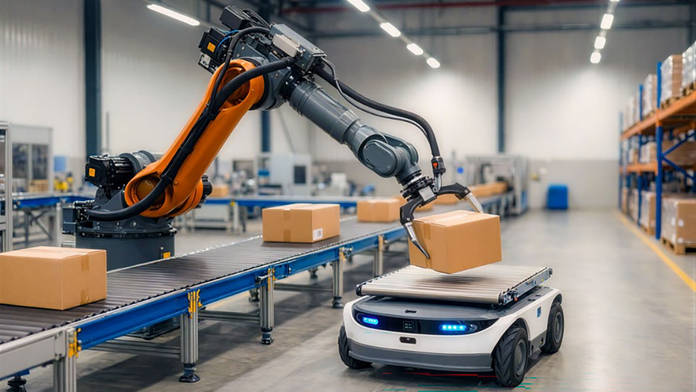
Robots are no longer a distant ambition for most large organisations. They are a five-year plan. But according to new Intel research, the urgency to deploy is outpacing the readiness to manage what comes next.
New research commissioned by Intel finds that robotics adoption is accelerating faster than organisations can operationally support it. The study, titled “The Robotics Readiness Gap”, surveyed 800 senior business and IT leaders, robotics specialists, and government and healthcare officials across the US, UK, Germany, Japan, China, and South Korea, all from organisations with annual revenue exceeding $500 million.
The central finding is a straightforward disconnect. Six in ten leaders expect their organisation to operate a fleet of robots within five years. But in reality, only four in ten currently have a formal strategy to manage a mixed human-robot workforce. The gap between ambition and readiness is the report’s defining tension.
“The next phase of robotics adoption won’t be defined by whether organisations can deploy robots, it will be defined by whether they’re ready to scale them. Those that embed robotics and Physical AI into their core operations, rather than layering them on top of existing systems, will be the ones who capture the full value of this shift.” John Healy, Vice President and General Manager, Industrial and Robotics Division, Intel
Five factors separating success from stalled pilots
Intel’s research identifies five areas where that readiness gap shows up most clearly:
- On strategy, 67% of leaders are confident their organisation will be ready to manage a mixed human-robot workforce by 2030, yet only 40% have a formal plan in place today. Confidence is running well ahead of preparation.
- On skills, two-thirds of leaders believe robotics will make their human workforce more skilled rather than less. At the same time, four in ten say talent availability is actively blocking them from scaling robotics beyond the pilot stage.
- On safety, 31% of leaders cite safety as the area where robotics has delivered the greatest value. Yet 55% say safety concerns have delayed deployment, and 68% believe clearer global safety standards would help accelerate adoption a signal that regulatory uncertainty is a meaningful brake on the industry.
- On shape, 77% of leaders say robotic performance matters more than appearance. But 65% believe current robot form factors are dictated by technology limitations rather than real-world operational needs, suggesting the hardware is still catching up to the use case.
- On scale, more than three-quarters of leaders say critical robotics applications require decisions within 100 milliseconds, with nearly a quarter requiring responses in under 10 milliseconds. Currently, 42% of organisations have a defined and funded edge or on-device AI strategy, with 39% actively developing one. The remaining 19% are operating without a clear path to the low-latency infrastructure that scaled robotics demands.
The Physical AI layer
Intel frames the report within its broader push into Physical AI, bringing AI-powered perception, reasoning, and decision-making into dynamic industrial environments. Intel is positioning its edge AI silicon alongside the Intel Robotics AI Suite and OpenVINO Physical AI tools. Together, these form the essential infrastructure layer for organisations. This foundation should enable companies to move seamlessly from pilot deployments to scaled operations.
The research also notes that organisations already deploying robots report measurable gains in productivity, quality, and speed of service. This increasingly treats robotics as a competitive necessity rather than an experimental project. Leaders predict full-scale deployment could double operational output.
The readiness gap Intel has identified is not primarily a technology problem. It is a strategy, skills, and infrastructure problem. Meanwhile, closing it will determine which organisations capture the value of the robotics shift and which ones remain stuck at the pilot stage.
“Work in the future will be a partnership between humans, agents, and robots all powered by artificial intelligence.” This excerpt is taken from a McKinsey Global Institute report published nine months ago. Click here to read the full report.
The workplace is changing fast. Robots aren’t just in factories anymore, they’re in hospitals, stores, and offices. The good news is that they aren’t here to take our jobs. Instead, they are being built to work alongside us and help us do things better. Because of better technology, today’s robots can actually learn and adapt to what humans need. They are becoming our teammates rather than just basic tools.
But getting humans and robots to work together smoothly is a big challenge. It means we literally have to rethink how we manage our teams and design our workspaces. More importantly, look at the future of work so that people are still the main focus.