
The OnePlus 15 only launched in late October, but leaks around its successor have already started doing the rounds. Earlier this week, the OnePlus 16 was tipped to get a 200MP camera, and now there’s fresh chatter about an even bigger change, this time to the display.
According to the latest leak by tipster Digital Chat Station in China, OnePlus is testing a screen with a refresh rate of at least 200Hz for its next flagship, the OnePlus 16. The tipster doesn’t specify the exact number, but even 200Hz would be a first for a mainstream smartphone. On paper, that’s a big jump, but in practice, it raises the same question that OnePlus is already facing with the OnePlus 15 — how often can you actually use it?

For context, the OnePlus 15, 15R and the current Ace 6T already are table toppers with their display tech. Even the company’s upcoming gaming-oriented Turbo series is expected to provide the same 165Hz refresh rate. The OnePlus 15 use BOE’s third-generation Oriental Screen – a 6.78-inch OLED panel with 1.5K resolution and a 165Hz refresh rate. No other phone currently combines those two numbers. Gaming-focussed phones like the ASUS ROG series have offered 185Hz in the past, but at a lower Full HD resolution. Honor’s Win series also features an FHD+ 185Hz display. Most mainstream flagships, on the other hand, stick to 120Hz even when they go sharper on resolution. Compared to the OnePlus 13, which had a QHD+ panel capped at 120Hz, the OnePlus 15 clearly prioritises smoothness.
A screen with ultra-fast scrolling and graphics at 200Hz+ sounds exciting, but there’s a catch. The 165Hz mode on the OnePlus 15 and the likes isn’t something you see all the time. For everyday use like scrolling through apps, watching videos, or even most games, the display stays at 120Hz using adaptive refresh. The full 165Hz is reserved for a small list of supported games including titles like Call of Duty: Mobile, BGMI, League of Legends: Wild Rift, Arena Breakout, and some others. It’s useful if you play these games regularly. If you don’t, you may honestly never notice it.
But recently, OnePlus quietly experimented with pushing 165Hz into regular apps. A recent update unlocked the option for apps like WhatsApp, Instagram, and X through Developer Options, which means it’s a test feature. But the refresh rate is not dynamic. Once enabled, the screen stays locked at 165Hz instead of scaling down, which leads to higher battery drain. OnePlus hasn’t enabled it by default, and for good reason. For most people, it wouldn’t make sense.
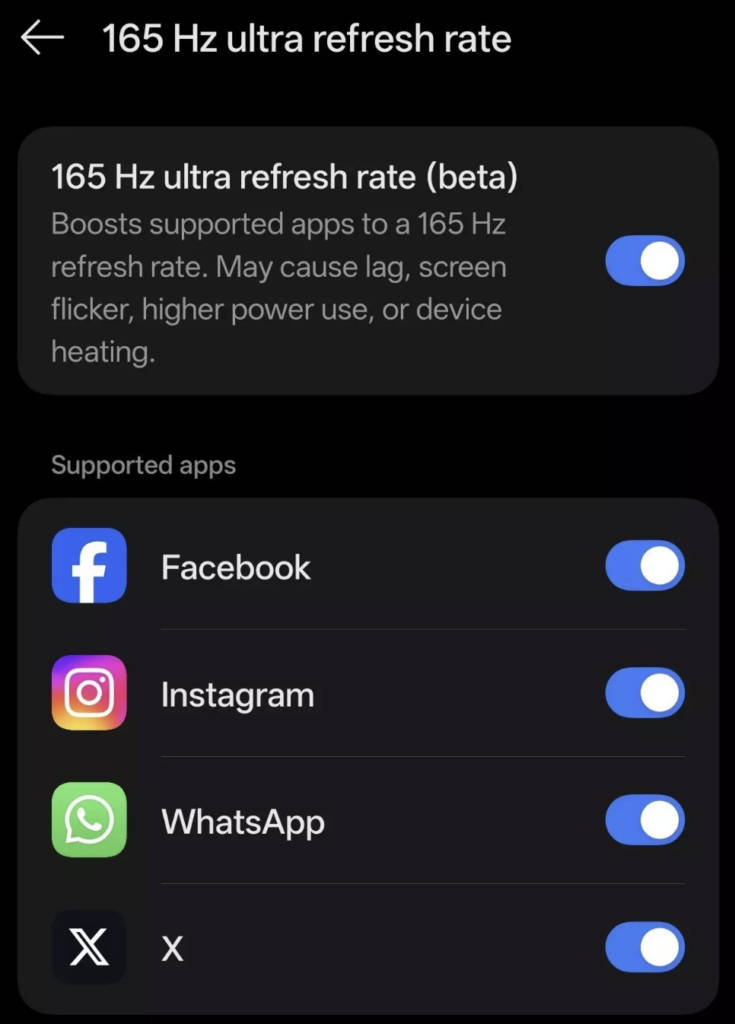
Which is why the rumoured 200Hz display on the OnePlus 16 needs to be looked at with caution. A higher refresh rate sounds impressive, but it doesn’t automatically translate to a better experience. App support is still limited, and without smarter dynamic scaling, battery life can take a hit, even with newer silicon-carbon batteries. Brands like ASUS have pushed extreme refresh rates on gaming phones for years, but mainstream flagships have been more restrained.
If OnePlus does go ahead with a 200Hz panel, the real work will be in making it usable. Wider game support, better optimisation, and clearer controls around when and how the refresh rate kicks in will matter more than the number itself. Until that happens, ultra-high refresh rates remain a feature most people will admire in a spec sheet, but rarely use. For buyers, the takeaway is simple. The OnePlus 15 already offers one of the smoothest displays on any phone today. For most users, 120Hz is still plenty. Unless OnePlus closes the gaps around support and efficiency, a 200Hz screen on the OnePlus 16 may end up being more about bragging rights than something you feel every day.