POCO M8 Power vs Realme P4 Power: which big-battery phone is suitable for you?


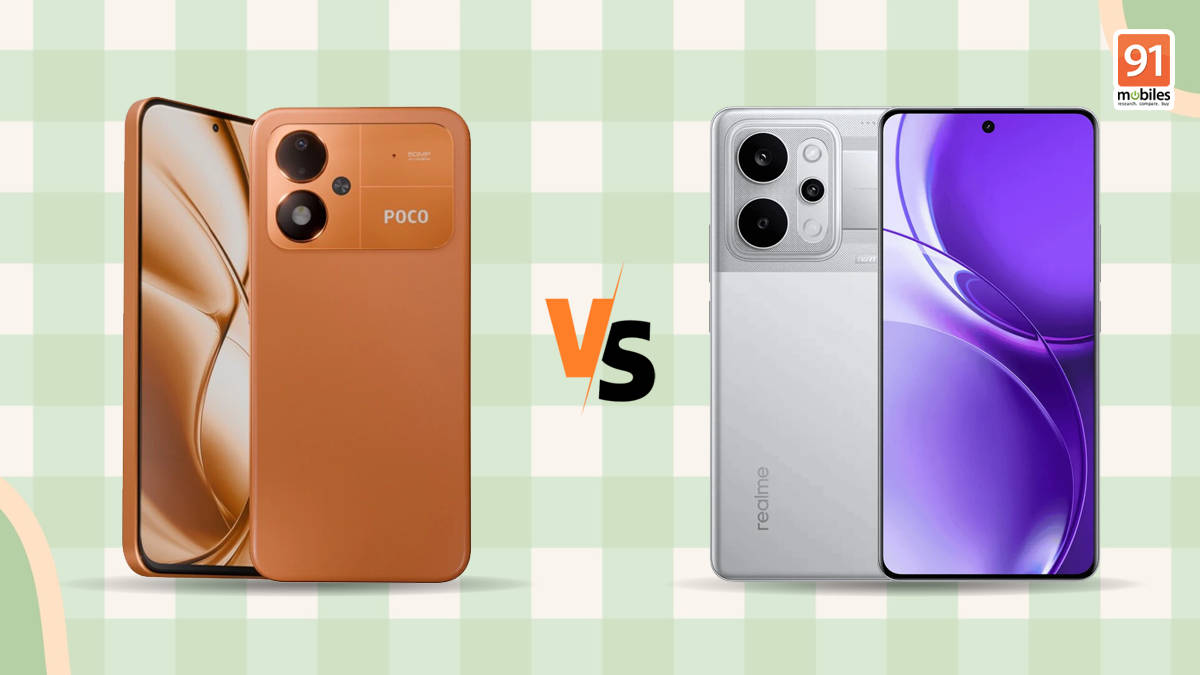
The POCO M8 Power and Realme P4 Power (review) both target buyers who want a phone with a large battery and a big AMOLED display. Both phones also offer 5G, Android 16, and dual rear cameras, so they appeal to target a similar group of users. However, the Realme P4 Power costs around Rs 5,000 more than the POCO M8 Power 5G.
That makes for an interesting question: does the Realme phone offer enough extra hardware to justify its higher price, or does the POCO phone provide better value with its lower cost? In this comparison, we look at the specifications of both phones across design, display, cameras, performance, software, and battery.
Table of Contents
POCO M8 Power vs Realme P4 Power: price, variants
| Variants | POCO M8 Power | Reame P4 Power |
| 6GB + 128GB | Rs 24,999 | NA |
| 8GB + 128GB | Rs 27,999 | Rs 29,999 |
| 8GB + 256GB | NA | Rs 31,999 |
| 12GB + 256GB | NA | Rs 34,999 |
POCO M8 Power vs Realme P4 Power: design
The POCO M8 Power and Realme P4 Power take different approaches to design. The POCO has a flat, simple body with a large camera bar, a matte plastic back, and a plastic frame. At 225 grams and around 8.4mm thick, it feels big and slightly chunky in hand, but the weight is well distributed.


The Realme P4 Power looks more eye-catching with its curved display and matte back design, which adds patterns and details around the camera area. It is slightly lighter at around 215–219 grams, although the body is thicker at 9.1mm.
The Realme P4 Power also offers much stronger protection in terms of specifications. Both phones use Gorilla Glass 7i on the front, but the POCO only has an IP65 rating, which protects it from dust and splashes.


The Realme P4 Power comes with IP66, IP68, and IP69 ratings, along with claimed MIL-STD-810H shock resistance. This gives it an advantage if you often use your phone outdoors or around water, while the POCO’s build should be enough for regular daily use.
POCO M8 Power vs Realme P4 Power: performance
The POCO M8 Power and realme P4 Power sit in different performance classes. The POCO uses the Snapdragon 4 Gen 4 with up to 8GB RAM and UFS 2.2 storage. It should handle calls, social media, streaming, and regular multitasking without much trouble, but it is not built for demanding use cases.
The realme P4 Power is much better suited to heavier use. Its Dimensity 7400 Ultra chip, up to 12GB RAM, and 256GB UFS 3.1 storage give it a clear advantage in app loading, gaming, and multitasking performance. In simple terms, the POCO is enough for basic daily use, while the realme offers more performance headroom and should stay comfortable with demanding apps for longer.
POCO M8 Power vs Realme P4 Power: cameras
The POCO M8 Power keeps things simple with a single 50MP rear camera and an 8MP selfie camera, both limited to 1080p video at 30fps. There’s no ultrawide or telephoto here, and you don’t get 4K recording or OIS, so this setup is clearly meant for basic photos, social media shots, and video calls rather than serious shooting. A comprehensive review later will share more concrete details about the phone’s camera performance.
The Realme P4 Power is much more ambitious on the camera side. It has a dual rear setup with a 50MP Sony IMX882 main sensor with OIS and an 8MP ultrawide, plus a 16MP selfie camera on the front. Here’s a look at some camera samples:
The main sensor is larger and has a bigger aperture that can shoot up to 4K30 video, while the ultrawide gives you more flexibility for landscapes and group shots. On paper, that gives the P4 Power a clear advantage in versatility and potential image quality, especially for people who care about video, ultrawide shots, and more stable low‑light photos.
POCO M8 Power vs Realme P4 Power: software
The POCO M8 Power comes with HyperOS 3, based on Android 16 which offers features such as Hyper Island, Circle to Search, and Gemini Live. POCO has also promised 4 Android version updates and 6 years of security patches, which is a great commitment for a phone in this price range.
| Smartphone | Pre-Installed Apps | Software Support |
| POCO M8 Power 5G | 73 | 4 Year OS Updates + 6 Year Security Updates |
| realme P4 Power | 60 | 3 Years OS Updates + 4 Years Security Updates |
The realme P4 Power runs realme UI 7.0, also based on Android 16. The interface is fairly clean and offers the usual realme customisation tools, AI features, and multitasking options. It is expected to receive 3 Android version updates and 4 years of security patches, which is shorter than POCO’s support period. So, while the two phones offer a similar software base, POCO has the edge for long-term updates.
POCO M8 Power vs Realme P4 Power: battery
Battery life is the main reason to consider either phone, but the realme P4 Power takes the whole “big-battery” concept even further. It packs a 10,001mAh silicon-carbon battery, compared with the POCO M8 Power’s still-large 8,000mAh cell. Both phones support reverse wired charging, but realme offers a higher 27W output compared with the POCO’s 22.5W.
The realme also charges faster, with 80W while the POCO uses 45W charging support. Both phones include their chargers in the box, so you don’t need to spend extra on a compatible adapter. Overall, the realme has the advantage in battery capacity and charging speed, while the POCO still offers good endurance for its price.
Conclusion
The POCO M8 Power and Realme P4 Power (review) are built around large batteries, but they take different routes to get there. The POCO keeps things simpler with a flat design, modest performance, a basic camera setup, and an 8,000mAh battery. It should suit users who mainly want a large screen, long battery life, and a phone for everyday tasks without spending too much.
The realme P4 Power has a clear advantage here, but the launch timing for both phones is also important to note. Realme launched the phone in January, when the memory shortage was in its early stage and RAM and storage costs were still more manageable. The POCO M8 Power arrives at a much tougher time, with memory and high-speed storage prices rising sharply because of demand from AI companies.
This does not change the fact that the realme P4 Power offers better value right now. It has a faster processor, better cameras, better durability, and a much larger battery. The POCO phone does offer longer software support, but its 8GB RAM and 128GB storage starting point could become limiting over time, especially as apps and games continue to get larger. So, the POCO makes sense as a more affordable battery-focused phone, while the realme remains the better long-term buy if your budget allows it.