The Redmi Note series has been a bestseller for Xiaomi in India, and with the Note 17, the brand is counting on an 8,000mAh battery, an AMOLED display, and extended software support to keep that streak going. I caught up with Sandeep Sarma, Associate Director, Marketing & PR, Xiaomi India, and Sandeep Singh Arora, Chief Business Officer, Xiaomi India, to talk about what’s changed with the Redmi Note 17, how buyer preferences are shifting, and where the Redmi brand is headed next.
Table of Contents
The Note series has a strong legacy behind it in India. How does the Note 17 carry that legacy forward?
Sarma:
Over the past 12 years, we’ve done 85 million Notes in India alone. That’s staggering, considering there are brands out there that haven’t done 85 million units across their entire lineup. Note is almost a brand in itself in India, something people trust and love to recommend. At one point, we tried pushing the series a few steps ahead of where the market actually wanted it to go, but the feedback from consumers, the market, and our fans was clear: the Note series is about being great at everything it does, not a one-trick pony. It has to be the best in display, battery life, and performance, because that’s what makes it worth recommending in the first place. We’ve also seen ownership periods stretch out. Back in 2017, people held onto a phone for maybe 9 months to a year; now it’s 3 to 3.5 years, and that number’s only going up. So we need a device that gives people peace of mind and stays easy to live with over that much longer ownership window, and that’s what keeps the Note legacy going.
The 8,000mAh battery is obviously the headline feature. What else stands out on this device?
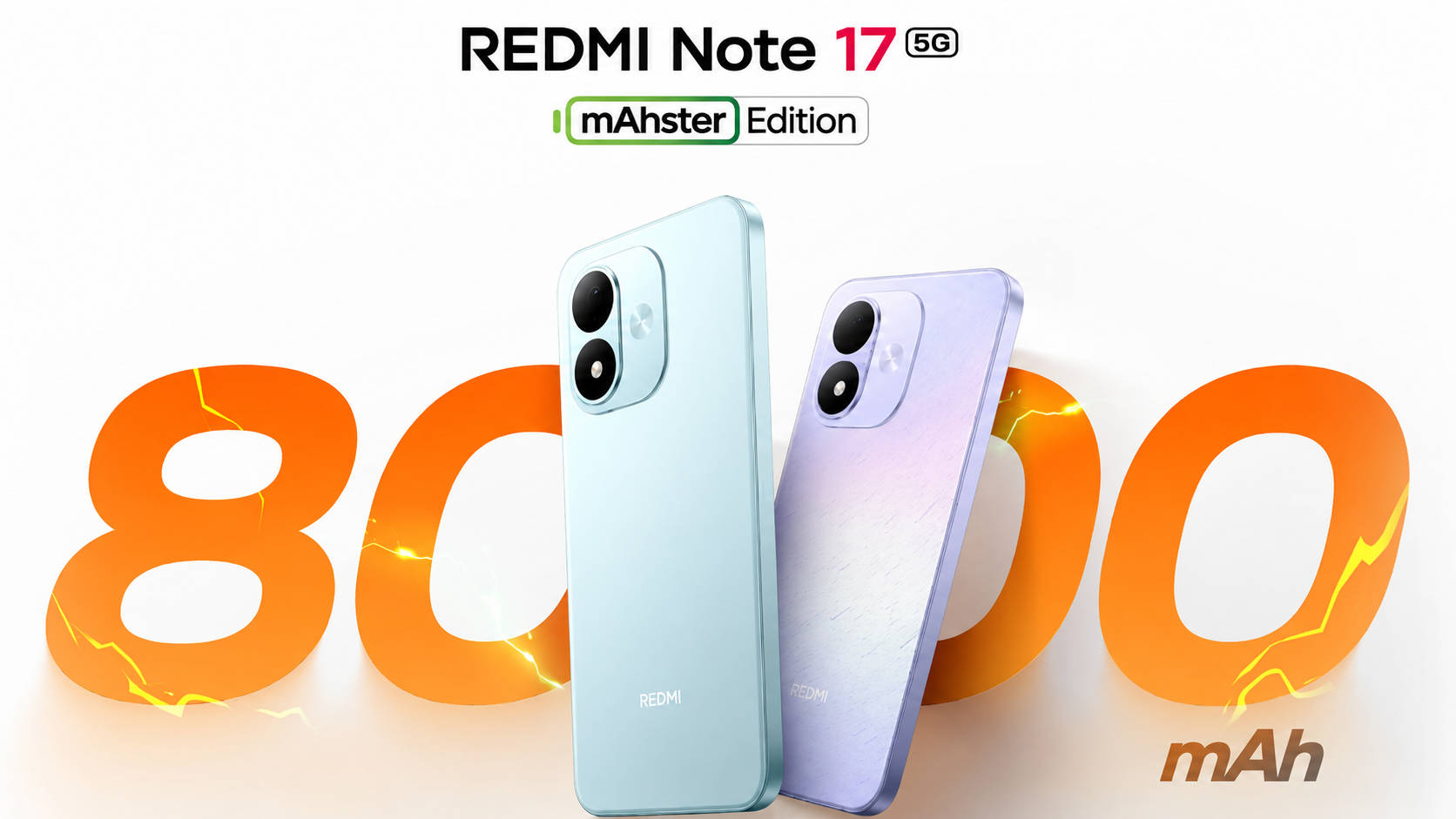
Sarma:
8,000mAh is there to grab attention; it’s the kind of number that gets a consumer to stop and look. But we also wanted to fix a longevity problem that’s common in this segment, where support tends to get skimped on. We offer 4 years of software updates and 6 years of security patches, which nearly doubles what consumers typically expect from a device’s lifecycle. In fact, we now think about the software and after-sales support first, before even finalising the hardware, because there’s a certain baseline expectation from the consumer that everything has to be built around. On the hardware side, this is one of the rare devices in its segment with an AMOLED display. We’ve also worked on network connectivity, which is an underrated pain point. If you compare even flagship devices to the Redmi Notes, the difference in stability is noticeable, and that only becomes obvious after months of actual use. The chipset is built on a 4nm process, which combined with the larger battery makes it considerably more efficient. We’ve also added fast charging and 22.5W reverse fast charging, actually higher than the direct fast-charging speeds on plenty of other phones. The 8,000mAh battery gets people’s attention, but every part of the device is designed around that same balance.
With a 7-inch AMOLED display and that big a battery as the focus, is there a sense that performance and cameras have taken a slight back seat this time?
Sarma:
Not really. The chipset is still a 4nm part, same generation as the predecessor. You might see slight deviations in synthetic benchmarks, but from a day-to-day usage standpoint, there’s no meaningful difference. This one runs on Android 16 and HyperOS 3, and the experience should get even smoother with HyperOS 4. We’ve specifically gone with a 2026 chipset, a Snapdragon 4 Gen 4, because using anything older would compromise how long we can promise updates for. We want a device launched in 2026 to still feel relevant in 2032, rather than launching something today and cutting support off by 2027, and that’s really the difference we’re going for. Beyond hardware, a lot of consumers now use their phone as their primary content-consumption device, so it’s really the AMOLED display, the battery, the processor, and all the fine-tuning together that shape the overall experience, and that’s what makes the Note the most recommended device in its segment.
Buyer preferences seem to be shifting alongside these longer ownership cycles. What other changes are you seeing?
Sarma:
Preferences have shifted quite a bit alongside ownership duration. Ten years ago, performance was almost always the top deciding factor, because every new generation brought a genuinely tangible leap. Now that baseline performance is high across the board, we’re seeing durability, battery life, service, and software support become much bigger factors. We track this every quarter, and if you plotted it over a 5-to-10-year window, you’d see the priorities have almost completely inverted. Part of that is simply because people are holding onto devices for longer. With a one-or-two-year ownership cycle, most people were already onto their next phone before software support or after-sales became a real issue. It used to be more “use and forget.” Now it’s about extracting real value out of the device and having a good experience across the entire ownership period.
Can we expect more variants in the Note 17 lineup?
Sarma:
Yes. The Note series spans multiple price bands, and just like before, we’ll have Pro and higher variants of the Note 17 as well, and we’ll announce those in due course.
Xiaomi’s Mi Fan community has always been a strong part of the brand. How much does community feedback actually shape these devices, on the hardware and software side?
Sarma:
I’d split that into hardware and software. On the hardware side, a lot of component choices come directly from community feedback. Fans tell us what they specifically want on a device, and while it might not make it into the current or even the next generation immediately, we do work toward incorporating it over time, since the broader consumer base tends to follow what our most enthusiastic fans (roughly that initial 10%) are asking for. A good example from the past is the Note 12: globally, the base Note didn’t have an ultra-wide camera, but in India, usage data showed it was genuinely needed, so we added it here specifically. There’s also an optimisation layer. We run what we call PPTGC testing (Power, Performance, Thermal, Gaming, and Camera), and until a few years ago this was done at a global level. We’ve since localised it further to capture more India-specific data: environmental conditions, network behaviour, and other factors unique to Indian usage. And then there’s software. GetApps was a piece of consistent feedback we acted on, which is why we now have the Indus App Store instead. And since we’re on the topic (this is probably the first time we’re saying this publicly), we’re also working on something for Diwali around watermarks, something fans have been asking for for a while. So it really plays out across three layers: hardware, optimisation, and software.
We’re well into the second half of the year now. What can users expect from Redmi in the coming months?
Arora:
Note is our most important franchise, and we’re kicking off the festive season with the Note 17 launch. As we get closer to the festivities, we’ll also be rolling out the higher variants of the Note series. So we’re heading into the festive season with a set of new products designed to meet consumer needs, build genuine excitement, and come with the right ownership offers for buyers during that period.
Where is the Redmi brand headed overall, especially with the industry seeing consolidation and brands exiting certain markets?
Arora:
We run three brands in the phones ecosystem. Redmi is our strongest: highest awareness, highest top-of-mind recall, and the largest user base. Xiaomi sits at the premium end, and POCO caters more to online consumers chasing performance. We intend to keep growing all three. Broadly, our direction is toward a stronger ecosystem, moving from a single device into the home, and eventually into a much larger ecosystem play. For Redmi specifically, we want to grow the franchise with a stronger ecosystem presence in phone-adjacent categories (you’ve already seen this with tablets, buds, and watches), while continuing to premiumise the core phone experience. Xiaomi, as our premium brand, will keep playing at the top end of phones, while also expanding our ecosystem beyond phone-adjacent categories, into areas like televisions and appliances.