After releasing tons of teasers over the past few weeks, Vivo has officially revealed the launch date for the X500 series in China. Set to be unveiled on September 21st, the series comprising the standard X500, X500 Pro, and X500 Pro Max will feature significant camera improvements on both the hardware and software fronts. The launch date announcement, along with key upgrades for the X500 series, was recently detailed during a creator-focused event in China.
Table of Contents
Vivo X500 series and MediaTek’s next-gen flagship chipset launch dates revealed
As noted above, the Vivo X500 series is set to launch in China on September 21st. Tipster Debayan Roy (@Gadgetsdata) on X notes that the phones will launch in India in October, which is the same timeframe for the OPPO Find X10 series India launch. On the other hand, MediaTek has just confirmed via its social media channels that it is hosting an event on September 15th to unveil its upcoming flagship Dimensity chipsets. The teaser hints at a “Pro” processor, likely indicating the rumoured Dimensity 9600 Pro, which could feature higher clock speeds than the standard Dimensity 9600.
Previously, Vivo officially confirmed that the X500 series will be powered by MediaTek’s next-generation flagship chipsets. In all likelihood, Vivo is referring to the Dimensity 9600 and Dimensity 9600 Pro, which could be present in the standard X500 and X500 Pro series, respectively.
Vivo X500 series photography and videography capabilities hinted
During the event, Vivo revealed several photography and videography capabilities of the X500 series. These include a BluePrint LightGuard 900 for the primary camera, co-developed with Sony, paired with ZEISS T* coating and optics to reduce unwanted reflections and flare in challenging lighting. The sensor can deliver up to 17 EV dynamic range (claimed cinema-grade level) for both photos and video, helping to retain highlight and shadow detail.
The phones, or at least the Pro models, will support 4K 240fps and 4K 120fps HDR video recording to capture ultra-smooth 4K slow-motion videos in HDR. Speaking of which, the phone will also support 10-bit 4:2:2 encoding, hardware-level 4K 120fps 10-bit Log video, and integration with the ACES colour system. A custom imaging co-processor will also be on board, designed in tandem with MediaTek on an advanced 2nm platform to power real-time Log video processing.


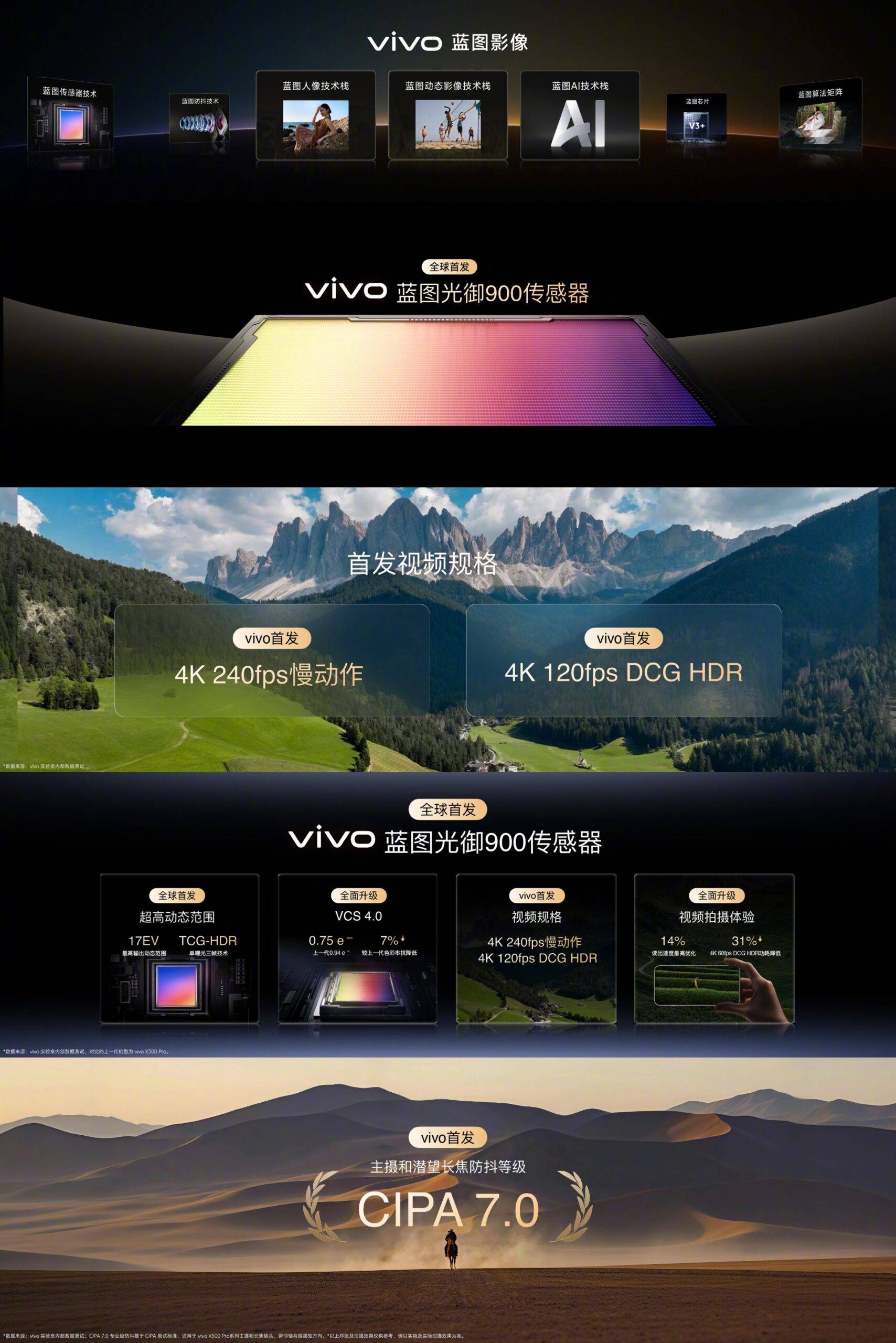
Since Vivo is known for implementing advanced stabilisation for its X series, the OIS has been further upgraded to CIPA 7.0, which brings a 3-degree wide-angle gimbal stabilisation system to the flagship X500 Pro Max. On the other hand, the VCS 4.0 & V3+ Imaging Architecture will offer enhanced noise reduction, low-light clarity, and scene processing. Then there’s a new AI Photography Assistant that suggests poses, shot frameworks, and scene-specific colour adjustments in real time.
Previously, the company confirmed that the Vivo X500 Pro Max will feature a 6.85-inch 2K AMOLED display with a 144Hz refresh rate from BOE, particularly the Q11 luminescent material. The panel promises double the lifespan of the displays featured on previous Vivo flagships, while being 21 percent more battery-efficient. The Vivo X500 series will boot OriginOS 7 out of the box, which is set to be unveiled during the Vivo Developer Conference (VDC) on September 16th.
It’s no surprise that Vivo continues to push the boundaries with regard to cameras on the Vivo X500 series. As is the tradition, the upcoming Vivo phones are heavily targeted towards creators and professionals who seek enhanced video and photography capabilities on the go. While the real-world benefits are not yet known, these phones may, due to the ongoing memory crisis, come at a considerably higher price than their predecessors.