ASUS ROG’s 20th anniversary was one giant flex


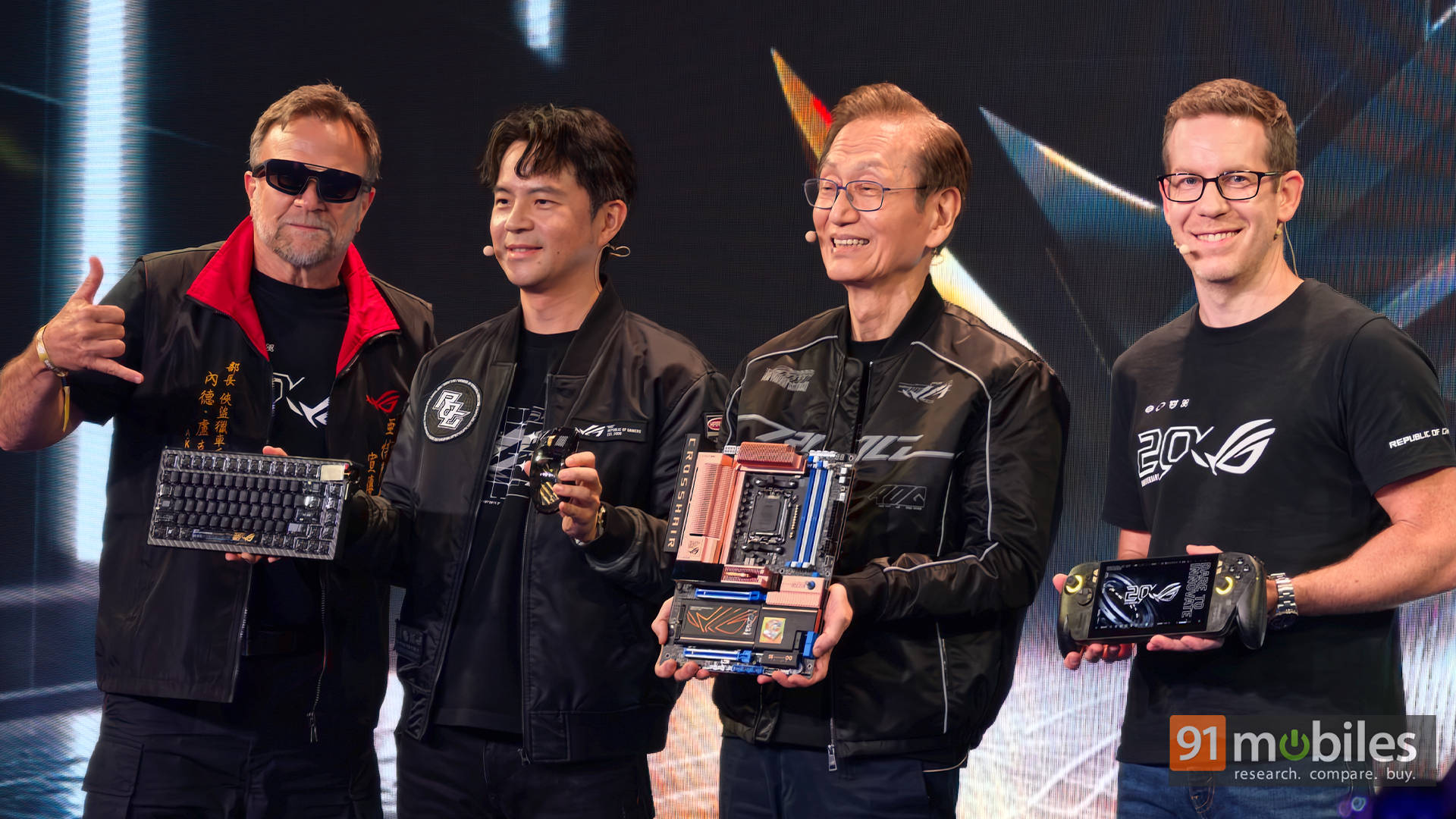
Most companies celebrate milestone birthdays with a commemorative logo, a flashy keynote, and maybe a limited-edition product. ROG celebrated turning 20 by building a motherboard with integrated liquid cooling, putting a curved AMOLED display on an RTX 5090 graphics card, stuffing flagship hardware into a three-litre mini PC, introducing a transparent special-edition gaming handheld, and casually dropping the world’s first 24.5-inch 540Hz OLED gaming monitor.
Walking through the anniversary showcase at Computex 2026, one thing became abundantly clear: ROG wasn’t interested in looking back. It was reminding everyone why PC enthusiasts fell in love with the brand in the first place.
Table of Contents
ROG’s monitors made my eyes very, very happy
The first stop on the floor was a wall of displays that immediately stole the spotlight. Leading the charge was the ROG Strix OLED XG259QWPG Ace, billed as the world’s first 24.5-inch 540Hz OLED esports monitor.


Pairing that refresh rate with a near-instant 0.02ms response time means motion looks absurdly clean, whether you’re tracking an opponent in Counter-Strike or simply dragging windows across your desktop. Even if you’re nowhere near esports level, the sheer smoothness is impossible to ignore.

Right beside it sat the equally impressive ROG Swift OLED PG32UCWM, a 32-inch 4K OLED display running at 240Hz that can instantly switch into 1080p at 480Hz with Dual Mode. One moment you’re editing photos or watching a movie in razor-sharp 4K, the next you’re chasing every possible competitive edge in Valorant. ASUS also integrates GaN technology directly into the monitor’s internal power supply, allowing for better thermal efficiency and a more compact design without relying on bulky external adapters.
Then, ASUS started flexing its DIY muscles
If the monitors got people through the door, the DIY showcase made them stay.

At the centre was the ROG Crosshair X870E Edition 20, a motherboard that doesn’t just embrace ASUS’ Back-To-the-Future (BTF) design philosophy by hiding connectors behind the board for cleaner cable management, but also integrates its own ROG Ryujin Edition 20 liquid cooling solution across the VRMs. It’s one of those products that immediately makes PC builders start mentally planning their next upgrade.

Next to it sat the ROG Astral GeForce RTX 5090 Edition 20, complete with a built-in curved AMOLED display capable of showing temperatures, clock speeds, system stats, GIFs, and custom animations directly on the graphics card itself. Is it necessary? Absolutely not. Does it make me want one anyway? Without question.

The entire setup was powered by the ROG Thor 3000W Titanium III Edition 20, a GaN-based power supply that can deliver enough juice for even the most ridiculous multi-GPU workstations while featuring a detachable OLED monitoring module. Everything was housed inside the equally outrageous AniMe Holo chassis, whose synchronized fan-mounted LEDs create floating holographic-style animations that make the entire PC look like it’s escaped from a sci-fi film.
The anniversary handheld might just be my favourite
Perhaps the product that best captured the spirit of ROG’s 20th anniversary was the ROG Xbox Ally X20 Edition 20. Wrapped in a stunning translucent black shell that reveals gold-accented internals beneath, it feels like a love letter to the era when transparent gadgets ruled the tech world.

More importantly, ASUS has finally brought an OLED display to the Ally family, upgrading it with a 7.4-inch ROG Nebula HDR OLED panel featuring a 120Hz refresh rate, 1,400 nits of peak HDR brightness, VESA DisplayHDR 1000 certification, and Corning DXC anti-reflective glass that significantly cuts down glare.

The hardware underneath is equally impressive, pairing AMD’s Ryzen AI Z2 Extreme processor with 24GB of LPDDR5X memory and 1TB of storage. ASUS has also introduced TMR joysticks for greater precision and durability, alongside a clever transforming D-pad that switches between four-way and eight-way operation depending on the game.

To complete the package, the anniversary edition ships with matching ROG XREAL R1 Edition 20 AR glasses, creating a massive virtual display that turns portable gaming into something that genuinely feels futuristic.
Tiny PCs are getting seriously scary
One of the biggest surprises of the event wasn’t a giant desktop at all. It was the ROG NUC 16 Edition 20.

Despite occupying a footprint of just three litres, ASUS has somehow squeezed in an Intel Core Ultra 9 290HX processor alongside an NVIDIA GeForce RTX 5090 Laptop GPU, creating a system powerful enough for gaming, AI workloads, and creative tasks while still being small enough to fit inside a backpack.

Keeping all that hardware under control is ASUS’ QuietFlow cooling system, which combines three fans with a dual vapor chamber design to efficiently manage heat. For anyone who wants flagship performance without dedicating half their desk to a desktop tower, it’s a remarkably compelling solution.
The SCAR 18 proves bigger can still be better
Not everyone wants a tiny PC, though. For those people, ASUS rolled out the refreshed ROG Strix SCAR 18, and calling it overkill almost feels like an understatement. Configured with an Intel Core Ultra 9 processor and an NVIDIA GeForce RTX 5090 Laptop GPU, the machine also introduces what ASUS calls the world’s first 18-inch 4K 240Hz Mini LED gaming display.

The panel packs over 2,000 local dimming zones and reaches up to 1,600 nits of peak HDR brightness, resulting in breathtaking contrast that looks just as impressive for gaming as it does for HDR video editing. It’s a desktop replacement in every sense of the phrase, except the part where you can still throw it into a backpack.
Twenty years later, ROG is still wonderfully unreasonable
What’s equally interesting is the strategy behind all of this. These aren’t products designed to chase the mass market—they’re statements of intent. By pushing boundaries with limited-edition hardware, cutting-edge displays, and engineering-first designs, ROG is doubling down on the ultra-premium enthusiast segment while setting the stage for technologies that could eventually trickle down into its mainstream lineup. In many ways, the 20th anniversary showcase felt less like a birthday celebration and more like a glimpse into where the brand sees PC gaming heading next.

Perhaps my favourite part of the showcase wasn’t a flagship monitor or bleeding-edge graphics card. It was the lovingly recreated display of the original 2006 ROG motherboard that started everything.
Standing beside 3,000W power supplies, holographic PC cases, miniature RTX 5090-powered systems, and transparent anniversary handhelds, it served as a reminder that ROG has spent two decades asking questions most companies wouldn’t even think to ask. What if a graphics card had a screen, or if a monitor could become two monitors in one, or if a mini PC didn’t have to compromise?

Walking away from the event, I realised the anniversary wasn’t really about celebrating the past. It was about celebrating a mindset. ROG has built its reputation by chasing ideas that often sound delightfully unreasonable before somehow turning them into real products. And after spending an evening surrounded by 540Hz OLEDs, holographic desktops, transparent handhelds, and impossibly compact gaming PCs, I’d argue that’s exactly the kind of energy the PC industry needs more of.