Best TVs in India Across Price Ranges: 2026


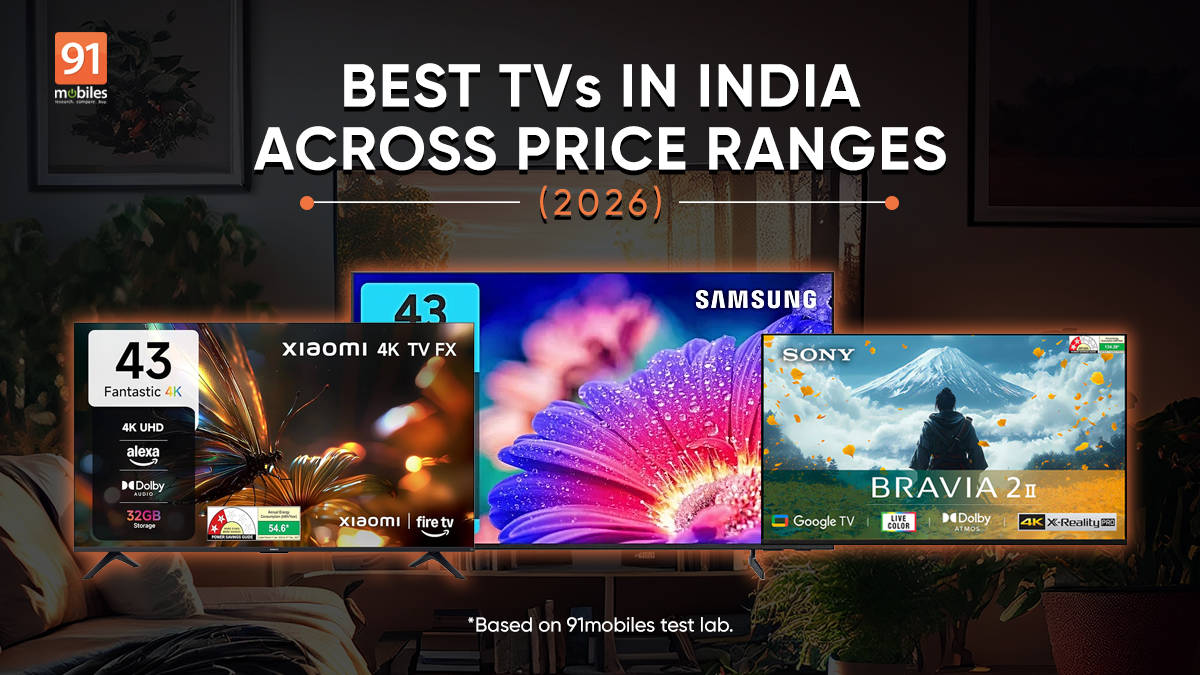
The Indian TV market is better than it has any right to be. Even the entry-level segment now comes with 4K labels, smart platforms, and feature lists long enough to distract buyers from the basic question: what will actually look good in a real room? The answer depends less on brand slogans and more on a TV’s panel type, processor, operating system, and the kind of trade-off it is built to make.
In 2026, Rs 25,000 buys you a credible 43-inch 4K LED with a decent smart platform, while Rs 50,000 unlocks QLED with Dolby Vision and genuine gaming features. Beyond that, Mini LED is now accessible under Rs 75,000, and OLED is no longer the preserve of six-figure budgets.
In this guide, we cover the best TVs in India for 2026 at every meaningful price tier. Prices in this guide reflect verified market rates as of June 2026. TV pricing in India fluctuates frequently, particularly around sale events, so treat these as reference points rather than fixed figures.
Table of Contents
Rs 20,000 to Rs 30,000
Samsung UE81A 43-inch Crystal 4K (UA43UE81AFULXL)


- Display: 43-inch Crystal LED, 4K UHD (3840 × 2160)
- HDR Support: HDR10+
- Refresh Rate: 50Hz
- Operating System: Tizen OS
- Ports & Connectivity: 3 x HDMI, 1 x USB, Wi-Fi 5, Bluetooth 5.2, eARC
- Audio Output: 20W Speakers
Samsung’s entry-level Crystal 4K lineup represents the brand at its most pragmatic. The UE81A carries a 43-inch 4K panel with Samsung’s Crystal Processor 4K for upscaling, HDR10+ support, and runs on Tizen OS. Connectivity is reasonable: three HDMI ports, one USB, Wi-Fi 5, Bluetooth 5.2, and HDMI eARC. Sound output is 20W with Q-Symphony support if you pair a compatible Samsung soundbar.
The picture quality story is familiar for this tier. Native 4K content looks clean, but the lack of local dimming means blacks are grey in dark scenes, and the 50Hz panel refresh rate is a limitation. The Tizen OS is responsive and includes Samsung TV Plus for free live TV. This is a comfortable second-room or guest-room TV. For a primary living room screen, you will want to stretch your budget.
Xiaomi FX 43-inch 4K Fire TV (L43MB-FIN)

- Display: 43-inch LED, 4K UHD (3840 × 2160)
- HDR Support: HDR10
- Operating System: Fire OS with Alexa
- Ports & Connectivity: 3 x HDMI, 2 x USB
- Audio Output: 24W Speakers with Dolby Audio
Xiaomi’s FX series runs Amazon’s Fire OS instead of Google TV, which means Alexa integration, access to Prime Video natively, and a home screen that leans toward Amazon’s content ecosystem. If you are already in the Amazon household, this integration works well. The TV carries a 4K LED panel with HDR10 support, 24W box speakers with Dolby Audio, 3GB RAM, 32GB storage, and three HDMI ports.
The Fire OS experience is fluid at this price point, and the PIP (picture-in-picture) mode is genuinely useful for monitoring security cameras while watching content. The picture quality is typical 43-inch LED territory: acceptable for streaming, weaker in darker scenes. Worth noting: the UI is Alexa-first, so users invested in Google Assistant or Google Home may find it limiting.
Rs 30,000 to Rs 50,000
Sony Bravia 2 II 43-inch Google TV (K-43S22BM2)

- Display: 43-inch Direct LED, 4K UHD (3840 × 2160)
- Processor: 4K Processor X1
- HDR Support: HDR10, HLG
- Operating System: Google TV
- Ports & Connectivity: 4 x HDMI (eARC, ALLM), 2 x USB, Wi-Fi 6, Bluetooth 5.3
- Audio Output: 20W Speakers with Dolby Atmos and DTS:X
- Gaming Features: Auto Low Latency Mode (ALLM)
Sony’s Bravia 2 II is the most capable standard LED TV under Rs 45,000 in India right now. The 43-inch variant runs on Google TV with the 4K Processor X1 for upscaling and scene optimisation via X-Reality Pro.
It supports HDR10 and HLG, with Motionflow XR 100 for motion handling. Audio is 20W via open baffle speakers with Dolby Atmos and DTS:X. Connectivity is strong: four HDMI ports with eARC and ALLM, two USB ports, Wi-Fi 6, and Bluetooth 5.3.
Google TV gives you a clean, well-organised home screen with access to the full Google Play Store, Chromecast built-in, and Apple AirPlay. The Bravia name still carries real weight at this price: Sony’s post-processing is conservative and accurate, meaning the picture avoids the oversaturated look some budget TVs default to. The trade-off is that picture quality is still constrained by the panel itself. This is an edge-lit LED without local dimming, so contrast is limited.
Lumio Vision 7 2026 55-inch QLED Google TV (FTW3-ADSJ)

- Display: 55-inch QLED, 4K UHD (3840 × 2160), 60Hz
- Processor: BOSS Processor
- Memory & Storage: 3GB RAM, 64GB Storage
- HDR Support: Dolby Vision, HDR10
- Colour Gamut: 108% DCI-P3, 78% Rec. 2020
- Operating System: Google TV
- Ports & Connectivity: 3 x HDMI, 3 x USB, Bluetooth 5.0, Chromecast built-in
- Audio Output: 30W Quad Driver Speakers with Dolby Atmos
Lumio is the most interesting TV brand to emerge in India in years. Founded by former Xiaomi and Flipkart executives, the company has built a reputation for punching well above its price class. The Vision 7 (2026) 55-inch is a QLED panel running Google TV on the company’s BOSS processor platform with 3GB DDR4 RAM and 64GB storage.
The display is said to deliver 78% Rec. 2020 colour coverage and 108% DCI-P3, which is genuinely impressive for a sub-Rs 40,000 TV. Dolby Vision and Dolby Atmos are present. The quad-driver speaker setup (two tweeters and two full-range) outputs 30W. The Vision 7 does run at 60Hz, so it is not a gaming-first TV, but ALLM is supported, and the input lag is managed well.
Samsung Vision AI UE85AH 55-inch Crystal 4K (UA55UE85AHULXL)

- Display: 55-inch Crystal LED, 4K UHD (3840 × 2160)
- HDR Support: HDR10+
- Operating System: Tizen OS with Vision AI
- Ports & Connectivity: 3 x HDMI, 1 x USB, Wi-Fi, Bluetooth, eARC
- Audio Output: 30W Dynamic Sound
- Smart Features: Solar Remote, Samsung TV Plus, SmartThings Support
Samsung’s Vision AI lineup for 2026 brings the AI-oriented feature set down to a Crystal 4K panel. The UE85AH is a 55-inch Crystal 4K running Tizen with Samsung’s Vision AI Companion features, HDR10+ support, and a 30W Dynamic Sound Pack.
The Vision AI features include content-type detection, ambient sound optimisation, and a deeper SmartThings integration. The Solar Remote is included.
As a practical TV, the UE85AH sits firmly in the upper end of standard LED territory. The picture quality improvements over Samsung’s cheaper UE81A are noticeable but not transformative: same panel class, stronger processing, and a better audio system.
LG AI NANO NU87 55-inch 4K (55NU870BPLA)

- Display: 55-inch LED, 4K UHD (3840 × 2160), 60Hz VRR
- Processor: Alpha 7 AI Processor Gen 9
- HDR Support: HDR10 Pro, HLG
- Operating System: webOS 2026
- AI Features: Gemini, Microsoft Copilot
- Gaming Features: 60Hz VRR, Auto Low Latency Mode (ALLM)
- Audio Output: 20W Speakers with Dolby Atmos and AI Sound Pro
- Software Support: 5 Years of OS Upgrades
LG’s NU87 is the 2026 NanoCell successor, now rebranded under the NANO AI lineup. It uses the Alpha 7 AI Processor Gen 9 and LG’s Nano Detail Enhancer for sharpening and upscaling. The NU87 runs webOS 2026 with Multi-AI support, meaning both Google Gemini and Microsoft Copilot are accessible through the platform.
HDR10 Pro (LG’s dynamic tone mapping applied to HDR10 content) is present alongside HLG. Gaming support includes 60Hz VRR and ALLM.
Sound output is Dolby Atmos with an AI Sound Pro system rated at a virtual 9.1.2 channel spread, which is marketing language for a 20W two-channel speaker with processing. LG also guarantees five years of webOS OS upgrades, which is a meaningful long-term commitment.
Rs 50,000 to Rs 75,000
Lumio Vision 9 2026 55-inch QD-Mini LED Google TV (EPIC3-ADSI)

- Display: 55-inch QD-Mini LED (EVA), 4K UHD, 144Hz (240Hz at 1080p)
- Processor: MediaTek Pentonic 700
- Memory & Storage: 3GB RAM, 64GB Storage
- Peak Brightness: Up to 800 nits
- Contrast Ratio: 7,000:1 Native, 100,000:1 with Local Dimming
- HDR Support: Dolby Vision, HDR10
- Colour Gamut: 110% DCI-P3, 82% Rec. 2020
- Gaming Features: 144Hz VRR, Auto Low Latency Mode (ALLM), HDMI 2.1
- Audio Output: 50W Hexa-Driver Speakers with Dolby Atmos
The Vision 9 2026 is Lumio’s flagship and the most technically ambitious TV in India under Rs 55,000. It uses a QD-Mini LED panel with EVA (Enhanced VA) technology that Lumio claims delivers a native 7,000:1 contrast ratio. The backlight system runs 1,920 Mini LEDs with precise local dimming.
Colour coverage is 82% Rec. 2020 and 110% DCI-P3. The display is native 4K at 144Hz, with 240Hz at 1080p resolution. VRR, ALLM, and HDMI 2.1 are present, making this a legitimate gaming-capable TV.
The heart of the Vision 9 is Lumio’s BOSS architecture, running a MediaTek Pentonic 700 chipset on 3GB DDR4 RAM and 64GB storage. Google TV is the smart platform. Sound output is 50W from a hexa-driver configuration (four full-range drivers plus two subwoofers) tuned by Lumio’s DGS 2.2 system, with low-frequency extension down to 38Hz.
The 2026 model also adds a DVB-S2 satellite port, allowing free-to-air channels via DD Free Dish.
Samsung QN70F 55-inch Neo QLED (QA55QN70FAULXL)


- Display: 55-inch Neo QLED (Mini LED), 4K UHD
- Processor: NQ4 AI Gen 2 Processor
- HDR Support: HDR10+, HLG
- Operating System: Tizen OS with Vision AI
- Gaming Features: 4K at 60Hz, Auto Low Latency Mode (ALLM)
- Audio Output: 20W Speakers with Dolby Atmos
- Ports & Connectivity: 4 x HDMI, 2 x USB, Wi-Fi, Bluetooth
Samsung’s Neo QLED QN70F is the brand’s accessible Mini LED entry point in India. It uses Quantum Mini LED backlighting with Quantum Matrix Technology Slim for finer dimming control, paired with the NQ4 AI Gen 2 processor across 20 neural networks. The panel supports HDR10+ but not Dolby Vision. The Vision AI feature set is present: content-type detection, ambient adjustments, and SmartThings integration.
The QN70F is a meaningful step above Samsung’s Crystal series in picture quality, particularly in contrast and HDR performance. A notable limitation: the QN70F has no Dolby Vision support.
Dark scene handling is noticeably better, and bright HDR highlights are rendered with more precision. That said, at Rs 72,990, it is a bit steep for the specs on offer, but the QN70F earns its place through Samsung’s brand trust, mature service network, and tight ecosystem integration.
Rs 75,000 to Rs 1,25,000
Sony Bravia 3 II 55-inch 4K 120Hz Google TV (K-55XR35M2)

- Display: 55-inch Direct LED, 4K UHD, 100Hz
- Processor: Cognitive Processor XR
- HDR Support: Dolby Vision, HDR10, HLG
- Operating System: Google TV
- Gaming Features: 4K at 120Hz, 4 x HDMI 2.1, VRR, Auto Low Latency Mode (ALLM), Dolby Vision Gaming
- Audio Output: 20W Speakers with Sound Positioning Tweeters, Dolby Atmos, DTS:X
- Ports & Connectivity: 4 x HDMI 2.1, Wi-Fi 6, Bluetooth 5.3
The Bravia 3 II is Sony’s 2026 mid-range flagship and the most capable LED TV in Sony’s lineup below the Bravia 7 series. It is powered by Sony’s XR (Cognitive Processor XR) platform and produces noticeably more natural motion and better object-level depth than standard AI processing.
The key specifications: 4K Direct LED panel with XR Triluminos Pro for colour, Motionflow XR 400 for motion handling, and support for HDR10, HLG, and Dolby Vision. For gaming, the Bravia 3 II has four HDMI 2.1 ports running 4K at 120Hz, VRR, ALLM, and Dolby Vision Gaming.
The 20W speaker system includes Sound Positioning Tweeters that track on-screen movement, and Acoustic Centre Sync allows a connected Sony soundbar to act as a true centre channel.
At Rs 99,990, this is a premium ask for a Direct LED panel without Mini LED. However, Sony’s processing refinement is genuinely class-leading, and the four full-speed HDMI 2.1 ports make it the best console gaming TV under Rs 1,20,000.
Xiaomi MagiQ S 75-inch QD-Mini LED Google TV (L75MC-IN)

- Display: 75-inch QD-Mini LED, 4K UHD, 60Hz
- Peak Brightness: Up to 1,200 nits
- Local Dimming: Up to 512 Dimming Zones
- HDR Support: Dolby Vision, HDR10+
- Operating System: Google TV
- Audio Output: 34W Quad Driver Speakers with Dolby Atmos
- Ports & Connectivity: 3 × HDMI, 2 × USB, AirPlay, Chromecast Built-in
If screen size is the priority, Rs 1 lakh now buys a 75-inch QD-Mini LED TV in India, and the Xiaomi MagiQ S is the most accessible way to get there. The MagiQ S uses Quantum Dot Mini LED technology with up to 512 local dimming zones, depending on the panel size, delivering brightness levels up to 1,200 nits peak.
Dolby Vision and HDR10+ are both supported. The speaker output is 34W quad-driver with Dolby Atmos. Google TV is the smart platform with Chromecast built-in and AirPlay support.
At 75 inches, the visual impact of that improved contrast is more pronounced than on a 55-inch screen. The trade-off is refresh rate: the MagiQ S is a 60Hz panel, which limits its gaming credentials.
Hisense E8S 65-inch Hi-QLED Mini LED (65E8S)

- Display: 65-inch Hi-QLED Mini LED, 4K UHD, 144Hz
- Native Contrast Ratio: 6,000:1
- Peak Brightness: Up to 700 nits
- HDR Support: Dolby Vision IQ, HDR10+, HLG
- Colour Gamut: Hi-QLED Colour, Pantone Validated
- Gaming Features: 144Hz, AMD FreeSync Premium, VRR, Auto Low Latency Mode (ALLM)
- Audio Output: 40W Speakers with Built-in Subwoofer, Devialet Tuning, Dolby Atmos
Hisense’s E8S brings together a rare combination at this price: Devialet-tuned audio, a native 144Hz panel, Dolby Vision IQ, and Hi-QLED colour with Pantone validation. The Mini LED backlight uses Full Array Local Dimming with a 6,000:1 native contrast ratio.
Peak brightness is rated at 700 nits. AMD FreeSync Premium is certified, making this one of the few TVs under Rs 80,000 that is properly validated for variable refresh rate gaming.
The Devialet audio partnership produces a 40W speaker system with a built-in subwoofer that is meaningfully better than the flat speaker arrays on most competing TVs.
The Hi-View AI Engine adjusts picture quality, contrast, and colour in real time based on content type, with Filmmaker Mode available for accurate colour playback.
Premium
LG OLED evo AI C6 55-inch (OLED55C6PLA)
- Display: 55-inch OLED evo, 4K UHD, 144Hz
- Processor: Alpha 11 AI Processor Gen 3
- HDR Support: Dolby Vision, HDR10, HLG, HGiG
- Operating System: webOS 2026
- AI Features: Gemini, Microsoft Copilot
- Gaming Features: 4 × HDMI 2.1, 4K at 144Hz, VRR, AMD FreeSync Premium, Auto Low Latency Mode (ALLM)
- Audio Output: 60W Speakers with Virtual 11.1.2 Channel Audio and Dolby Atmos
The LG C6 is the 2026 iteration of the C-series, which remains the most recommended OLED TV for most buyers. It uses LG’s Alpha 11 AI Processor Gen 3 for picture and sound processing, with the OLED evo panel. The C6 supports Dolby Vision, HDR10, HLG, and HGIG for gaming.
For gaming, the C6 has four HDMI 2.1 ports all running at 4K 144Hz, with VRR, AMD FreeSync Premium, and ALLM. This is the most capable gaming TV in its price range, period. The Alpha 11 Gen 3 processor enables AI Super Upscaling, AI Picture Pro for scene-by-scene optimisation, and virtual 11.1.2 channel audio from the 60W speaker system.
LG’s webOS 2026 integrates Google Gemini and Microsoft Copilot, and comes with the AI Magic Remote for gesture and voice control.
Though LG has significantly improved burn-in management with pixel refreshers and panel maintenance routines, OLED brightness is lower than premium Mini LED in daylight conditions, making it less suitable for bright living rooms.
LG QNED evo AI QNED85 65-inch Mini LED (65QNED85BLA)

- Display: 65-inch QNED Mini LED, 4K UHD, 144Hz VRR
- Processor: Alpha 8 AI Processor Gen 3
- HDR Support: Dolby Vision, HDR10 Pro, HLG
- Colour Gamut: 100% Colour Volume (DCI-P3, Intertek Certified)
- Operating System: webOS 2026
- AI Features: Gemini, Microsoft Copilot
- Gaming Features: 144Hz VRR, Auto Low Latency Mode (ALLM), AMD FreeSync Premium
The QNED85 is LG’s 2026 flagship Mini LED TV and the correct answer for buyers who want a bright living-room TV rather than a dark-room OLED. It uses Mini LED with Precision Dimming, Dynamic QNED Colour Pro with 100% Colour Volume certified by Intertek, and the Alpha 8 AI Processor Gen 3. The panel runs at 144Hz with VRR support, making it a capable gaming TV as well.
The QNED85 carries Dolby Vision, HDR10 Pro, and HLG. webOS 2026 is the platform with Multi-AI (Google Gemini and Microsoft Copilot). The 20W speaker system with Dolby Atmos handles everyday viewing but will benefit from a soundbar in a large room. The Super Slim Design keeps the panel remarkably thin, which is relevant if wall-mounting in a living room.
Sony Bravia 7 II 55-inch True RGB Mini LED (K-55XR70M2)

- Display: 55-inch True RGB Mini LED, 4K UHD, 120Hz
- Display Technology: RGB Backlight Master Drive Pro with Independent Red, Green, and Blue LEDs
- Processor: Cognitive Processor XR
- HDR Support: Dolby Vision, HDR10, HLG, Dolby Vision Gaming
- Operating System: Google TV
- Gaming Features: 4 × HDMI 2.1, 4K at 120Hz, VRR, Auto Low Latency Mode (ALLM)
- Audio Output: 40W Speakers with Sound Positioning Tweeters, Dolby Atmos, DTS:X
The Bravia 7 II is Sony’s most ambitious TV launch in India in recent memory, and the first True RGB TV available to Indian consumers. Unlike conventional Mini LED televisions that use white LEDs filtered through colour layers, the Bravia 7 II independently controls red, green, and blue LEDs through Sony’s RGB Backlight Master Drive Pro.
The Bravia 7 II carries Sony’s XR Cognitive Processor, Dolby Vision, HDR10, and HLG. For gaming, four HDMI 2.1 ports handle 4K at 120Hz with VRR, ALLM, and Dolby Vision Gaming. PS5 optimisation includes a dedicated Game Menu with a real-time FPS counter and latency display.
The 40W quad-driver audio with Sound Positioning Tweeters and Acoustic Centre Sync is among the best built-in TV audio at this price. IMAX Enhanced, Studio Calibrated modes for Netflix, and Auto Calibration via CalMAN round out the premium content credentials.
Samsung S95F 55-inch QD-OLED (QA55S95FAULXL)

- Display: 55-inch QD-OLED, 4K UHD, 144Hz
- Processor: NQ4 AI Gen 3 Processor (128 Neural Networks)
- HDR Support: HDR10+, HLG
- Operating System: Tizen OS with Vision AI
- Gaming Features: 4K at 144Hz, AMD FreeSync Premium Pro, VRR, Gaming Hub
- Audio Output: 60W Speakers with Dolby Atmos
- Design: One Connect Box
The S95F is Samsung’s QD-OLED flagship for 2025, combining OLED’s self-illuminating pixel structure with a Quantum Dot layer for dramatically improved colour volume and brightness compared to conventional WRGB OLED. The result is an OLED TV that is measurably brighter than LG’s OLED evo panels, with colour accuracy that competes with anything on the market.
The S95F is powered by Samsung’s NQ4 AI Gen 3 processor with 128 neural networks. It supports Dolby Atmos and HDR10+, though it does not support Dolby Vision. The gaming credentials are strong: 4K 144Hz, FreeSync Premium Pro, VRR, and the full Samsung Gaming Hub with cloud gaming access.
For users who stream content primarily through HDR10+ sources (Amazon Prime Video is notable here) and game heavily, it is a strong choice.