KEF LS Luxe review: The all-in-one that’s hunting your hi-fi rack


As one of the most anticipated products to arrive in my Listening Lab, the KEF LS Luxe has all the hallmarks to be a landmark product. Its bold pitch promises to replace a bulky power amp, fiddly streamer, complicated DAC topologies and low-noise preamps and power supplies. All of these typically separate components have been shoehorned into a very unbox-looking box, and that’s what makes this British loudspeaker specialist special. They don’t shy away from marrying their most coveted engineering principles to an industrial designer that hates squares.

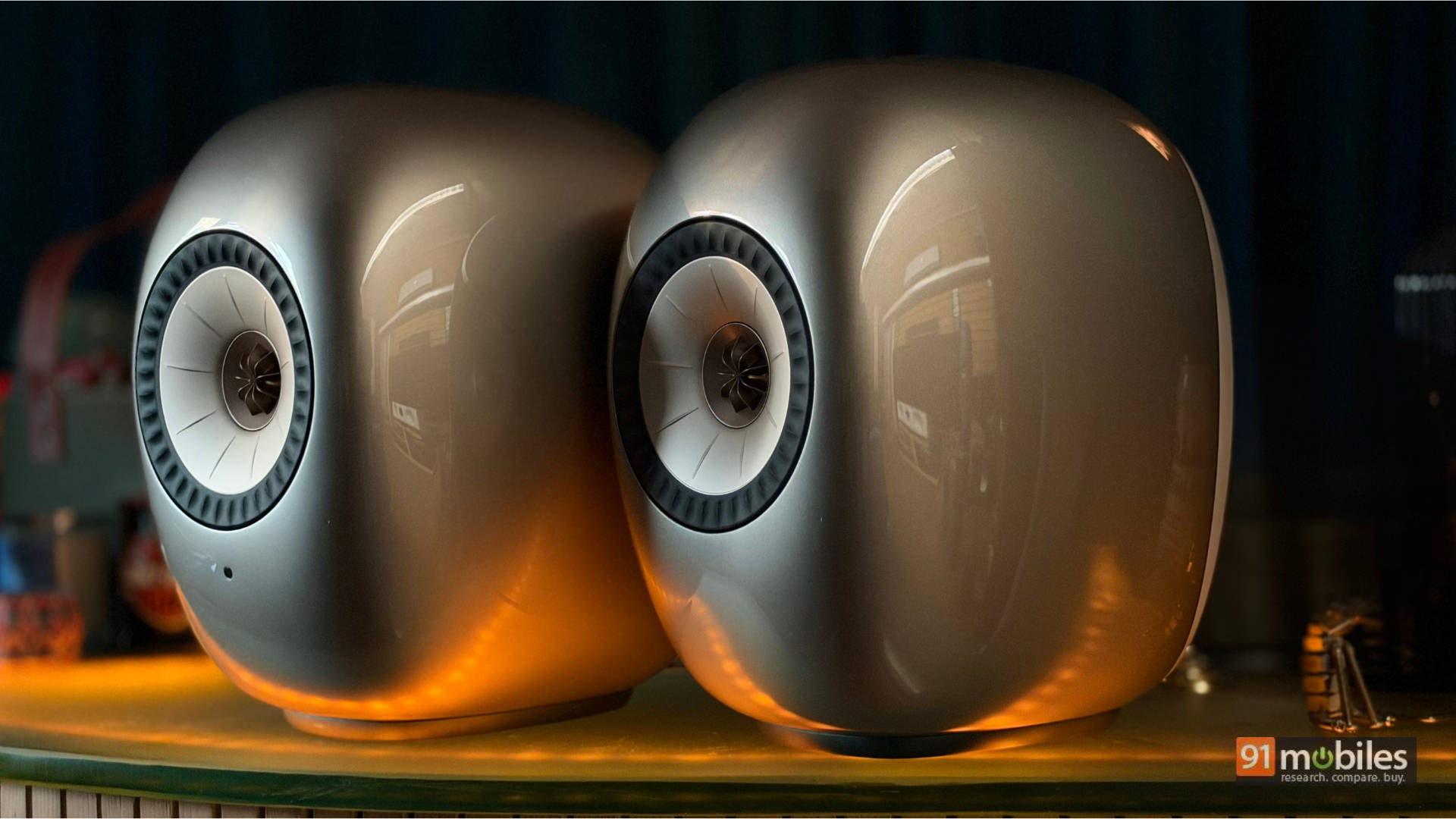
Table of Contents
Design (9.5/10)
What you get is an ovoid shape that is subjective in its appeal but undoubtedly a case of form and function. Ross Lovegrove’s sculpted cabinets use bulk moulding compound, so there are no seams or hard edges. This reduces diffraction and standing waves, and along with KEF’s proprietary coincident driver technology that puts the tweeter in the throat of the midrange driver, it really does make for a super precise and coherent-sounding speaker.

The driver sits on a decoupled chassis, minimising vibrations even further from smearing of the sound. It all sits pretty on optional stands (Rs 89,900), which are essential to extract the maximum performance from these “bookshelf” speakers. If you want to experience their full potential of conjuring a 3D soundstage, they’ll definitely trump any bookshelf.
Three finishes are on offer, from Dusk Titanium and Eclipse Black to Mineral White, all of which feel properly premium.

Tech (10/10)
At the heart of this beauty is KEF’s 12th-generation 6.5-inch Uni-Q driver, with the tweeter sitting in the middle of the mid/bass cone for a true point source. Metamaterial Absorption Technology is another recent KEF innovation that puts a maze-like disc at the back of the tweeter to mop up rear wave energy, so all that you hear is pristine treble from the front of the dome and no residual resonance.
The headline act is VECO, Velocity Control Technology, borrowed from KEF’s XIO soundbar. It tracks cone movement and corrects errors in real time, working with current-drive amplifiers. Each speaker carries 280W of Class D for the mid/bass and 100W of Class AB for the tweeter, again to optimise each amplifier topology for the kind of power requirement for separate high- and low-frequency drivers.

Connectivity is the real draw. HDMI eARC, optical, coaxial, analogue, AirPlay 2, Google Cast, Bluetooth and the major streaming services mean the amp rack can genuinely go. Each speaker has a subwoofer output, and the KEF Connect app offers full digital control of a pair of subs. Be sure to switch off the high-pass filter during setup, or bass would be truncated at 50 or 80Hz. The app has a ton of functionality, although I wish the volume slider lived on every screen, not just input selection.

The high-quality remote with clearly marked volume buttons makes amends, though. Another word of advice here for audiophiles looking to extract maximum performance is to use the supplied interlink cable between the Left/Right speakers. It improved everything from bass definition to lowering the noise floor in our tests and unlocking even higher resolution than the 24-bit/96kHz wireless ceiling. Unless your cat chewed off the cable or your decor absolutely doesn’t allow for an additional cable, it’s absolutely imperative for the Luxe to sound the way they can.

Sound (9/10)
Just like any great mini monitor, what you get struck by first is inner detail, clarity and transient speed. The sound simply floats in a phantom centre space between the speakers, thanks to an inert shell and point source driver. The midrange is natural and the top end sparkles without trying to rip your head off. Like all KEF Uni-Q designs, off-axis response is superbly linear, so I enjoyed a stereo image even seated outside the right speaker’s line of sight.

Donald Fagen’s Morph the Cat is the bass proof with accurate pitch definition, while Daft Punk’s Get Lucky shows speed. Nile Rodgers’ guitar snaps and the hi-hats shimmer without sizzling. Play well-recorded acoustic material and guitars hang in precise, holographic positions. Where the LS Luxe edges towards its theoretical limits is music like Hanumankind or Billie Eilish’s Bad Guy, which exposes the low-frequency limitations. The pulse is tidy, but one or even two subwoofers give the dynamics real scale. You can hear the DSP working and VECO earning its living, but it never fatigues, a testament to the ultra-low distortion KEF chases. There’s also a Phase invert toggle in the app that can make a difference to the focus, opening up the soundstage or making it a bit more intimate with tighter bass. Neither is wrong, and it’ll depend on your personal preference and room-to-speaker interaction. If there were a correct setting, KEF would have locked it, so don’t be afraid to experiment.

Verdict
Against Klipsch’s The Sevens, price aside, the difference is scale. The KEFs trade some of it for a sound that is decidedly more precise and refined. Use the cable, add a sub or two, and the LS Luxe delivers serious hi-fi without the usual rack of boxes. At Rs 4,69,000 a pair, it is not cheap, and the optional stands add to the bill. But very few systems replace this much hardware this convincingly. If you want serious sound, a clean look and a shorter equipment list, start here.
Editor’s Rating: 9.5 / 10
Pros
- Holographic imaging that genuinely disappears
- Tuneful bass that never fatigues
- Replaces your amp, streamer and preamp
Cons
- Needs subwoofers for full dynamic range
- Wireless speaker link sacrifices bass weight
- App volume slider isn’t always available

