Nothing Phone (4a) vs Motorola Edge 70: a face-off between lifestyle-focused smartphones


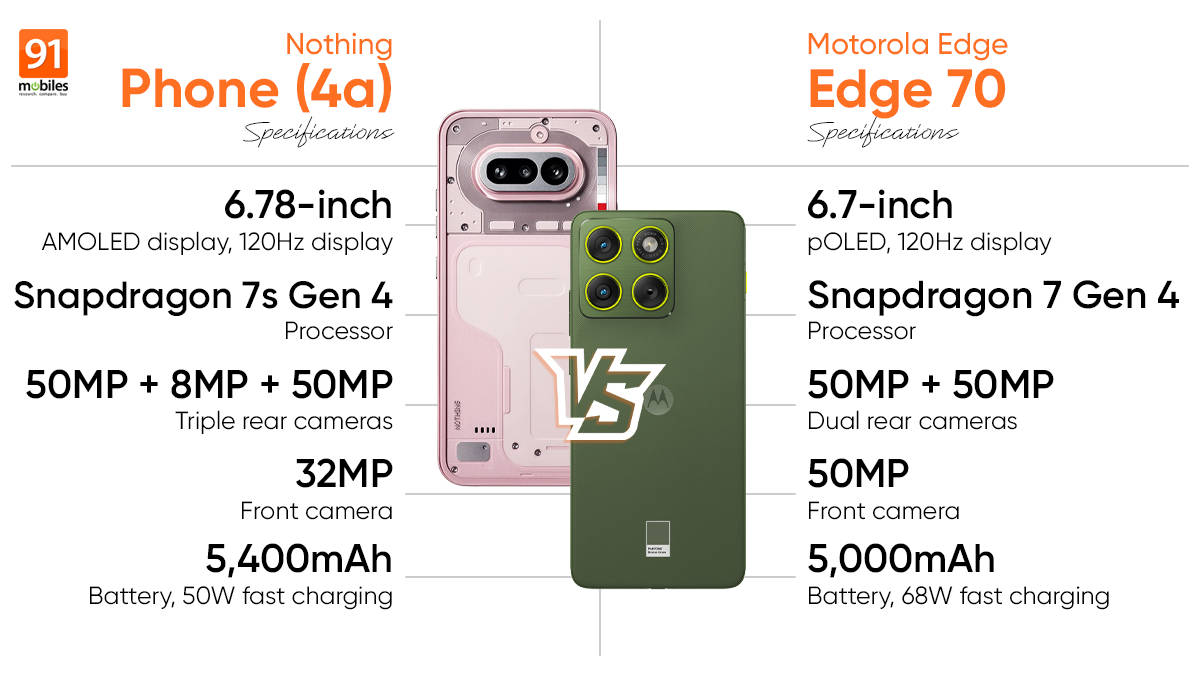
The Nothing Phone (4a) and the Motorola Edge 70 are two lifestyle-focused smartphones available in India at nearly the same price point. The Nothing smartphone (review) carries a sticker price of Rs 31,999, while the Motorola Edge 70 (review) can be purchased for as low as Rs 29,999. Both smartphones have already been reviewed on 91mobiles, where their key strengths and shortcomings were highlighted. In this article, we compare the two devices across important aspects to determine which one delivers the better value for money.
Table of Contents
Design: unique vs durable
The Nothing Phone (4a) and the Motorola Edge 70 bring distinct design philosophies to the table, each with its own visual appeal. The Nothing device stands out with its transparent rear panel and the new Glyph Bar, which allows users to interact with notifications, calls, and other alerts even when the phone is placed face down. The lighting interface uses multiple mini-LEDs to deliver customisable visual cues, making it both functional and visually distinctive.


The Phone (4a) also boasts flat edges to make it easy to hold despite its relatively thick build and heavy form factor. The handset measures 8.55mm in thickness and weighs 204 grams. While the handset is available in some eye-catching colours, including Black, White, Blue, and Pink, its durability remains slightly underwhelming. The Nothing Phone (4a) is IP64 rated, which only protects it from minor splashes of water and rain.
If durability and the ability to handle rough usage are priorities, the Motorola Edge 70 may have the upper hand. The handset comes with IP68 and IP69 ratings for water and dust resistance, along with MIL-STD-810H certification, which helps it withstand minor drops and everyday wear and tear.


While it may not be as visually distinctive as the Nothing Phone (4a), the Motorola device makes up for it with a slim and lightweight build that is comfortable to handle. The Edge 70 measures 5.99mm in thickness and weighs 159 grams, allowing it to slide easily in and out of pockets. Additionally, unlike its rival, the Motorola smartphone features an aluminium chassis, giving it a more premium in-hand feel. The back panel uses a fabric-like texture instead of glass, which helps reduce fingerprints and smudges while also improving grip.
Display: comparable visuals
The Motorola Edge 70 and Nothing Phone (4a) both sport near-identical display specifications. The handsets feature a 6.7-inch flat display with 1.5k resolution, 100 percent DCI-P3 colour gamut, HDR10+ support, and 120Hz refresh rate. While the Motorola smartphone offers a pOLED display instead of AMOLED, we found the colour accuracy and contrast to be pretty much the same as the Nothing Phone (4a).

Even though the Nothing smartphone boasts relatively higher 5,000 nits peak brightness, its 1,600 nits HBM brightness remains the same as the Motorola Edge 70. In most scenarios, the displays appeared equally bright.
That said, the viewing experience feels slightly more elevated on the Nothing Phone (4a), thanks to its more refined stereo speakers. The audio may feel muffled at maximum volume, but the experience at 70-80 percent loudness is much more balanced than the Motorola Edge 70, which delivers a relatively flat and unappealing sound.
Performance: Snapdragon chipsets at play
Both smartphones rock Qualcomm’s mid-range Snapdragon chipsets under the hood. However, the Motorola Edge 70 has a tad more promising Snapdragon 7 Gen 4 SoC, paired with fast LPDDR5X RAM and UFS 3.1 storage. The Nothing Phone (4a), on the contrary, is powered by the Snapdragon 7s Gen 4 SoC, aided by inferior LPDDR4X RAM and UFS 3.1 storage.
AnTuTu score


Motorola Edge 70
Qualcomm Snapdragon 7 Gen 4
1,402,932

Nothing Phone 4a 8GB RAM
Qualcomm Snapdragon 7s Gen 4
1,176,492
AnTuTu assesses a smartphone's CPU, GPU, memory, and overall user experience (higher is better)
This does not translate into a day-and-night difference in performance between the two smartphones, as they posted identical scores in synthetic benchmarks during our internal testing. Both devices handle regular usage equally well. However, if you want your device to manage occasional multitasking with similar ease, the Edge 70 might be a better fit.
The Motorola smartphone is relatively faster at launching apps, thanks to its higher CPU clock speed and faster RAM type compared to the Phone (4a). Moreover, the Edge 70 can complete certain tasks a fraction of a second quicker than its counterpart and handle multiple shots in quick succession.
Cameras: one offers versatility, the other focuses on details
The Nothing Phone (4a) delivers a triple-rear camera system, which offers a 50MP primary sensor, an 8MP ultrawide lens, and a 50MP tetraprism periscope-telephoto unit. The front camera is a 32MP sensor for selfies and video calling. This set of versatile cameras focuses on delivering natural-looking photos with balanced colours. That said, the handset takes a backseat when it comes to preserving details and providing exposure to shadowy areas.
The ultrawide lens remains one of the weakest links on the smartphone, but its telephoto lens holds the key to strong portrait photography. At 3.5x (equivalent to 80mm focal length), you get precise edge detection and natural looking bokeh effect. The facial details also appear respectable with near-accurate skin tones. The telephoto sensor also doubles up as a macro lens at 7x and uses AI to enhance images with a digital zoom of up to 70x.
The Motorola Edge 70 sticks to the more contemporary dual-rear camera setup, comprising 50MP primary and ultrawide sensors. The front camera is also a 50MP shooter. Thanks to these high-res sensors, the Motorola Edge 70 edges past the Phone (4a) with superior detailing in daylight, lowlight, and selfies. The handset also does well to retain more highlights, though the colour tuning tends to lean cooler and slightly more contrast-heavy.
The ultrawide camera also performs reliably, maintaining consistent colours with the primary sensor and handling exposure better in challenging lighting conditions. It is only in portraits where the smartphone falls behind its counterpart. This can be attributed to the lack of a dedicated telephoto lens, which leads to warping around the edges of the subject and underwhelming facial details. Overall, the Edge 70’s cameras focus on sharpness and balanced exposure, with particularly solid ultrawide and selfie performance.
Software: clean, easy to use
You get a slightly different software experience on both smartphones. The Nothing Phone (4a) opts for its trademark black and white theme with NothingOS 4.1, along with a clean and bloatware-free interface. The smartphone also keeps things simple, with minimum AI features, customisation options, clock style, and wallpapers. That said, users can still style up their lock screen using wallpapers with depth effect, group applications in folders in the app drawer, and store memories, screenshots, notes, and more in Essential Space.


The Motorola Edge 70, on the other hand, runs Hello UI on top of Android 16, which comes with a few third-party apps pre-installed. That said, the overall experience remains close to stock Android. Similar to the Phone (4a), the Edge 70 also offers limited customisation options, but it includes a few additional AI features beyond the standard Circle to Search, Gemini, text enhancement tools, and photo editing features. Thanks to MotoAI, the handset can summarise notifications and live conversations, offer contextual suggestions, and save or tag useful information using voice prompts, among other capabilities.
| Smartphone | Battery Capacity | Charging Support | Charging time (20% to 100% ) |
| Nothing Phone 4a 8GB RAM | 5400 mAh | 50W Quick Charging v4.0 | 1h 11m |
| Motorola Edge 70 | 5000 mAh | 68W Turbo Charging | 44m |
These AI tools can come in handy and enhance usability, especially for users who want to get more done on their smartphones.
Both smartphones promise three major OS upgrades; however, the Nothing Phone (4a) will be relevant longer with six years of security updates compared to four years on the Edge 70.
Battery: not class-leading, but dependable
The Nothing Phone (4a) and the Motorola Edge 70 both come with modest battery capacity instead of the segment-defining 7,000mAh. The Nothing Phone (4a)’s 5,400mAh battery is bigger in capacity than the Edge 70, which rocks the 5,000mAh battery. This resulted in the Nothing smartphone outperforming its counterpart on the PCMark battery test by roughly three hours.
PCMark Battery score (in hours)
Nothing Phone 4a 8GB RAM
5400 mAh
14.7
Motorola Edge 70
5000 mAh
11.2
PCMark battery test measures phone battery life from 100% to 20% (higher is better)
But the Motorola Edge 70 seems to be optimised better for real-world usage. The handset’s battery dropped by 15 percent during our internal testing, which included an hour-long gaming and video streaming. The Nothing Phone (4a)’s battery consumption was almost twice during the same tests. One can expect roughly 5 hours of screen time on both smartphones on moderate to heavy usage. This should suffice for regular users, if not heavy.

When it comes to charging, the Motorola Edge 70 has the advantage. The smartphone ships with a compatible 68W PD fast charger, which can fully charge the device in just 44 minutes. The Phone (4a), meanwhile, supports 50W charging and does not include a charger in the box. Its charging time is also longer, taking around 71 minutes to reach a full charge.
Verdict
Incidentally, Nothing Phone (4a) and Motorola Edge 70 target buyers looking for a stylish mid-range smartphone, but they approach the idea of a “lifestyle device” quite differently. Nothing’s unique aesthetic and Glyph Interface reinforce its identity as a design-led disruptor, whereas Motorola’s focus on durability and practical AI features aligns with its strategy to offer reliable, user-friendly devices in the mid-range market.
So, who should buy which smartphone?
| Smartphone | What works |
| Nothing Phone (4a) |
|
| Motorola Edge 70 |
|