Vivo V80 vs OPPO Reno 16: which phone offers better value under Rs 70,000?


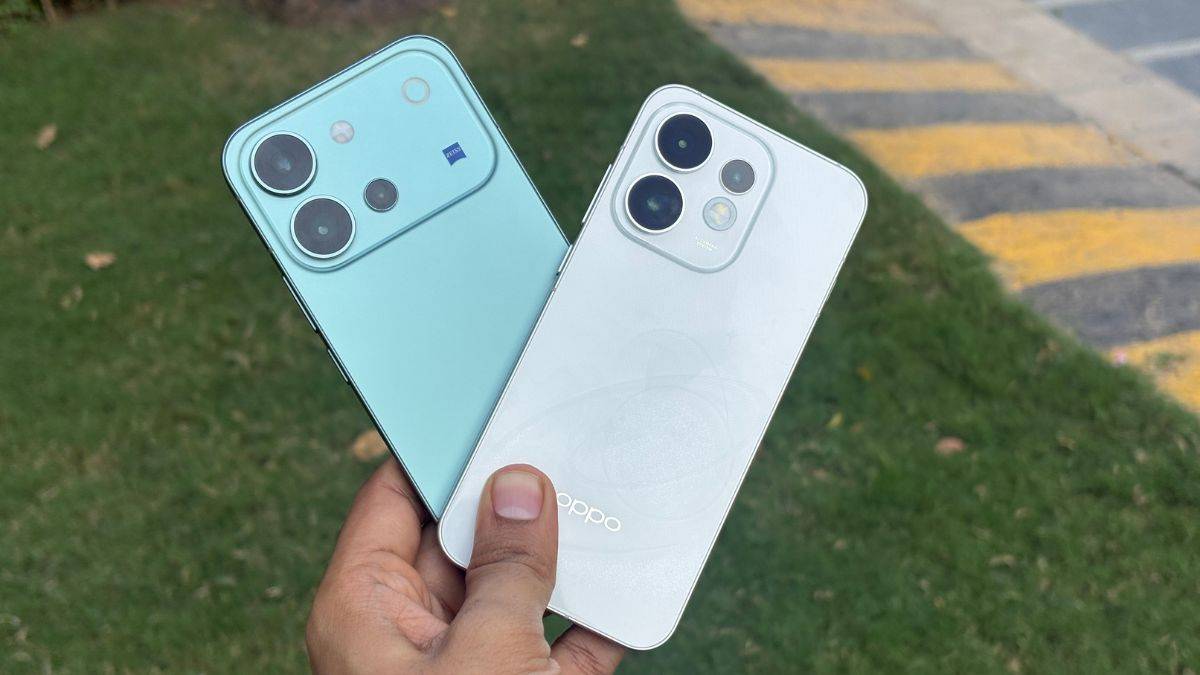
The Vivo V80 aims to stand out in the premium mid-range segment with its stylish design, Zeiss-backed cameras with AI features, and a large battery, all packed into a relatively compact form factor. However, it faces stiff competition from the OPPO Reno 16, another strong contender in this segment that offers an equally compelling mix of specs and features.
With both smartphones targeting a similar audience, we compare the Vivo V80 (review) and OPPO Reno 16 (review) across key aspects to help you decide which one better suits your needs.
Table of Contents
Vivo V80 vs OPPO Reno 16: design
Both Vivo V and OPPO Reno series place a strong emphasis on design. The Vivo V80 features a prominent camera island, dubbed the Floating Camera Module, which houses the rear camera sensors and an LED flash. Its design may remind some users of the iPhone 17 Pro or iPhone 18 Pro. The V80 is available in three colour options: Sunrise Anthem, Horizon Blue, and Stellar Black.
The OPPO Reno 16, meanwhile, takes a different approach with a 3D planet-inspired pattern and a shimmering finish that changes with the viewing angle. This effect is particularly noticeable on the Starry White variant. Twilight Violet offers a more understated appearance, while Stellar Purple has a more pronounced, bubbly shimmer.
Vivo V80
OPPO Reno 16
In terms of ergonomics, the Reno 16 is the more compact option, thanks to its 6.3-inch display, compared to the Vivo V80’s 6.59-inch screen. If you prefer a smaller phone that is easier to handle, the Reno 16 is the better choice. However, if you want a relatively compact design without compromising too much on screen size, the Vivo V80 is worth considering. Both phones are lightweight, feature flat edges, and are comfortable to hold and use.
Durability is another point of difference. The OPPO Reno 16 carries IP66, IP68, IP69, and IP69K ratings, offering broader certified protection against dust and water. The Vivo V80, meanwhile, comes with IP68 and IP69 ratings.
| Smartphone | Thickness | Weight | IP rating |
| Vivo V80 | 7.69 mm | 203g | IP68 + IP69 |
| OPPO Reno 16 | 8.4 mm | 193g | IP66, IP68, IP69, and IP69K |
Ultimately, the choice comes down to your design preferences, preferred form factor, and durability requirements. The Reno 16 is better suited to those who favour a smaller phone with distinctive finishes and more extensive ingress-protection ratings, while the Vivo V80 caters to users who prefer a slightly larger display and a bold camera-centric design.
Vivo V80 vs OPPO Reno 16: display
The Vivo V80 and OPPO Reno 16 both offer vibrant AMOLED displays with adaptive refresh rates, ensuring smooth scrolling and an enjoyable viewing experience. However, the Vivo V80 has an edge in terms of screen size, refresh rate, and peak brightness. It features a 6.59-inch FHD+ AMOLED panel with a 2,750 × 1,260-pixel resolution, a 144Hz refresh rate, HDR10+ support, and up to 5,000 nits of peak brightness. While you can manually set the refresh rate at 144Hz, all apps are capped at 90Hz or 120Hz, and only select titles like Clash of Clans support it. So the visual scrolling experience is largely 120Hz. Otherwise, the display delivers crisp details, punchy colours, and fluid animations, making it well-suited for everything from everyday browsing to watching videos and gaming.
| Smartphone | Display | Peak brightness | Refresh rate |
| Vivo V80 | 6.59-inch FHD+ AMOLED | 5,000 nits | 144Hz |
| OPPO Reno 16 | 6.32-inch FHD+ AMOLED | 3,600 nits | 120Hz |
The OPPO Reno 16, meanwhile, sports a smaller 6.32-inch FHD+ AMOLED display with a 2,640 × 1,216-pixel resolution, a 120Hz adaptive refresh rate, 3,600 nits peak brightness, and HDR10+ support. It offers vivid colours and a pleasing viewing experience for streaming content, gaming, and scrolling through social media. Its smaller size also makes the phone easier to handle, particularly for users who prefer a more compact form factor.


The Vivo V80 might seem to have an advantage here, thanks to its higher refresh rate and peak brightness. But real-life differences may not be very noticeable, so unless you’re too concerned about the numbers, either should be fine. Both offer smooth, vibrant screens, so the choice largely comes down to screen size.
Vivo V80 vs OPPO Reno 16: performance
Both the Vivo V80 and OPPO Reno 16 are powered by the Qualcomm Snapdragon 7 Gen 4 chipset. While it is a capable mid-range processor, it feels underwhelming at this price point, where buyers might expect a newer and more powerful SoC. On paper, this should translate to similar performance on both phones, but our testing revealed some differences.
AnTuTu score


OPPO Reno16 5G
Qualcomm Snapdragon 7 Gen 4
1,457,989

vivo V80 5G
Qualcomm Snapdragon 7 Gen 4
1,356,175
AnTuTu assesses a smartphone's CPU, GPU, memory, and overall user experience (higher is better)
Starting with benchmarks, the OPPO Reno 16 scored higher than the Vivo V80 on both AnTuTu and Geekbench. While benchmark scores don’t always reflect real-world performance, the difference was noticeable in everyday use as well.
Geekbench multi-core score
OPPO Reno16 5G
Qualcomm Snapdragon 7 Gen 4
4,114
vivo V80 5G
Qualcomm Snapdragon 7 Gen 4
3,609
Geekbench assesses the efficiency of the CPU's single and multiple cores (higher is better)
The Vivo V80 handled routine tasks such as social media browsing, switching between apps, and multitasking comfortably overall, but we encountered occasional stutters and lags during use. The OPPO Reno 16, in comparison, delivered a smoother and more consistent experience across the same tasks. This makes it the more reliable option for everyday use and could be a deciding factor for buyers choosing between the two.
Geekbench single-core score
OPPO Reno16 5G
Qualcomm Snapdragon 7 Gen 4
1,283
vivo V80 5G
Qualcomm Snapdragon 7 Gen 4
1,228
Geekbench assesses the efficiency of the CPU's single and multiple cores (higher is better)
That said, neither phone is particularly suited to demanding workloads, so users looking for performance-focused devices may want to explore alternatives in this price segment.
Vivo V80 vs OPPO Reno 16: battery
The Vivo V80 packs a 7,200mAh battery, the largest yet on a V-series smartphone, while the OPPO Reno 16 houses a slightly smaller 6,700mAh unit. However, the benchmark results tell a different story. In our PCMark battery test, the Reno 16 lasted 23 hours and 48 minutes, significantly longer than the Vivo V80, which clocked 18 hours and 36 minutes. This suggests that the Reno 16 has better battery optimisation, despite having a smaller battery.
PCMark Battery score (in hours)
OPPO Reno16 5G
6700 mAh
23.8
vivo V80 5G
7200 mAh
18.6
PCMark battery test measures phone battery life from 100% to 20% (higher is better)
In real-world usage, however, both phones deliver reliable endurance. They comfortably last an entire day with typical activities such as browsing social media, streaming content, and using mobile data. Depending on your usage, you may even be able to squeeze out some battery life into the following day.
| Smartphone | Battery capacity | Charging support | Charging time (20-100% |
| Vivo V80 | 7,200mAh | 90W FlashCharge | 60 |
| OPPO Reno 16 | 6,700mAh | 80W SUPERVOOC | 62 |
Both smartphones support fast charging, with the Vivo V80 offering 90W charging and the OPPO Reno 16 supporting 80W. The difference in charging times is marginal, though. The V80 took around an hour to charge from 20 to 100 percent, while the Reno 16 took approximately 62 minutes.
Overall, both phones offer comparable battery experiences in everyday use. The Reno 16 has the advantage in our battery endurance test, but the Vivo V80 counters with a larger battery and slightly faster charging. Your choice will depend on whether you prioritise measured battery life or battery capacity and charging speed.
Vivo V80 vs OPPO Reno 16: cameras
The Vivo V80 and OPPO Reno 16 both offer versatile camera systems with 50MP primary, telephoto, and front cameras, along with AI-powered photography tools. However, they differ in their ultrawide cameras and zoom capabilities. The V80 features Zeiss-backed optics, comprising a 50MP main camera, a 50MP telephoto lens with 3x optical zoom, and an 8MP ultra-wide camera. The Reno 16, meanwhile, gets a 50MP Sony LYT-600 primary sensor, a 50MP ultra-wide camera, and a 50MP Samsung JN5 telephoto camera with 3.5x optical zoom.
Vivo V80
OPPO Reno 16
Both phones also offer several AI editing and creative features, including portrait effects and tools to enhance photos and videos. For example, the Vivo V80 offers more than 30 AI-powered creative features, AI Diwali Portrait 2.0, and 4K Cinematic video recording. The Reno 16 comes with features such as AI Remix Collage and AI Portrait Glow.
In real-world testing, the Vivo V80’s colour science favours punchy colours and high contrast in daylight. Its 3x telephoto camera performs well for portraits and focal length variety, but pushing into digital zoom leads to a noticeable loss of detail. Low-light performance is also a weak spot, with significant noise reducing clarity, though the phone handles exposure and lens flares impressively well.
The OPPO Reno 16, in comparison, prioritises a more natural look, delivering accurate skin tones, well-preserved details, and good dynamic range across most shooting conditions. Even in portrait shots, you can see that the Reno 16 delivers natural bokeh and precise edge detection. In low-light shots, the Reno 16 captures sharper images with better detail retention. The handset also produces images with more natural colours and overall realism compared to the Vivo V80.
Overall, the OPPO Reno 16 is the more consistent camera phone, particularly for those who prefer natural-looking images with reliable detail and colour accuracy. The Vivo V80 is a worthy alternative for users who favour punchier colours and stronger contrast in their photos.
Vivo V80 vs OPPO Reno 16: software
The Vivo V80 runs Android 17-based OriginOS 7 out of the box, while the OPPO Reno 16 ships with Android 16-based ColorOS 16. Both offer long-term software support, with Vivo promising four OS upgrades and six years of security updates, compared to OPPO’s five OS upgrades and six years of security patches. This balances out the software update policy, as both phones would be updated to the same final software version, which is Android 21.
| Smartphone | Software version OTB | Software support |
| Vivo V80 | OriginOS 7 + Android 17 | 4 OS upgrades + 6 years security patches |
| OPPO Reno 16 | ColorOS 16 + Android 16 | 5 OS upgrades + 6 years security patches |
OriginOS 7 focuses on visual customisation, with fluid Dynamic Glow animations, translucent interface elements, and interactive Pet Pals themes featuring cats and dogs. ColorOS 16, meanwhile, puts greater emphasis on AI-powered productivity. Features such as Mind Pilot bring Gemini, Perplexity, and ChatGPT into one interface, while the AI Snap Key saves on-screen content to Mind Space. Other tools include AI Bill Manager, translation features, and AI-powered photo editing.
Overall, the OPPO Reno 16 is better suited to users who want AI tools and productivity features. The Vivo V80 is a better fit for those who enjoy visual customisation, playful interface elements, and getting the latest Android version out of the box. Both offer solid long-term support, so the choice largely depends on which software experience better suits your needs.
Verdict
The Vivo V80 and OPPO Reno 16 cater to similar buyers but have distinct strengths. The Vivo V80 starts at Rs 62,999 for 8GB + 128GB, while the Reno 16 costs Rs 66,999 for 8GB + 256GB. The 8GB + 256GB variant of the V80 is actually more expensive, costing Rs 69,999.
| Variant | Vivo V80 price | OPPO Reno 16 price |
| 8GB + 128GB | Rs 62,999 | NA |
| 8GB + 256GB | Rs 69,999 | Rs 66,999 |
| 8GB + 512GB | Rs 79,999 | NA |
| 12GB + 256GB | NA | Rs 72,999 |
The Reno 16 has a more compact design, delivers smoother everyday performance despite sharing the same Snapdragon 7 Gen 4 chipset, and captures more consistent photos with better detail, skin tones, and dynamic range. It also lasted longer in our battery test. The Vivo V80, meanwhile, offers a larger 6.59-inch display with a 144Hz refresh rate, a bigger 7,200mAh battery, and faster 90W charging. Its cameras also produce punchier colours and stronger contrast.
On the software front, you get the latest Android 17-based OriginOS 7 on the V80 and playful customisation options, while the Reno 16 offers AI-focused tools through ColorOS 16. Both promise six years of security updates.
Overall, the OPPO Reno 16 is the better all-rounder for performance, cameras, storage, and battery endurance. The Vivo V80 is worth considering if you want a brighter, higher-refresh-rate display, a larger battery, faster charging, and a lower starting price.