Galaxy AI in India: Samsung’s Jay Kim and JB Park on hybrid AI, privacy, and what comes after phones, watches, and glasses


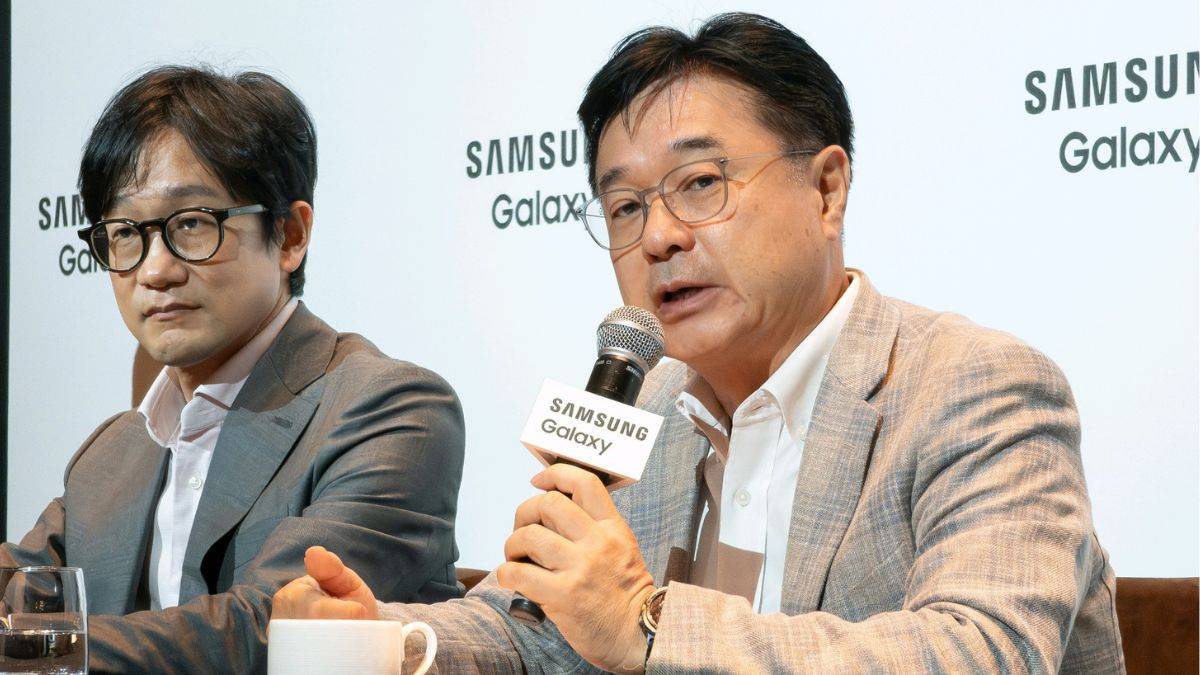
A day after Samsung’s global Unpacked event in London, where the company showed off the Galaxy Z Fold8, the Z Fold8 Ultra and the Z Flip8, alongside new watches and its first pairs of AI glasses, Indian journalists sat down with Jay Kim, Corporate EVP and Head of the Customer Experience Office for Samsung’s MX Division, and JB Park, CEO and President of Samsung Southwest Asia. The topic of discussion was where Galaxy AI is headed next — in India specifically, and across Samsung’s expanding device lineup. Here’s a rundown of the key points that came up.
Table of Contents
Bringing Galaxy AI to India: language, R&D, and adoption
Higher AI usage than the global average: Park pointed out that Indian consumers use Galaxy AI features like Photo Assist, Creative Studio, and Audio Eraser nearly twice as often as the global average, crediting partnerships with IITs, local startups, and Samsung’s own R&D centres for pushing usability forward. He called this “just the beginning” of Samsung’s India-specific AI roadmap.
Hindi and Gujarati support, with more to come: Samsung built Hindi into Galaxy AI from day one in 2024, and has since added Gujarati — work Park attributed to the company’s Noida and Bengaluru R&D centres, which he said have meaningfully improved Hindi-language performance across newer AI features. Features like Call Assist and Interpreter are already seeing real usage among native Hindi and Gujarati speakers, and Samsung is working to expand language coverage further.
Solving distinctly local problems: Beyond editing tools, Park highlighted Voice Focus — a feature developed by Samsung’s Indian R&D teams that automatically detects and suppresses background noise during calls, without requiring the user to switch modes manually.

Measuring real usage, not novelty
A three-part test for every AI feature: Kim said Samsung evaluates AI features on whether they’re meaningful, easy to access, and safe — a framework the company has used since Galaxy AI’s 2024 debut on the Galaxy S24. Circle to Search (built with Google), Photo Assist, Creative Studio, Call Assist, and Live Translate are among the most consistently used features globally.
Different features, different success metrics: Not every feature needs to be used daily to be considered successful, Kim noted — some are meant for frequent use, while others matter more in the moment they’re needed, even if that’s occasional.
The philosophy: AI should be invisible: Kim was direct about Samsung’s underlying approach — consumers shouldn’t need to know whether a task was completed using AI or not. “We’re not really focusing on AI per se. We’re focusing on what consumers want,” he said, describing the goal as removing friction rather than showcasing the technology itself. Park echoed this, pointing to the new My FanCam editing feature on the Galaxy Z Fold8 — which automatically reframes video to keep a moving subject centred, a job that once needed a professional editor — as an example of AI quietly doing work in the background rather than demanding attention.


Memory prices, margins, and the festive season
Asked about the ongoing memory crunch and its effect on flagship discounting, Park acknowledged the Indian market has already seen roughly 15% degrowth this year due to rising material costs, with the second half expected to stay difficult. Samsung’s approach, he said, is to absorb as much of that cost pressure as possible rather than passing it fully to consumers — backing festive-season affordability through interest-free EMI options and seasonal discounts.
Keeping pace with an AI cycle that moves faster than hardware

AI evolves in months, hardware in years: Kim acknowledged the mismatch head-on, half-joking that a six-to-seven-month AI upgrade cycle is comforting compared to what the pace could be. He broke down how AI touches every layer of the stack — cloud, on-device, app-level, and OS-level — which means hardware planning has to account for chipset and memory needs well ahead of time, in coordination with partners like Qualcomm and Google.
Moving ahead of the platform, deliberately: As an example, Kim pointed out that Samsung applied Android 17 features to the Galaxy S26 before Android 17 had even officially rolled out — evidence, he said, of Samsung trying to stay a step ahead of the ecosystem rather than reacting to it. Park drew a parallel to the Intel-Microsoft dynamic of the PC era, where minimum hardware requirements were dictated by how fast the software layer evolved — a similar dynamic, he suggested, is now playing out between Samsung, Qualcomm, and Google.
Privacy, security, and the hybrid on-device/cloud approach
No privacy without strong security: Kim laid out Samsung’s privacy architecture in some detail — Knox as the security foundation, the Personal Data Engine (PDE) keeping personal context on-device for personalised AI, Knox Enhanced Encrypted Protection (KEEP) isolating sensitive data into app-specific encrypted environments, and Knox Vault safeguarding encryption keys in tamper-resistant hardware. On top of this sit user-facing controls — Advanced Intelligence settings, a Security & Privacy Dashboard, Permission Usage tracking, and Auto Blocker for threat monitoring.
No fixed on-device/cloud split: On whether Samsung is pushing more AI processing onto the device for data safety, Kim said there’s no target percentage — Samsung’s approach is hybrid by design, and the actual on-device/cloud balance depends entirely on individual consumer needs and usage patterns rather than a company-wide mandate. Some users lean almost entirely on-device, he said, others rely heavily on the cloud, and Samsung’s job is to make both options equally safe and frictionless.

Model dependency and staying resilient
Not reliant on a single AI partner: Asked what happens if a partner like Google were to pull back Gemini support in certain regions, Kim said Samsung already runs multiple models across its devices — not just Gemini — including its own internal models, an open-weight model, and a frontier model, with different models optimised for different services depending on the region and local partnerships.
A regulatory balancing act: Kim framed this as an industry-wide issue rather than a Samsung-specific risk, noting that governments globally are increasingly engaging directly with foundation model providers. Samsung’s approach, he said, is to manage this region by region while working closely with local regulators. He also noted that Samsung is actively testing newer models as they become available, including the recently released Claude Fable 5, alongside its own open-weight model.
On owning AI infrastructure outright: On whether Samsung might eventually reduce its dependence on partners like Google by building out proprietary AI infrastructure, Kim reiterated that core Galaxy AI services will continue to be offered without charge, while the company continues evaluating costs and sustainability. He added that Samsung already uses multiple models beyond Gemini today, selecting whichever is best optimised for a given service rather than committing to one provider exclusively.
Beyond the phone: glasses, wearables, and the next computing hub

The vision behind Samsung’s new glasses: Park, who said he has personally tracked the XR industry for over a decade, described Samsung’s newly unveiled smart glasses as aiming to be more genuinely “intelligent” than existing products in the category — with a camera positioned at eye level that understands context based on what the wearer is actually looking at, tightly linked to the phone as a computing hub. He positioned this as a hands-free, always-available interface rather than a replacement for the phone.
Why the phone stays central: Both executives were clear that glasses and wearables extend the phone’s computing power rather than replace it — glasses in particular need to stay light and comfortable, which means offloading heavy processing to the paired phone. Kim added that the phone and PC will remain the primary computing hubs, with watches focused on continuous health and wellness sensing, and glasses serving as a hands-free camera-driven interface layer on top.
Design matters as much as intelligence: Park emphasised that for glasses specifically, styling and comfort are just as important as the technology inside, since the product sits on a person’s face — which is why Samsung partnered with established eyewear brands rather than treating glasses as a purely engineering problem.
Redesigning UX for an agentic, multilingual India
From apps to agents: Kim described Samsung’s UX shift toward “agentic” experiences — reducing the number of steps a consumer needs to take across apps to get something done. Early attempts at manually stitching AI into individual app functions weren’t scalable, he said, which led Samsung toward supporting MCP (an emerging industry standard for AI-agent interoperability) and building an on-device Automation feature — introduced with the Galaxy S26 — that can navigate a screen and complete tasks like booking a cab on a user’s behalf. He was candid that this is still an early, imperfect first step.
Voice and vision as the next UX layers: Kim expects UX to increasingly spread beyond typed input toward voice and vision-based interaction across phones, watches, and glasses, while stressing that Samsung is deliberately pacing this rollout so it doesn’t disrupt its wider partner ecosystem.
India’s linguistic complexity is a design constraint, not an afterthought: Kim acknowledged India’s scale of linguistic diversity directly, saying Samsung is leaning on local R&D teams and continuous market feedback to make sure hyper-localised, contextual AI experiences don’t get shortchanged in favour of a one-size-fits-all global model.

One seamless experience across every device
Responding to a question from 91mobiles on how Samsung plans to keep the AI experience consistent across products with vastly different computing power, from flagship phones down to watches and glasses, Kim admitted there’s no perfect answer yet, but described the guiding approach: a hybrid model where the cloud carries the load for less powerful devices, while flagship hardware handles more on-device processing. Galaxy AI serves the flagship tier, while a separate tier called Awesome Intelligence is aimed at mass-market devices, leaning more heavily on the cloud. Samsung is actively working to “cascade” flagship-level AI capabilities down to the mass-tier lineup over time, informed by ongoing research into which AI features matter most to users at each price segment.
Disclosure: This writer attended Samsung Unpacked in London on Samsung India’s invitation