Inside SRI-Noida: KY Roo and Dr Amitabh Thapliyal on how Samsung’s India R&D team is shaping the Galaxy Watch and Samsung Health


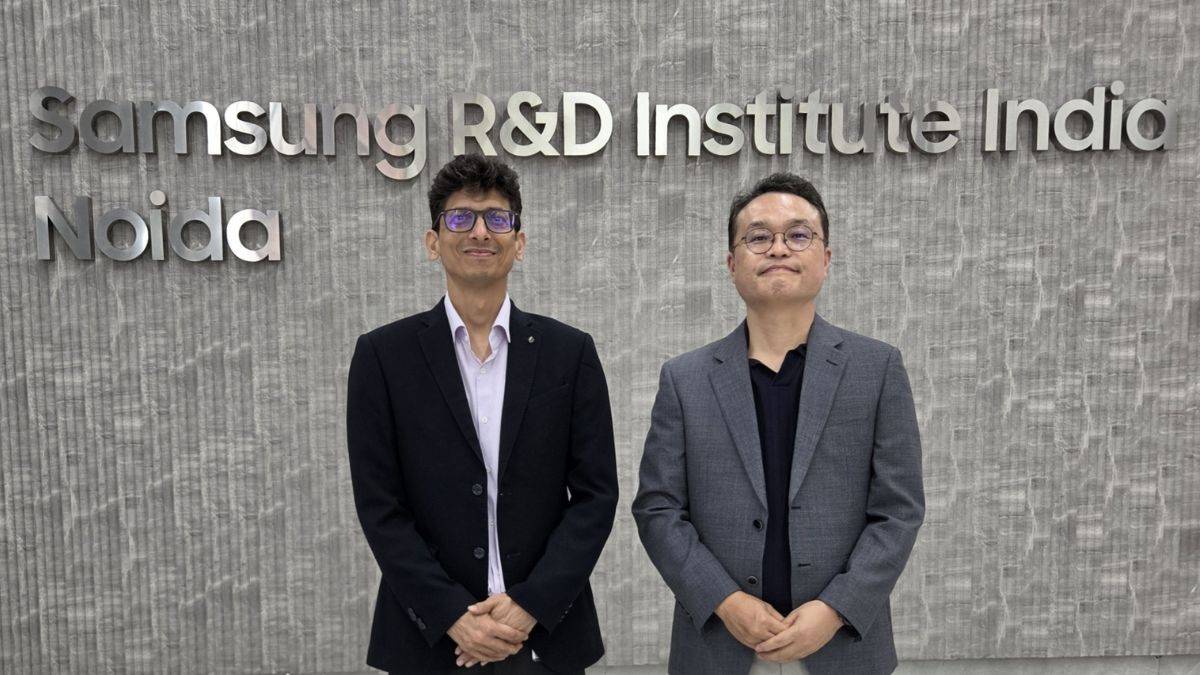
Samsung’s R&D Institute India, Noida, has been running for close to 20 years, but its role has expanded well beyond supporting Galaxy flagship development. On a visit to the facility, KY Roo, Managing Director, SRI-Noida, and Dr Amitabh Thapliyal, Vice President and Head of Service Development, walked us through what the centre has been working on, from India-specific health services to the algorithm fixes born out of very local problems, like the humble auto-rickshaw. Here’s what transpired during the session.
SRI-Noida’s mandate: from flagship phones to AI-native health R&D
Two decades in, now positioning itself as AI-native:KY Roo opened by noting SRI-Noida was set up in 2007, with focus areas spanning Galaxy phones, wearables, tablets, and software. The centre has registered a number of global IP filings in AI and health, and publishes in AI, health, and networking conferences. Roo said the centre’s ambition is to become a global leader in AI-native innovation, built around three pillars: innovation, engineer training, and collaboration with top universities and startups, including an AI certification course run with IIT Ropar and an internal SRI-N University with dedicated schools for AI, technology, and leadership.
Three domains define the centre’s work: SRI-Noida collaborates closely with Suwon on flagship Galaxy S and Z series development. It also contributes significantly to health, AI frameworks, and Knox, and has led several India-specific service launches over the past three to four years, starting with an ABDM-compliant personal health record built with EkaCare, followed by a medication service with Tata 1mg, and FindCare this year. The centre also built Hindi and Gujarati language support into Galaxy AI, and developed PayNow, an India-specific on-device AI payment engine for Samsung Wallet on the Galaxy Z Fold8, alongside ongoing work on agentic AI features.
Samsung Health’s five pillars, and what’s new on the Galaxy Watch9 and Watch Ultra2


The health platform is fundamentally a sync layer:
Dr Amitabh Thapliyal, who leads digital health work at the centre, described Samsung Health’s core job as syncing data between phone and wearable, managing that sync framework, and building the wellness and preventive-care tracking applications on top of it.
Five categories anchor Samsung Health: Activity (daily tracking, exercise, running coaching, cardio load), Sleep (holistic sleep quality and bedtime coaching), Nutrition (food tracking and BMI), Mindfulness (meditation, stress monitoring, breathing exercises, mood logging), and Vitals (heart health, blood oxygen, blood pressure, and vascular load) together form what Amitabh called a bid to bring comprehensive healthcare into one place.
Vitals, cardio load, and trail running: the features under the hood

Overnight vitals tracking with context:
While asleep, the watch tracks heart rate, heart rate variability, skin temperature, respiratory rate, and SpO2. If any of these fall out of range, the app explains why, and offers recommendations to bring them back within range, something Dr Amitabh flagged as a new addition.
Daily cardio load personalises exertion limits: Rather than a one-size-fits-all activity target, daily cardio load factors in age, physique, vitals, and recovery, primarily how much sleep a person is getting, to calculate a personalised limit across three bands: optimal, under, and over range. Depending on training goals, it recommends how much and what kind of exercise to do that day, and flags when it’s time to back off and recover instead.
Trail running gets dedicated navigation and hydration tools: Built specifically for the Watch Ultra2, this includes uphill guidance for the climbs and loops typical of trail routes, plus a hydration alert that estimates sweat loss during a run and prompts users to rehydrate in real time.
India-first: ABDM, FindCare, and a connected healthcare journey
A three-part India roadmap:SRI-Noida has rolled out a Medication Tracker with Tata 1mg, an ABDM-compliant Health Record with EkaCare, and FindCare with Tata 1mg and PharmEasy for doctor consultations, lab tests, and medicine orders.
The pitch is a frictionless, connected journey: Thapliyal laid out a scenario where a doctor consultation through FindCare generates a digital prescription, which Samsung’s AI Vision Parser reads automatically; that data flows into the medication tracker, which sets reminders continued on the Galaxy Watch, while the entire interaction gets logged into the user’s ABDM-linked health record for future hospital visits. The stated goal is eliminating the usual friction points in Indian healthcare: manual prescription entry, fragmented records, and missed medication.
Fixing algorithms for Indian roads: the auto-rickshaw problem
Asked for a concrete example of India-specific engineering, Amitabh kept returning to the same case study: auto cycle detection. During validation, the algorithm was initially misreading slow-moving auto-rickshaws on bumpy roads as bicycle rides, a false positive that wasn’t showing up in other markets. SRI-Noida’s engineers re-tuned the sensor algorithm to account for this, and the fix was rolled into the global product rather than staying India-specific, which Amitabh offered as a broader example of how local field testing feeds back into Samsung’s worldwide algorithms.
On the more technical hardware questions, such as how motion artefacts, skin-contact variation, or darker skin tones affect PPG sensor accuracy, Dr Amitabh went back to SRI-Noida’s software mandate and noted that algorithms are fine-tuned with demographic and regional data before global deployment.
Wellness, not diagnosis: where Samsung draws the line


Samsung’s watches are positioned as preventive and wellness devices, not diagnostic ones, and the company has never claimed otherwise. The philosophy is to analyse longitudinal biosensor data, rather than single-day readings, to offer actionable recommendations, with the explicit goal of nudging users toward consulting a doctor when something looks off rather than replacing that doctor. Features requiring regulatory clearance, like blood pressure and ECG, are deliberately kept in a separate app to keep their approval process independent of the core watch experience. This was especially noteworthy, since we’ve counted the separate-app requirement as a con in our reviews of Galaxy Watch models.
Privacy, Knox, and consent-based data sharing
Health data on device is protected by Knox, and anything sent to the cloud is end-to-end encrypted. It’s only transmitted with explicit user consent, as per Amitabh, describing this as a hybrid approach that leans on-device wherever possible. On data sharing specifically, he was direct: Samsung does not share collected health data such as sleep or heart rate with outside parties. Where ABDM is involved, sharing with hospitals or doctors only happens through the framework’s own consent mechanism, which stays entirely under the user’s control.
Ring vs watch: shared sensors, different constraints

The Galaxy Ring and Galaxy Watch share core sensor technology, including PPG, and much of the underlying software pipeline, signal extraction, analysis, and turning that into insights, works the same way across both. What differs is scale: the watch carries more sensors and has more surface area to work with, while the ring’s smaller form factor limits sensor count.
The case for a screenless tracker
When asked whether a display-less design might ultimately serve health tracking better, given how much detail still requires opening the companion phone app, Amitabh’s response stayed at the level of Samsung’s broader philosophy. He said that the company continuously incorporates consumer feedback, and that the goal is building personalised intelligence rather than a simple stats display.
What’s next
Asked directly about glucose monitoring, a feature the industry has been circling for years, Dr Amitabh didn’t share specifics, saying that Samsung holds new features to strict quality and safety checks before release, and that multiple teams are actively working in this direction. He gave a similar response on output from Samsung’s MOUs with institutes like IIT Madras, and on whether screenless trackers might reduce the health anxiety some users report from constantly checking smartwatch metrics, both filed under “future strategy.”
On a lighter note, asked for his own favourite feature, Amitabh, a marathon runner training for an ultra marathon, picked trail running without hesitation. He described Samsung’s engineers as genuine everyday users of what they build, testing features like uphill guidance and hydration alerts on their own runs before they ever reach consumers, calling it the most rewarding part of the job: watching something go from an idea on a screen to a tool he personally relies on mid-run.