NVIDIA DLSS 4.5 with improved Ray Reconstruction for games announced at Gamescom 2026


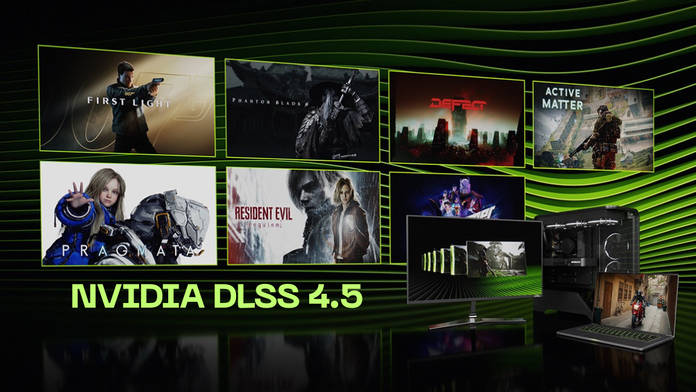
NVIDIA has announced DLSS 4.5, the latest version of its AI-powered graphics technology, with several upgrades for improving image quality and performance in demanding games. The biggest focus this time is on making path tracing more practical, which is a rendering technique that can produce highly realistic lighting but remains extremely demanding even on powerful hardware. Let’s take a closer look at what DLSS 4.5 brings below.
Table of Contents
What does DLSS 4.5 actually improve?
DLSS 4.5 builds on NVIDIA’s AI-based rendering technology, using AI to reconstruct frames and improve performance without asking the GPU to render everything at full resolution. The new version focuses on better image quality and frame generation, with a particular focus on ray-traced and path-traced games.
Then there is the Dynamic Multi-Frame Generation, which can generate up to three additional frames for every traditionally rendered frame. This can push frame rates higher while reducing the amount of work the GPU needs to do itself.
NVIDIA has also upgraded Ray Reconstruction, which uses AI to improve image quality in ray-traced and path-traced scenes. It replaces traditional denoising methods and uses information from the game engine and previous frames to reconstruct cleaner and more detailed images.
DLSS 4.5 introduces a second-generation transformer model for Ray Reconstruction. NVIDIA says the new model has better spatial and temporal awareness, which can improve lighting accuracy, image stability and clarity during movement.
Path tracing is still an extremely demanding affair, though. It calculates much more information about how light moves through a scene than traditional rendering or conventional ray tracing, which puts a heavy load on the GPU. Even high-end graphics cards can struggle with it at higher resolutions and settings.
This is where the DLSS 4.5 upgrades might make a difference. Ray Reconstruction can help clean up the image, while frame generation can add frames without requiring the GPU to render each one normally. Together, they can make path-traced games feel much smoother.
Show Full Article
How does DLSS 4.5 make a difference?
DLSS has gone from being mainly a way to recover performance when running games at higher resolutions to becoming a much bigger part of how NVIDIA renders games. DLSS 4.5 improves that further, particularly for demanding effects such as path tracing.
The important thing to remember is that DLSS 4.5 doesn’t make path tracing less demanding. Instead, it uses AI to help the GPU deal with some of that workload through image reconstruction and frame generation.
This means high-end desktops and gaming laptops should benefit the most, as they already have enough raw performance to handle the demanding rendering work. Mid-range systems can still benefit from DLSS, but you may need to lower the resolution, graphics settings or path-tracing effects to maintain smooth performance.


NVIDIA has announced support across a range of major AAA games, including popular AAA titles. You can check out the detailed announcements here.
How to enable DLSS 4.5 Ray Reconstruction
You can try DLSS 4.5 Ray Reconstruction now through the NVIDIA app’s Early Access programme. Go to Settings > About in the NVIDIA app and opt in to Early Access releases. NVIDIA says the official release will follow in September. You will also need GeForce Game Ready Driver 580.88 WHQL or newer.
Once enabled, open the Graphics section and select a supported game. Scroll down to Driver Settings, select DLSS Override – Model Presets, choose Custom, and then select Recommended or Preset F under the Ray Reconstruction option. Click Apply to save the changes.
You can also select Global Settings instead of an individual game to apply the updated Ray Reconstruction model across supported games in your library.