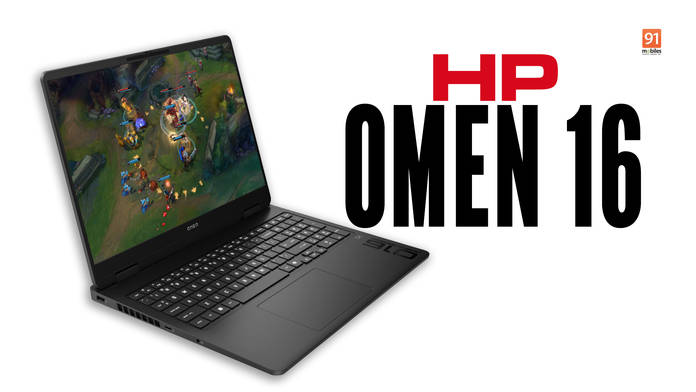
On August 20 in New Delhi, HP introduced the OMEN 16, its latest gaming laptop designed for players and power users. The new machine aims to strike a balance between high performance, advanced thermals, and customisation. All at a price that doesn’t entirely blow up the budget. Buyers can choose between Intel Core Ultra or AMD Ryzen AI processors, paired with up to an NVIDIA GeForce RTX 5070 Ti, making it ready for AAA gaming and heavy workloads.
The OMEN 16 is available in Shadow Black, starting at ₹1,29,999. You’ll find it across the HP Online Store, HP World, Amazon, Croma, Reliance Digital, and pretty much every big retailer that sells gaming hardware.
Now, let’s be honest: Rs 1.3 lakh isn’t exactly “budget-friendly” in the Indian market. But for a premium gaming laptop rocking AI smarts, RTX 50-series graphics, and a sturdy build, it’s actually in line with what ASUS, MSI, and Lenovo are charging for similar configurations. If anything, HP has tried to position this one in that sweet spot where hardcore gamers and creators feel like they’re getting serious value without leaping into the ultra-expensive Rs 2 lakh+ category.
Under the hood, the OMEN 16 supports up to 170W Total Processor Power, which basically means the CPUs, whether Intel’s Core Ultra or AMD’s Ryzen AI chips, have enough room to flex their muscles without being throttled. HP hasn’t spilt the beans on exact SKUs yet, but expect those H or HX series workhorses that can handle both gaming marathons and heavy multitasking.
On the graphics side, the 12GB NVIDIA GeForce RTX 5070 Ti Laptop GPU isn’t just for show. Based on our past testing of laptops with GPUs in this range, you can expect buttery smooth gameplay in esports titles like Valorant (easily above 300 FPS at high settings) and solid 70–90 FPS in demanding AAA games like Cyberpunk 2077 or Alan Wake 2 at QHD resolution.
The real kicker here is OMEN AI with Unleashed Mode, which tweaks performance and cooling on the fly. That means less time fiddling with fan curves and more time just gaming. Oh, there’s also the self-cleaning fan, which is a small but genius touch. I mean, nobody wants their expensive laptop to choke on dust three months in, right?
The laptop sports a 16-inch QHD (2560×1600) panel with a 240Hz refresh rate, 500 nits brightness, and 100% sRGB coverage. Tech jargon aside, it basically means that it’s bright, crisp, colour-accurate, and fast enough for both competitive gamers and creators working on photo/video edits. The Eyesafe certification is a nice bonus, because let’s face it: gaming binges at 2 AM aren’t kind to the eyes.
Moving on to build quality, if you’ve ever used HP’s Victus lineup, you’d know the hinges aren’t its strongest suit. The OMEN series, though, has always stepped things up with sturdier frames and a more premium feel. From early impressions, the new OMEN 16 looks to follow that tradition, which should put buyers at ease. Add in the 4-zone RGB keyboard, a solid Full HD webcam with noise reduction (streamers, take note), and an 83Wh battery that charges to 50% in about half an episode of your favourite Netflix show, and it’s clear HP is thinking beyond just raw specs.
Oh, and let’s not forget, HP has leaned into sustainability here too, with ocean-bound plastics and recycled materials baked into the design. It’s the kind of small detail that won’t affect your FPS but does make you feel a little better about your purchase. No? Well, maybe it’s just HP that thinks you might.
With a starting price tag of Rs 1,29,999, the HP OMEN 16 seems to be a pretty solid package on paper. That said, it’s worth noting that HP has configured the RTX 5070 Ti variant at 115W TGP, which is the maximum as per NVIDIA’s standard spec. On the other hand, rival gaming laptops like the MSI Vector 16 HX and ASUS ROG Strix G16 both push the same GPU up to 140W TGP with overboost technologies.
The good news, however, is that our testing of the HP OMEN Max 16 (review) with the RTX 5080 showed it could keep pace with similar configs such as the ASUS ROG Strix SCAR 16 (review) and the Gigabyte AORUS Master 16 (review), suggesting the RTX 5070 Ti variant could also hold its own. We’ll know more once we run our full benchmarks. So stay tuned for the review.