Best phones under Rs 40,000: expert picks for cameras, battery, performance, and more


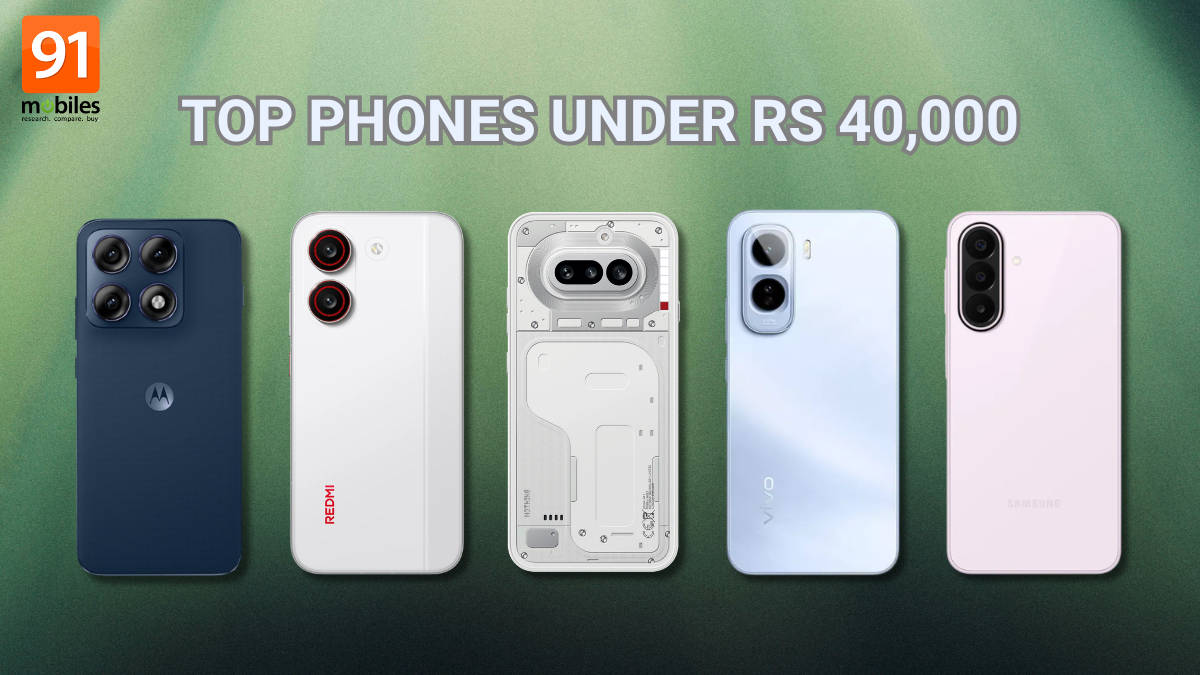
With memory prices rising constantly, the mid-range battleground has shifted, and Rs 40,000 now marks the sweet spot where you get decent value without stretching your budget. At this price, phones bring better chipsets, larger batteries, improved cameras, and longer software support than ever before. That also makes it harder to pick the right one, since each brand is prioritising different strengths.
This list highlights the front-runners in the sub-Rs 40,000 segment across five key areas: overall balance, performance, cameras, software, and battery. We based these picks on real-world testing, benchmarks, and daily usage, so you can make an informed decision based on what matters most to you.
| Phone | Best for | Price |
| Motorola Edge 70 Pro | Best overall | Rs 39,999 |
| POCO X8 Pro | Top performer | Rs 36,999 |
| Tecno Camon 50 Ultra | Most versatile cameras | Rs 39,999 |
| Samsung Galaxy A27 | Longest software support | Rs 34,999 |
| Vivo T5 Pro | Best battery life | Rs 35,999 |
*Winners and prices as of 30 July, 2026
If you want a balanced phone, the Motorola Edge 70 Pro is the best all‑rounder; if performance matters most, the POCO X8 Pro is the one to go for. Camera‑focused buyers should look at the Tecno Camon 50 Ultra, while anyone who wants the longest battery life will find the Vivo T5 Pro hard to beat. And if software support is your main concern, the Samsung Galaxy A27 is easily the best option at this price point. So the “best” phone really depends on what you care about most.
Motorola Edge 70 Pro — Best overall
Price: Rs 39,999 for 8GB + 256GB
Why we chose it
The Motorola Edge 70 Pro (review) wins this category because it covers the basics well without forcing big compromises. It uses an ultra-slim design and a bright, colour-rich AMOLED display that looks good for daily use and media. The MediaTek Dimensity 8500 Extreme handles both demanding and routine tasks smoothly, and the 6,500mAh battery lasts a full day even with heavy use. Its 90W fast-charge support is extremely convenient when you need a quick top-up.


Low-light photos come out clean and detailed, which helps in common shooting scenarios. It doesn’t include wireless charging and a dedicated telephoto lens, and its software update promise is shorter than some rivals, but it still offers the most balanced mix of design, display, battery, and everyday performance in this price range.
POCO X8 Pro — Best performance
Price: Rs 36,999 for 8GB + 256GB
Why we chose it
If you game a lot or push apps hard, the POCO X8 Pro gives you the most consistent performance under Rs 40,000. It runs the MediaTek Dimensity 8500 Ultra with up to 12GB LPDDR5X Ultra RAM and 256GB UFS 4.1 storage. It comes with a 5,300 mm² stainless steel layer and a graphite layer vapour chamber that the company says improves thermal management by 3x over a normal vapour chamber.
AnTuTu score


Motorola Edge 70 Pro 5G
MediaTek Dimensity 8500 Extreme
2,194,258

vivo T5 Pro
Qualcomm Snapdragon 7s Gen 4
1,167,242

Tecno Camon 50 Ultra
MediaTek Dimensity 7400 Ultimate
998,070
AnTuTu assesses a smartphone's CPU, GPU, memory, and overall user experience (higher is better)
In practice, this keeps frame rates steady, and the phone supports 120 fps in BGMI and COD: Mobile with Wild Boost on. Its AnTuTu and Geekbench scores rank near the top in this price range. The phone does get warm near the camera module during long sessions, and it’s not the most thermally efficient overall, but it delivers the best high-performance experience for gamers under Rs 40,000.
Tecno Camon 50 Ultra — Best cameras
Price: Rs 39,999 for 8GB + 256GB
Why we chose it
The Tecno Camon 50 Ultra (review) takes the crown here because it adds a proper periscope telephoto lens that most phones in this range skip. It uses a 50MP Samsung JN5 sensor with OIS and a tetra-prism design, giving you 3x optical zoom (around 70mm) for portraits with accurate colours, clean subject separation, and natural bokeh.
The 50MP main camera keeps colours close to real life, though fine textures can look soft and shadows lose depth in tougher lighting. The 8MP ultrawide pushes contrast and saturation for a punchy look, and the 50MP front camera has great skin colours and detail level, although the inclusion of a telephoto camera still makes it the best pick here.
Samsung Galaxy A27 — Best software
Price: Rs 34,999 for 8GB + 128GB
Why we chose it
No other phone under Rs 40,000 matches the Galaxy A27 5G’s (review) software support: it ships with One UI 8.5 (Android 16) and promises six years of OS updates plus six years of security patches. This 6+6 commitment keeps the phone current and secure long after rivals stop getting updates. One UI feels clean and well-organised, with less bloat than older versions and fewer pre-installed apps than the Realme 16 or Redmi Turbo 5.
| Smartphone | Pre-Installed Apps | Software Support |
| Samsung Galaxy A27 5G | 48 | 6 Year OS Updates + 6 Year Security Updates |
| OnePlus Nord CE 6 5G | 54 | 2 Year OS Updates + 4 Year Security Updates |
| realme 16 | 60 | 3 Year OS Updates + 4 Year Security Updates |
Samsung’s interface stays simple and familiar, so most users can get used to it quickly. The AI suite also punches above its weight, with Circle to Search supporting multi-object selection, on-device photo edits, AI call tools like live transcription and call captions, and on-device access to Gemini, Bixby, and Perplexity.
Vivo T5 Pro — Best battery
Price: Rs 35,999 for 8GB + 128GB
Why we chose it
Battery life is the Vivo T5 Pro’s (review) strongest point, and it leans hard into that strength with a 9,020mAh cell that feels closer to a power bank than a typical phone. Thanks to Vivo’s 4th‑gen silicone‑anode tech, the phone stays light despite the huge battery, and in daily use it easily clears two days with around six hours of screen‑on time. Very heavy users can still expect about 1.5 days before needing a charge, and standby drain sits around 2 percent overnight.
PCMark Battery score (in hours)

realme P4 Power
10001 mAh
21.1
vivo T5 Pro
9020 mAh
18.7

Xiaomi Redmi Note 15 Pro
6580 mAh
14.4
PCMark battery test measures phone battery life from 100% to 20% (higher is better)
In gaming, the battery drops just 5 percent over 45 minutes, and an hour of YouTube playback costs only about 4 percent. Charging keeps up with 90W support, filling the battery from 20 to 100 percent in under an hour, so you won’t spend much time plugged in.
FAQs
Is it wise to buy a 2025 phone under Rs 40,000 in 2026?
Yes, if the price has dropped and the core hardware still holds up. With memory costs pushing prices up, many 2025 models in the sub‑Rs 40,000 range now offer better value than several new launches at similar prices.
Should I prioritise specs or software updates under Rs 40,000?
If you upgrade every two years, focus on chipset, camera, display and battery. If you plan to keep the phone for four to five years, long‑term OS updates, security patches and a clean UI matter just as much as raw specs.
How long can I realistically use these phones?
All the phones in this list should comfortably last 3–5 years with regular updates, decent battery health and enough storage for everyday use. You won’t feel forced to upgrade just because the software or hardware feels outdated too soon.
Are sale offers and bank discounts worth waiting for in this market?
Yes, but don’t wait indefinitely. Predictable price drops are less common now, especially in the mid‑range. If you need a phone, it’s better to buy when you see a solid deal, bank offer or exchange bonus rather than hold out for a big cut that may not come.