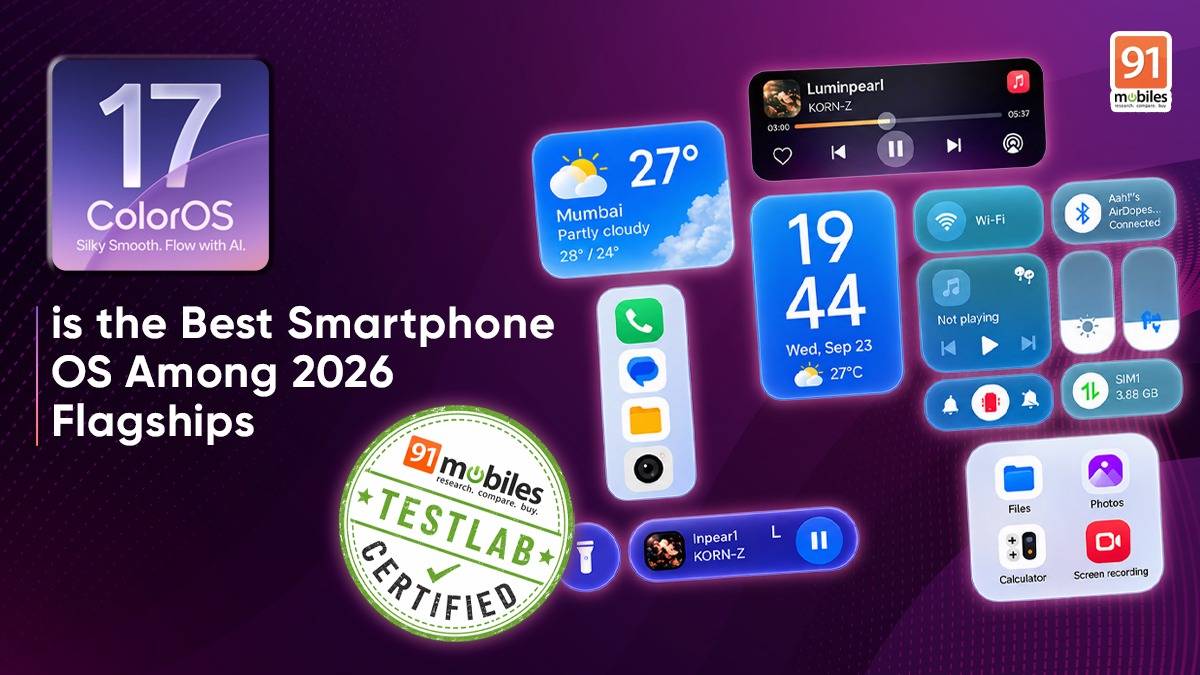
ColorOS 17 is the Best Smartphone OS Among 2026 Flagships: 91mobiles TestLab


A phone’s software shapes how it feels every day: how fast apps open, how smooth every swipe feels, how much you can customise it to your taste, and whether it includes the tools you need. In the Indian market, hardware usually gets all the attention, but the OS plays an equally important role in deciding whether a great processor feels crisp and responsive or cluttered and slow.
Our survey of 5,000+ users (a 91mobiles audience poll, October 2026) shows what people want from a smartphone OS. Performance and smoothness topped the list (89% rated it 4 or 5 out of 5), followed by battery life (83%), privacy and updates (81% each) and customisation (76%). AI came last (64%).
OPPO positions ColorOS 17 as a step up in smoothness, memory management and AI. We don’t take marketing statements at face value at 91mobiles TestLab, so we ran ColorOS 17 against vivo’s OriginOS 7, Xiaomi’s HyperOS 3, Samsung’s One UI 9, and Google’s Pixel software on flagship hardware under matched conditions to see whether the numbers hold up.
Table of Contents
Test Methodology
Five phones went through the same checks:
- OPPO Find X10 Pro Max (running ColorOS 17)
- vivo X300 Pro (running OriginOS 7)
- Xiaomi 17 (running HyperOS 3)
- Samsung Galaxy S26 Ultra (running One UI 9)
- Google Pixel 11 Pro (running on Android 17)


We factory-reset every device, loaded the same set of 50 apps, locked brightness, ran each test at least three times in the same room, and filmed the sessions. The tests cover four areas: customisation and ease of use, performance, ecosystem and software, and longevity and efficiency.
We counted how often each OS finished first or second across 25 tests in those four areas. The OS with the most top-two finishes is our best overall. The comparison covers five Android flagships.
These are 2026 flagships on different chips, so speed, thermal and battery numbers blend hardware and software. And some results are measured with a timer or counter, while others are ranked by our testers. We have labelled them appropriately as we go.
Everyday Use: Where ColorOS 17 Pulls Ahead
We started with what you touch every day: the lock screen, settings, one-handed use and first setup.
| Device | Lock screen widgets (max) | Settings Search: Successful Attempts (30) | One-Handed Mode: Successful Activations (30) | Initial setup time of the OS (in minutes) |
OPPO (ColorOS 17) | 8 | 30 | 29 | 2:40 |
vivo (OriginOS 7) | 4 | 24 | 29 | 2:45 |
Samsung (One UI 9) | 4 | 30 | 29 | 3:40 |
Xiaomi (HyperOS 3) | 0 | 27 | 24 | 2:56 |
Google Pixel | 3 | 27 | 22 | 3:21 |
Right off the bat, the lock screen is where ColorOS 17 stands apart. It supports up to eight widgets and puts them on a full-screen, always-on display. Xiaomi offers the most clock styles (20) and animated or custom-image always-on displays, but no lock-screen widgets.
The built-in tools come next. ColorOS 17 handles PDF merge, split, encryption and signing natively, and its video editor exports 4K at 120 fps (vivo’s manages 4K at 60 fps). Samsung’s and Xiaomi’s tools to make video from images are capped at FHD, and the Pixel can’t make video from images offline. All five OSes can unzip files natively.
We ranked ColorOS 17’s privacy dashboard the deepest of the five. Xiaomi adds a thin layer of extra features on top of what Android offers natively. Samsung and vivo offer additional on-device privacy features, including private space and app encryption. Samsung adds Blockchain keystone as an additional feature for those into that stuff. OPPO takes it further with advanced AI privacy features, including enhanced protection mode (for app installs, data, permissions), payment protection, deceptive app scanning, scam detection (synthetic voice, AI face swap, cross-app scam detection), private space, system cloner, and screen-sharing protection.
On AI photo editing, it has the broadest toolset we tested, including generative edit. Samsung’s generative tools were faster, but OPPO can even tweak environmental lighting for a more seamless look; vivo’s weren’t available at the time of testing, and Xiaomi’s are limited to tools like Eraser and Expand. With iOS 27, Apple also debuted AI editing, including Expand, Reframe, and Improved Eraser; it offers generative editing, but that feature lives in a separate app rather than the default Photos gallery, adding an extra step to the workflow.
ColorOS 17 also stands out for how deeply it integrates AI into the default Gallery app. Beyond generative editing, OPPO offers tools such as AI Popout, Remix Collage and Portrait Glow, bringing creative effects, collage creation and portrait enhancements into the same app users already rely on for their photos. Its broader AI ecosystem, including LLM-powered features to find and sort files, adds another dimension beyond image editing.
The distinction isn’t just how many AI tools each platform offers, but how easily users can access them in everyday workflows. Having creative tools integrated into the default gallery app, as found in the case of Android, reduces the need to switch between apps, making its approach more cohesive for users who regularly edit photos
Disclaimer: We tested photo-editing AI only, not assistants or search. In our slow-motion review, ColorOS 17 ranked smoothest.
Speed and Efficiency: How ColorOS 17 Holds Up
Speed, thermals and storage depend on hardware as much as software, so read this section with that in mind. Even so, ColorOS 17 holds its own against flagships on very different chips.
| Device | Boot (sec) | 10-app launch set (sec) | 4K export | Thermal rise (°C) | OS + Preloads (GB) |
OPPO (ColorOS 17) | 17.3 | 49 | 1:52 | 7.2 | 28.6 |
vivo (OriginOS 7) | 20.0 | 51 | 1:32 | 10.5 | 34.4 |
Samsung (One UI 9) | 13.0 | 48 | 2:16 | 8.9 | 19.6 |
Xiaomi (HyperOS 3) | 16.3 | 48 | 2:37 | 8.6 | 31.3 |
Google Pixel | 10.3 | 45 | 3:55 | 6.2 | 42.0 |
Boot is the three-run average. Launch and export are each phone’s best of three runs.
ColorOS 17 – Quick where it counts: It exports 4K video in 1 minute 52 seconds, second only to vivo, and keeps heat in check with a 7.2°C rise under sustained load, second only to the Pixel. It opens our 10-app set in 49 seconds, within four seconds of the fastest.
Google Pixel 11 Pro – The lightest and coolest: It boots in about 10 seconds, gets through our launch set fastest, runs coolest under sustained load, and ships with no third-party preloads. It also exports 4K slowest (3 minutes 55 seconds against ColorOS 17’s 1 minute 52 seconds) and uses the most storage.
Samsung Galaxy S26 Ultra – Footprint and support: It uses the least storage, promises 7 years of updates and has the broadest ecosystem of the five.
vivo X300 Pro – Export speed: 4K export in 1 minute 32 seconds, the fastest on test.
Xiaomi 17 – Lock screen options, but no outright wins: It has the richest clock and always-on options, and it trailed in our tests.
ColorOS 17 still has room to grow in three places: boot time (17.3 seconds, fourth of five), preloads (69 apps, 7 of them third-party, against 42 on the Pixel) and update support (5 years against 7 for Samsung and Pixel).
What Earned It the TestLab Certification?
ColorOS 17 finished in the top two in 18 of our lab tests, ahead of Samsung (14), vivo (13), Pixel (8) and Xiaomi (6). The wins came in everyday use: the lock screen, built-in tools, privacy controls, AI photo editing, and setup.
| Phone | Outright win | Top-two finishes |
OPPO (ColorOS 17) | 8 | 18 |
Samsung (One UI 9) | 4 | 14 |
vivo (OriginOS 7) | 3 | 13 |
Google Pixel 11 Pro | 6 | 8 |
Xiaomi (HyperOS 3) | 0 | 6 |
A phone earns a point for every test it finishes first or second, including ties. One caveat worth flagging: a top-two count treats first and second the same.
ColorOS 17 vs iOS 27: where do they stand against each other?
Android and iOS are two separate worlds, with two distinct bare-bones structures. On one hand, Android offers ease of use, the freedom to tweak the entire UI to your liking, is open to third-party app stores, doesn’t lock you into a specific ecosystem, and even hopped on the AI bandwagon a few years ago. iOS, on the other hand, is designed specifically for the Apple ecosystem, requires an extra step for most tasks, and also hopped on the AI train quite late, that too with limited use cases.
As noted above, ColorOS 17 turned out to be the best and smoothest Android skin, with a wide range of features for everyday use across students, professionals, and creators. iOS 27 has a lot to catch up in terms of flexibility, ease of use, feature set and ironing them out.
Bottom Line: ColorOS 17 is the Best Smartphone OS We Tested
Beyond the spec sheet and into lab numbers, ColorOS 17 comes out on top. It finished in the top two more often than any rival, and it did so where everyday use matters most: the most customisable lock screen, the deepest privacy dashboard with built-in scam protection, the broadest built-in tools and AI photo editing, and the quickest first setup. The results also reflect what users value most. In the 91mobiles audience poll, 89% of respondents rated performance and smoothness as important factors in a smartphone.
ColorOS 17 addresses this priority with its special Luminous Engine. The brand says this improves app launch stability by 55% over ColorOS 16, speeding up first-launch Gallery thumbnail loading by up to 50%, and keeping over 25% more apps active in the background. They further claim that even in simulated six-year ageing tests, it retains over 90% of its day-one smoothness, demonstrating a focus on performance that lasts.
AI is another area where ColorOS 17 stands out, offering a wide range of AI features across photography and productivity that make everyday tasks and creative possibilities more accessible. It also holds its own on speed, finishing second in both 4K export and thermal control. Rivals lead on a few individual measures, such as the Pixel’s boot time and Samsung and Pixel’s seven-year update promises, but none matched ColorOS 17’s overall result.
Based on our survey and lab tests, ColorOS 17 earns its 91mobiles TestLab certification as the Best Smartphone OS among the five Android flagships we tested. While iOS 27 wasn’t part of the full TestLab because of its fundamentally different structure, ColorOS 17 is far better than iOS in what it offers, including modern privacy features, rich visual appeal, and a practical set of features.
Check out the detailed report here:

Disclaimer: Certified through a two-phase evaluation as of 19th October 2026: a consumer survey of 5,000+ Indian smartphone users, and controlled lab testing on competing flagship smartphones (OPPO Find X10 Pro Max, vivo X300 Pro, Xiaomi 17, Samsung Galaxy S26 Ultra and Google Pixel 11 Pro). Based on outright wins and top-two finishes across the evaluation.

